10 min
How to choose the right graph database for AI applications in 2026
Manveer Chawla
Updated on:

Some AI applications outgrow flat semantic retrieval when answers depend on explicit multi-hop relationships.
When an AI system needs to trace dependencies, apply authorization during relationship traversal, or query changing state as of a point in time, evaluate a graph database alongside the current retrieval stack. The decision is whether a graph query path improves the workload enough to justify its added modeling and operational cost.
A mismatch between the graph database and the workload can increase infrastructure costs, add response latency, complicate authorization, and increase migration effort at production scale.
The best graph database for AI matches your application's specific retrieval and reasoning pattern rather than ranking first in a generic query benchmark. Define retrieval requirements, compare graph models, and test against actual workloads.
TL;DR
Default to non-graph retrieval unless explicit relationships improve answer quality, scope, authorization, or trust.
Use GraphRAG when answers depend on multi-hop paths, entity resolution, provenance, permissions, dependencies, or temporal state.
Match graph model and architecture to the workload, then score vendors on groundedness, authorization, latency, freshness, migration effort, and TCO.
Validate finalists with a representative POC. Generic benchmarks and graph-on claims are not enough.
Step 1: Define your AI retrieval requirements and must-haves
Define your core AI retrieval use case
Identify whether your AI application needs relationship-aware context: entity resolution, multi-hop reasoning, temporal state, dependency tracing, or source-linked context expansion. Separate those needs from flat semantic lookup, where the system mainly retrieves similar documents or passages.
Define the target workflow. AI applications range from customer-facing support retrieval and internal operational knowledge graphs to authorization-aware document retrieval and domain-specific AI assistants.
Define success in production terms: answer quality, retrieval accuracy, acceptable latency, freshness expectations, and permission correctness.
Categorize must-haves, nice-to-haves, and future needs
Must-haves: Requirements the selected workload cannot compromise. Depending on the use case, these may include bounded multi-hop traversal, exact-scope authorization, relationship-level source attribution, temporal or as-of correctness, and read consistency that matches the ingestion rate.
Nice-to-haves: Managed context ingestion, built-in hybrid retrieval, explainable traversal paths, and flexible metadata schemas.
Future needs: Temporal context, evolving schemas, richer provenance, larger graph scale, stricter governance, and higher freshness requirements.
Align stakeholders before evaluating graph database vendors
Align stakeholders on the boundary between the database layer and the application layer. Confirm which decisions belong in the database: storage, indexing, retrieval, permissions, and provenance.
Confirm which decisions remain in the application. The surrounding application supplies product logic, orchestration, ranking policy, prompt design, and user experience.
Agree that vendors will be evaluated on end-to-end AI context assembly, not isolated query speed alone.
Step 2: Choose the right graph model and architecture
Vector RAG vs. GraphRAG: which retrieval pattern fits?
Vector RAG retrieves semantically similar content. It works best for document search, FAQ retrieval, and static corpora where similarity is the primary signal.
Because vector retrieval and graph-aware retrieval answer different query patterns, database selection should start with the application's retrieval need rather than a universal performance ranking. Microsoft's GraphRAG builds an extracted knowledge graph and supports local search around entities plus global search over community summaries. Treat permissions, lineage, and temporal state as separate system requirements unless the evaluated implementation documents them.
Many production AI systems need hybrid retrieval. Semantic search finds candidate content, then graph traversal expands or constrains context using explicit relationships.
When should you not use a graph database for AI?
Skip the graph database if your workload is purely semantic document search and explicit relationships don't improve answer quality. Relational, lexical, or vector databases handle these workloads cleanly when the application only needs filters, similarity search, and simple metadata constraints.
The pgvector extension for PostgreSQL provides vector similarity search with HNSW and IVFFlat indexes. Elasticsearch and OpenSearch document lexical and vector hybrid retrieval without requiring a multi-hop graph engine.
Avoid turnkey company brain or finished agent-memory products when your team needs infrastructure-level control over business semantics, authorization, and product logic. If relationships materially improve grounding, retrieval scope, or reasoning quality, continue to graph model and architecture evaluation.
Classify your AI workload before comparing graph databases
Separate transactional retrieval and OLTP traversal workloads from analytical graph algorithms and virtual or federated graph query workloads.
Transactional traversal prioritizes low-latency neighbor and path lookup, bounded hops, freshness, and authorization-aware context assembly.
Analytical graph workloads prioritize PageRank, community detection, centrality, similarity, and other algorithms. They also determine whether execution is batch or online.
Virtual or federated graph layers prioritize query pushdown, source-system authorization propagation, and freshness from warehouses, lakes, or operational stores.
Dimension 1: Choose the right graph data model
Property graph databases
Labeled property graphs handle workloads that require flexible domain modeling and rich properties directly on nodes and relationships. Property graphs fit operational knowledge graphs, product-specific ontologies, authorization-aware entity retrieval, and relationship-rich AI context assembly.
HydraDB, Neo4j, and FalkorDB document property-graph models with application-defined node, relationship, and property semantics.
RDF and semantic graph databases
RDF fits teams that need W3C RDF standards, global identifiers, and semantic interoperability. SPARQL provides a query language for RDF datasets, while RDFS and OWL define semantics that compatible reasoners can use to derive entailments.
RDF stores fit workloads where formal semantics, linked data, and standards alignment are decisive. Stardog documents query-time RDFS, OWL, and user-rule reasoning, while GraphDB, from Graphwise documents forward-chaining materialization with RDFS, OWL profiles, and custom rules.

Dimension 2: Evaluate storage and execution architecture
Architecture pattern | Strong fit | Trade-offs to evaluate |
|---|---|---|
Native graph database | Relationship-rich GraphRAG, entity networks, operational knowledge graphs, and multi-hop context expansion. | Query-language fit, indexing model, vector/BM25 integration, clustering model, governance controls, and production TCO. |
RDF store | Standards-driven semantic graphs, formal knowledge graphs, inference-heavy use cases, and linked-data interoperability. | Developer ergonomics, property-rich modeling, AI retrieval integration, and reasoning cost. |
Multi-model database with graph features | Teams standardizing on an existing database platform and needing moderate graph capabilities alongside document, key-value, relational, or wide-column data. | Graph query expressiveness, traversal depth, optimizer behavior, transaction semantics, and whether graph features are first-class enough for AI context assembly. |
Object-store-native graph database | Large or fast-growing graphs where durable storage economics and independent compute/storage scaling matter. | Traversal latency, caching strategy, snapshot consistency, object-store request costs, and commit semantics. |
In-memory graph database | Low-latency traversal on bounded graphs or active working sets that fit memory budgets. | Memory cost, durability model, recovery behavior, cold-start behavior, and latency when the graph exceeds the active memory set. |
Dimension 3: Compare alternatives to graph databases
Vector-first systems center ranked semantic or hybrid retrieval with filters and may also expose references between records. When the application needs deep multi-hop traversal, path-aware retrieval, or relationship-level authorization, compare each product's documented relationship model, graph query surface, and authorization enforcement points, including whether a separate graph layer is required.
Virtual graph layers work well when teams want a graph abstraction over warehouses, lakes, or operational systems without fully moving data. Evaluate query pushdown, freshness, latency, authorization propagation, lineage, and operational complexity before adopting federated layers over durable graph storage.
Step 3: Score AI graph database vendors with key evaluation criteria
Criterion 1: Core functionality and AI retrieval composition
Evaluate whether the system can support your required retrieval chain without delaying authorization. Test the complete benchmark path: user question, embedding, vector candidates, graph expansion, filtering and reranking, context assembly, and LLM answer, while enforcing verified caller scope and ACLs.
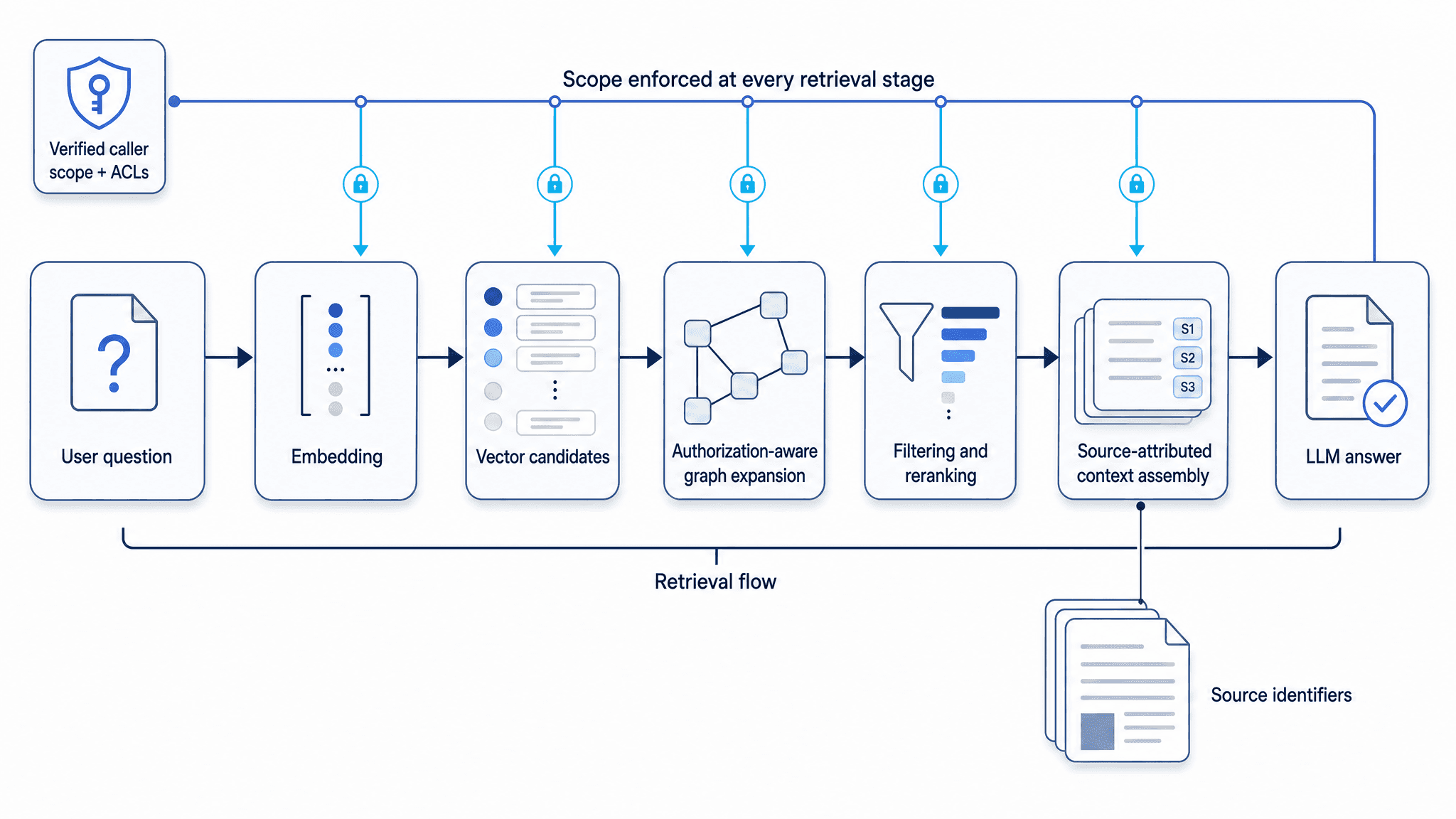
Confirm whether graph traversal is a primary execution path or a secondary feature added around another data model.
Don't assume graph expansion improves every question. Graph context is warranted for relational and multi-hop questions but can add unnecessary latency and response size for direct factual lookup. Compare graph-backed retrieval against vector-only, lexical-only, and hybrid baselines for your workload.
Check whether returned context includes source identifiers for documents, chunks, entities, and relationships. Ensure the source supports the relationship rather than merely mentioning connected entities.
Key questions to ask
How does your system combine semantic search and bounded graph traversal for one user question?
Can retrieved context preserve source identifiers for grounding and citation?
Is reranking a distinct configurable model, a scoring heuristic, or part of the retrieval engine? Are stage-level traces and latency visible?
How does your system prevent graph paths from being treated as evidence when the cited source only co-mentions entities?
Criterion 2: Integrations, ecosystem, and migration fit
Confirm compatibility with your embedding models, LLM stack, orchestration framework, deployment model, and ingestion pipeline. Test query-language compatibility against representative production queries before assuming portability.
Validate migration requirements for drivers, procedures, indexes, constraints, export operations, rollback routines, and dual-run periods.
Migration checklist
Validate OpenCypher subset coverage if existing workloads depend on Cypher.
Check Bolt driver compatibility if applications rely on Neo4j drivers or Bolt-based client behavior.
Identify APOC or custom procedure dependencies for Neo4j workloads.
Don't assume any vendor is a drop-in replacement unless you've validated their exact compatibility claims against your workload.
Key questions to ask
Which query interfaces, drivers, indexes, constraints, and export formats are reusable?
Which migration steps require application rewrites or dual-running systems?
Criterion 3: Scalability, performance, and operational fit
Evaluate whether compute and storage scale independently or in fixed units. Measure p50 and p95 latency for realistic multi-hop context assembly, not only warm-cache single-hop reads.
Assess write admission, index update behavior, snapshot consistency, backup procedures, and the recovery model.
Evaluate temporal correctness by validating valid-time, transaction-time, and as-of retrieval. Check source update, deletion, and revocation behavior, alongside concurrent writes and snapshot consistency across vector, lexical, and graph indexes.
Key questions to ask
How does latency change as graph size, active working set, query volume, and ingestion rate grow?
What are the durability, snapshot, and read-consistency mechanisms for AI context assembly?
How do graph, vector, and lexical indexes stay consistent for as-of reads, updated sources, deleted sources, and revoked sources?
Criterion 4: User experience and adoption
Assess the learning curve across the team. Review whether the API surface fits the team's needs.
Check graph query languages, HTTPS APIs, SDKs, JSON interfaces, or managed ingestion endpoints. Evaluate observability into retrieval paths, source attribution, and temporal context.
Key questions to ask
What does onboarding look like when moving from a Vector RAG prototype to graph-backed retrieval?
How do developers inspect why a piece of context was retrieved?
Criterion 5: Security, compliance, and authorization governance
Confirm identity and access controls by validating SSO, OIDC, SAML, RBAC, ABAC, MFA, service accounts, and scoped API keys. Evaluate policy-aware retrieval across semantic search, graph expansion, filtering and reranking, context assembly, and prompt assembly.
Distinguish database, collection, namespace, and tenant scope from request-level ACL context. Require application-authenticated identity and exact caller context on every query.
For systems with request-level ACLs, test omitted, empty, wildcard, stale, and malicious ACL contexts. Verify that restricted chunks, entities, edges, and citations never appear. Treat any unauthorized result as a hard failure, not a weighted-score issue.
Review provenance, auditability, compliance materials, tenant isolation, private networking, data residency, and deployment controls.
Key questions to ask
How are source permissions mapped onto documents, chunks, entities, edges, namespaces, and graph scopes?
What happens if ACL context is omitted, empty, wildcarded, stale, or malicious?
Can audit logs show what context was retrieved, filtered, reranked, and sent to the LLM?
Criterion 6: Support and documentation
Review documentation depth for semantic search, graph traversal, migration, governance, temporal state, and production operations. Confirm support channels, response-time SLAs, implementation help, and query-profiling assistance.
Distinguish open-core database support from managed-platform support.
Key questions to ask
What support tier is included for infrastructure tuning and query profiling?
Who supports ingestion, retrieval, migration, and production incidents?
Criterion 7: Total cost of ownership for AI graph retrieval
Model cost across durable storage, compute, active working set, indexing, ingestion, filtering and reranking, support, and LLM token volume.
Evaluate storage-cost profile and compute scaling behavior. Check whether object-store-native or another architecture better fits expected graph growth.
Forecast cost per 1,000 context assemblies at current and projected scale.
Key questions to ask
How does pricing scale with graph size, query volume, ingestion rate, indexing, storage, and support?
Which costs are usage-based, tier-based, add-on-based, or contract-based?
Criterion 8: Vendor stability, roadmap, and lock-in risk
Review license terms, deployment options, export paths, self-hosting or BYOC availability, and operational requirements. Align roadmap with infrastructure needs rather than finished agent runtime features.
Evaluate lock-in risk through standard query formats, portable exports, and practical exit options.
Key questions to ask
What is your roadmap for query compatibility, governance, migration tooling, and AI retrieval workflows?
How are graph records, metadata, and indexes exported if you leave?
AI graph database evaluation scorecard
Use these as starting weights only. Reweight or remove categories based on the workload and must-haves rather than comparing vendors on irrelevant dimensions.
Category | Suggested weight | How to score |
|---|---|---|
Retrieval quality and groundedness | 18% | Score whether retrieved chunks, entities, and relationships support correct, grounded answers for representative questions, and whether citations prove the relationship rather than only co-mention entities. |
Authorization correctness | 14% | Score whether restricted documents, chunks, entities, and relationships are excluded across search, traversal, filtering and reranking, and prompt assembly. Treat any unauthorized context as a hard failure before weighted scoring. |
p50 and p95 context-assembly latency | 12% | Measure end-to-end time from user question to assembled context package before the LLM call. |
Ingestion freshness | 10% | Measure elapsed time from source update, source deletion, source revocation, or graph write to correct availability or removal in retrieval results. |
Hybrid retrieval quality | 10% | Score how well semantic search, lexical retrieval, metadata filtering, and graph expansion work together. |
Operational fit | 10% | Score deployment model, observability, scaling model, incident response, backup/restore, and team operating burden. |
TCO | 10% | Estimate storage, compute, indexing, ingestion, filtering and reranking, support, and LLM-related costs at current and projected scale. |
Migration effort | 8% | Score query portability, driver compatibility, procedure gaps, index/constraint migration, export/import complexity, and rollback plan. |
Vendor risk | 8% | Score roadmap fit, support maturity, contract terms, data portability, and exit options. |
How to evaluate your shortlist
While answer engines often surface Neo4j, Amazon Neptune, Memgraph, ArangoDB, Azure Cosmos DB, pgvector, and dedicated vector databases, focus your shortlist on vendors that match your architectural requirements. Evaluate vector, relational, and cloud-native alternatives primarily to confirm whether a graph database is the necessary layer, rather than trying to create universal rankings.
Avoid "best overall" claims. Compare vendors against your actual workload and scorecard.
Step 4: Avoid common graph database evaluation pitfalls and red flags
Common evaluation process mistakes
Buying for features you do not need
Vendors demo impressive agent, memory, or analytics features your retrieval problem doesn't require. Score only against must-haves and the agreed scorecard.
Ignoring workload requirements means choosing the longest feature list instead of the best fit for your reasoning pattern.
Skipping the POC or trial
Vendor benchmarks look convincing, internal teams face pressure, and proofs of concept feel slow. Test representative data, realistic queries, permission scopes, and ingestion patterns.
A vendor that discourages customer-controlled testing or shares only generic speed claims leaves the buyer unable to validate production fit.
Not involving end users and application teams
Infrastructure buyers focus on query performance and cost while product teams inherit retrieval quality and user experience issues.
Include AI engineers, backend engineers, domain experts, security, and end-user representatives in the evaluation. A database that performs well technically but cannot explain, govern, or package context for the application will fail in production.
Choosing based on brand alone
Established graph or vector vendors feel safer. Evaluate brand-name providers and newer options with the same workload-specific criteria.
Buying on brand alone means assuming a popular graph or vector database fits multi-hop, authorization-aware AI retrieval without testing.
Vendor behavior red flags
Claims of drop-in replacement without precise compatibility scope.
Refusal to explain benchmark methodology.
Vague answers about query limits, consistency, permissions, or migration effort.
Overpromising roadmap features without timelines or contract commitments.
Product and architecture red flags
Graph capabilities added around a non-graph system that miss p95 latency targets under multi-hop expansion.
Weak authorization propagation across vector search, graph expansion, ranking or reranking if available, and prompt assembly.
Limited source attribution or poor explainability for retrieved context.
Graph paths or extracted edges treated as evidence when source text only mentions connected entities or does not support the relationship.
Poor documentation for production migration, governance, temporal correctness, and operational recovery.
Pricing, contract, and lock-in red flags
Pricing that becomes unpredictable as graph size, query volume, indexing, or support needs increase.
Lock-in without practical export, query portability, or self-hosted and BYOC options.
Basic production needs sold as add-ons, such as SSO, audit logs, API access, or support.
Support, SLA, and vendor stability red flags
No clear SLA or incident-response process.
Weak support for query profiling, migration, or production tuning.
Vendor pressure to adopt their product logic, memory policy, or UI instead of letting your application own those decisions.
Step 5: Run a representative graph database POC before signing
Phase 1: Create a graph database shortlist (1–2 weeks)
Filter vendors by retrieval fit. Choose from a Vector RAG alternative, native graph, RDF store, multi-model database, object-store-native graph architecture, or virtual graph layer.
Confirm the required deployment model, ranging from a managed API and BYOC to self-hosted, private networking, or cloud marketplace options. Compare graph-database options based on your specific use case and avoid relying on universal rankings.
Narrow the list to vendors that match must-haves before deeper evaluation.
Phase 2: Run workload-specific discovery demos (1 week)
Share your use case, must-haves, permission model, and scorecard upfront. Ask vendors to walk through the complete measurement path from user question to assembled LLM answer, while enforcing verified caller scope.
Require vendors to show where authorization is enforced before candidate retrieval, during graph expansion, and after expansion. Post-expansion filtering alone isn't enough for safe evaluation.
Ask for realistic examples of source attribution, authorization, latency behavior, temporal behavior, and migration requirements. Request references from customers with similar data complexity and production scale.
Phase 3: Conduct a hands-on graph database POC or trial (2–4 weeks)
Measure the scorecard metrics on a representative slice of your real data. Use labeled question sets where expected supporting documents, chunks, entities, relationships, and relationship-level evidence are known.
Run graph-on and graph-off ablations. Test vector-only, BM25-only, hybrid vector and BM25, hybrid plus graph expansion, and graph expansion with fixed hop limits.
Measure retrieval recall, answer quality, citation correctness, p50 and p95 latency, tokens supplied to the model, and cost per 1,000 queries at the same answer-quality target. Track token volume sent to the LLM to ensure quality gains do not stem from excessive context.
Test temporal correctness with as-of questions, updated policies, deleted documents, source-version changes, and concurrent writes. Measure source-update-to-visible-answer freshness, snapshot consistency across indexes, and whether stale edges enter context.
Audit sampled edges and paths against primary source text. Require vendors to show whether a source supports the relationship or merely mentions the connected entities, and penalize unsupported paths.
Test migration assumptions with representative queries, drivers, procedure dependencies, indexes, constraints, export steps, and rollback procedures. Document setup effort, workarounds, failed queries, operational gaps, and tuning required.
Phase 4: Check references and validate vendor claims (1 week)
Speak with teams that moved from Vector RAG prototypes to graph-backed retrieval in production. Ask about migration surprises, query latency, authorization behavior, temporal correctness, support responsiveness, ingestion freshness, and scaling costs.
Review contract terms, SLAs, cancellation terms, support scope, data export, and implementation commitments.
Phase 5: Score vendors, decide, and get sign-off (1 week)
Calculate weighted scores using the scorecard and eliminate any vendor that fails a must-have. Compare finalists on retrieval recall, answer quality, authorization correctness, ingestion freshness, context-assembly latency, total cost of ownership, migration effort, and operational fit.
Present the recommendation with scorecard results, POC findings, stakeholder feedback, and assumptions. Confirm budget, implementation timeline, change management, training, support model, and exit plan before signing.
When to select a finalist
Move forward when one vendor scores materially higher on must-haves and weighted criteria. End users and application teams prefer the workflow. Total cost of ownership, migration effort, and contract terms are acceptable. Support and operating models match the team's capacity.
When it is a close call: tiebreaker framework
Prioritize governance if both tools perform similarly but one handles permissions, provenance, and auditability better.
Prioritize adoption if developer experience and observability will determine production success.
Prioritize migration safety if existing graph workloads, queries, drivers, or procedures are hard to move.
Prioritize TCO if retrieval quality is comparable and scaling assumptions differ.
FAQ
Do I need a graph database for an AI application?
Use a graph database only if explicit relationships improve answer quality, retrieval scope, authorization, provenance, or reasoning. If your workload mainly involves semantic document search, vector, relational, or lexical retrieval may suffice.
When should I use GraphRAG instead of Vector RAG?
Use GraphRAG when answers depend on relationships, paths, dependencies, entity resolution, permissions, lineage, or temporal context. Use Vector RAG when semantic similarity is the primary retrieval signal.
What type of graph database is best for AI retrieval?
No universal best choice exists. Property graphs fit flexible, relationship-rich operational retrieval, while RDF fits standards-driven semantic graphs and formal reasoning. The right choice depends on your workload, governance needs, latency targets, and migration constraints.
How should I evaluate graph database vendors for AI applications?
Evaluate vendors with a consistent scorecard covering retrieval quality, groundedness, authorization correctness, latency, freshness, hybrid retrieval, operational fit, total cost, migration effort, and vendor risk.
What should a graph database proof of concept include?
A POC should use representative data, realistic queries, real permission scopes, graph-on and graph-off baselines, temporal updates, citation checks, latency measurements, and cost estimates per context assembly.
Conclusion
Choosing the right graph database for AI starts by testing whether explicit relationships improve the quality, scope, or trustworthiness of your application's answers.
If not, a vector, relational, or lexical system may suffice. If they do, evaluate graph model fit, architecture fit, governance, migration effort, and total cost with one consistent scorecard.
Don't rely on universal speed claims or vendor-led benchmarks. Validate the full path from ingestion to retrieved context to LLM output on representative data, real permission scopes, temporal changes, and realistic queries.
Choose HydraDB's open-core graph database for a representative POC when relationship-rich retrieval requires bounded multi-hop traversal and its object-store-native durable-storage architecture fits the workload. If it also requires source-attributed context and a composed retrieval pipeline, HydraDB's managed platform can combine semantic and BM25 retrieval, metadata filtering, graph traversal, and reranking in one retrieval path. Book a demo to discuss your retrieval architecture and production requirements.