8 min
Best graph databases for AI ontology in 2026: RDF vs labeled property graph comparison
Manveer Chawla
Updated on :

Organizations increasingly use AI agents to reason across complex internal data. A vector database is often enough for basic text retrieval, but it can fall short once agents need to follow multiple relationships, apply domain rules, and distinguish current facts from historical ones.
For these workloads, teams may need a customer-controlled operational ontology and a graph database to store and query that connected context.
The choice is between RDF systems, built for formal semantics and standards interoperability, and labeled property graphs, built for operational traversal and developer-friendly querying.
The control model presents another choice between standalone graph infrastructure, where customers retain ownership of domain semantics, and an integrated platform that bundles ontology, application, and action execution.
Key takeaways
There is no universal best graph database for an AI ontology. The right choice depends on the graph model, reasoning requirements, deployment needs, and desired level of control.
GraphDB supports RDF workloads that need SPARQL, SHACL validation, and materialized RDFS/OWL-profile reasoning. Stardog fits RDF workloads that need virtualization and query-time reasoning.
Neo4j suits workloads built around its native Cypher and Bolt behavior and its established tooling.
Amazon Neptune suits teams that want a managed AWS service for either RDF or property graph workloads.
HydraDB fits workloads that need customer-controlled LPG infrastructure, with hybrid retrieval available on its managed platform.
The database provides retrieval infrastructure. Applications still own authorization, orchestration, domain rules, and how point-in-time context is requested and verified.
AI ontologies, knowledge graphs, and semantic layers
An AI ontology defines a shared model of a domain, its entities, relationships, and the rules that govern them. It gives extraction and reasoning workflows a controlled vocabulary, which keeps entity and relationship types from multiplying unchecked.
A knowledge graph is the connected instance data organized according to that ontology. It contains concrete customers, contracts, policies, products, vendors, and source documents that populate the graph.
An analytics semantic layer is a business intelligence abstraction that standardizes metrics and query concepts, helping analysts define terms like revenue or active customer. On its own, it doesn’t give you the object, relationship, and authorization model an operational AI system may need.
The graph database stores, indexes, and traverses graph data. Ontology tooling helps teams design, govern, and validate the model itself.
The application layer still owns domain semantics, authorization policy, extraction rules, entity resolution, agent orchestration, and the user experience.
Vendors heavily market the label "semantic graph database" for RDF-oriented systems. Concrete selection criteria include SPARQL support, SHACL validation, and supported RDFS or OWL reasoning.
Choosing a graph database for an AI ontology
RDF and labeled property graph
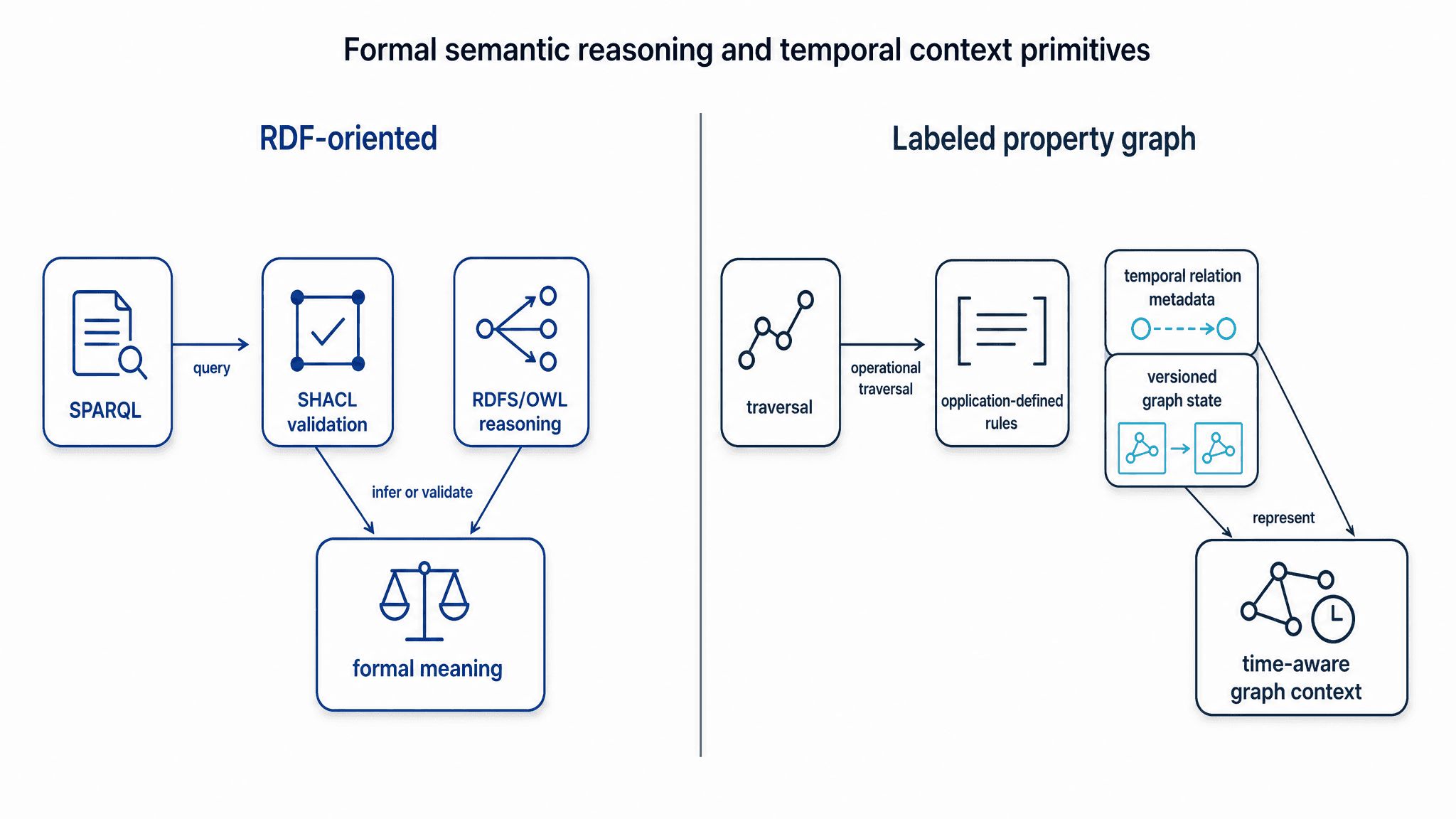
Resource Description Framework (RDF) systems suit workloads where formal semantics and standards interoperability are essential. They support capabilities such as SPARQL queries, SHACL validation, and documented RDFS or OWL-profile reasoning. Common use cases include regulated knowledge graph programs, semantic data integration, and data catalogs that require formal logic.
Teams without RDF, SPARQL, or OWL expertise should account for the learning curve associated with a different data model, query language, and ontology-engineering approach.
Labeled property graphs (LPGs) suit applications that prioritize graph modeling, traversal-based queries, and application-defined rules. They can support operational AI context that changes with the domain. For example, an application could traverse from a customer to a contract, an obligation, an exception, and its source document. LPG systems generally don’t provide native OWL or RDFS reasoning.
Formal reasoning and temporal context solve different problems. RDFS and OWL infer relationships, while SHACL validates graph data against defined constraints. Temporal metadata and versioned graph state show how facts and relationships change over time.
Standalone graph infrastructure and integrated platforms
With a standalone graph database, customers build and manage the application, ontology, authorization policies, and agent workflows. This model suits teams that want control over their domain semantics, AI workflows, and deployment environment.
An integrated platform combines ontology management, governance, applications, and action execution in one environment. It suits teams that want those pieces working together with less custom integration work.
Evaluation criteria for AI ontology graph databases
Modeling ergonomics and ontology evolution
The database should support flexible entity and relationship modeling, efficient traversal, and the schema or indexing mechanisms suited to its graph model. Its query language should also match that model, with Cypher, openCypher, or Gremlin for LPGs and SPARQL for RDF.
Your team usually defines the business meaning of entities and relationships, approves ontology changes, and manages how those changes affect agents and users.
Validation, constraints, and semantic reasoning
RDF systems should support documented RDFS or OWL-profile reasoning and SHACL validation when formal semantics are required. LPG systems should supply the constraints, indexes, and types that make application-defined validation practical.
Beyond the database's own reasoning model, your team still owns business rules, runtime decision logic for agents, exception handling, and approval workflows.
Ontology-aware retrieval and GraphRAG for AI agents
GraphRAG is a retrieval pattern that uses graph relationships to find connected context. Depending on your workload, the database or retrieval layer may need to support multi-hop traversal, graph expansion around matched entities, and vector similarity.
Lexical search, such as BM25-ranked search, helps find exact terms like names, clauses, IDs, codes, and compliance phrases. Metadata filters can then narrow the results by tenant, source, region, document type, or classification.
Temporal relation metadata and versioned graph state support versioned facts, contracts, and policies. The database should also provide provenance fields such as source document, timestamp, lineage, and confidence.
Your application or platform usually handles entity resolution, ranking, retrieval orchestration, authorization, prompt construction, and agent behavior.
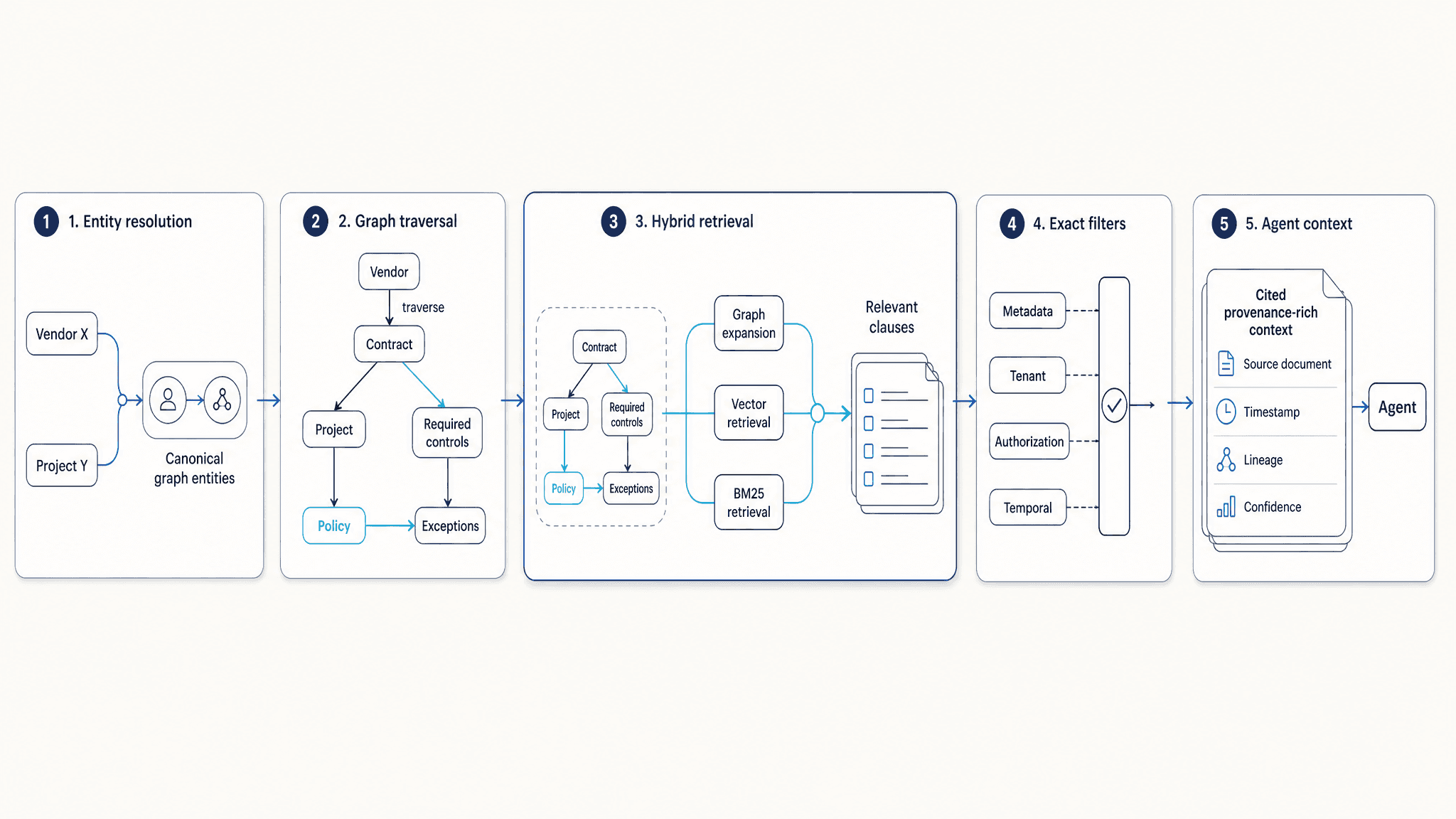
For example, an approval request involving Vendor X, Project Y, and the current security policy could follow this workflow:
Resolve Vendor X and Project Y to canonical graph entities.
Traverse vendor, contract, project, required controls, policy, and exceptions.
Combine graph expansion with vector and BM25 retrieval over relevant clauses.
Apply metadata, tenant, authorization, and temporal filters.
Return cited, provenance-rich context to the agent while reducing reliance on generated graph queries.
Governance, access control, and auditability
The database should support access-control integration points and tenant and workspace separation. It should also support metadata filtering and audit logging so you can review retrieval activity after the fact.
Deployment model, scalability, and total cost of ownership
You should compare managed cloud, bring your own cloud (BYOC), and self-hosted options. Assess whether compute and storage scale separately and how much memory your workload requires.
You should also consider storage, I/O, backup, and operational costs. Test portability and performance as graph size, retrieval volume, and query concurrency grow.
Vector-only databases without native multi-hop traversal and integrated ontology platforms without database-level control are excluded from the main comparison. Relevant alternatives are covered separately.
Best graph databases for AI ontology: quick comparison
Architecture lane, reasoning depth, and operational control separate these five databases.
Database | Workload fit | Architecture lane | RDFS/OWL inference and SHACL support | Storage/deployment architecture |
HydraDB | Customer-controlled LPG infrastructure with object-store-native durability. Its managed platform adds hybrid retrieval, exact filters, versioned graph state, and source-attributed results. | Labeled property graph | No native OWL/RDFS reasoning or SHACL validation | Open core is object-store-native and self-hostable. The managed platform is available with BYOC or fully self-hosted Enterprise options. |
Neo4j | Workloads requiring Neo4j-native Cypher and Bolt behavior, APOC, Graph Data Science, or AuraDB's managed service. | Labeled property graph | Self-hosted n10s adds SHACL validation and basic inferencing. The n10s plugin isn't available in Aura, and native OWL/RDFS reasoning isn't part of the core database. | |
Amazon Neptune | Workloads requiring a managed AWS graph service using either RDF/SPARQL or a property graph queried with Gremlin or openCypher. | RDF or LPG. The same data isn't queried across both models. | No native OWL/RDFS inferencing or SHACL validation is documented. External tooling supplies those capabilities when required. | |
GraphDB | Workloads requiring RDF/SPARQL, SHACL validation, and supported RDFS/OWL-profile inferencing. | RDF-oriented | Materialized RDFS, OWL-Horst, OWL 2 RL/QL, and custom-rule inference, plus SHACL validation | RDF-native. GraphDB Free is on-premises, while Enterprise supports on-premises and managed service. |
Stardog | Workloads that require a semantic data fabric with virtualization and query-time reasoning over documented profiles. | RDF-oriented | Query-time RDFS, OWL, and user-defined-rule inference, plus SHACL constraints | Enterprise knowledge-graph platform available in cloud or self-managed deployments. |
Graph database reviews for AI ontology use cases
HydraDB: customer-controlled labeled-property-graph database for AI agents
Best for: Operational AI agents or GraphRAG-style retrieval workloads on customer-controlled labeled property graph infrastructure.
Architecture lane: Labeled property graph.
Why it fits
HydraDB is an object-store-native graph database designed for AI workloads that need durable graph storage and relationship traversal. Its architecture decouples compute from storage and uses S3-compatible object storage as the durable layer, so the entire graph doesn't need to remain in memory.
The open graph database core supports a documented OpenCypher subset through Bolt 5.1 to 5.4 and an HTTPS query API. The managed extraction and retrieval platform combines graph context, semantic search, BM25-style lexical retrieval, and exact metadata filtering.
HydraDB supports versioned graph state and temporal reasoning for time-aware agent context. The managed platform supports customer-supplied entities and relations through Bring Your Own Graph, providing infrastructure primitives for source attribution and retrieval.
Pricing/deployment: Usage- and storage-based pricing with managed tiers. Enterprise options for BYOC or self-hosted deployments.
Where the fit breaks down
HydraDB doesn’t support native OWL or RDFS reasoning or SHACL validation. Its OpenCypher support covers a documented subset, so you may need to change unsupported queries when migrating from Neo4j.
You must also provide the ontology editor, governance workflows, and user experience. Domain semantics, authorization policy, and orchestration stay yours to define.
Neo4j: Neo4j-native LPG tooling, Cypher, and managed options
Best for: Workloads that require Neo4j-native Cypher and Bolt behavior, drivers and tooling, APOC, Graph Data Science, or AuraDB.
Architecture lane: Labeled property graph.
Why it fits
Neo4j's portfolio includes a labeled property graph database, Cypher and Bolt, supported drivers, visualization tools, Graph Data Science, self-managed editions, and AuraDB.
If you already use Neo4j, Cypher offers a familiar query language. For self-hosted Community and Enterprise editions, the NeoSemantics plugin supports RDF import and export, ontology and vocabulary mapping, SHACL validation, and basic inferencing. NeoSemantics isn't available in Aura, so Aura deployments require a different interoperability path.
Pricing/deployment: Available as self-managed software and as the Neo4j Aura managed cloud service, with free and paid tiers.
Where the fit breaks down
RDF and ontology integration generally relies on NeoSemantics mapping and application-layer logic, since the core database doesn't provide native OWL or RDFS inferencing.
You should test cost and performance against your graph size, memory needs, and expected query volume. Consider RDF-native alternatives if you need formal SHACL, OWL, or RDFS semantics.
Amazon Neptune: AWS-managed graph database for RDF and property graphs
Best for: Managed AWS graph workloads requiring flexibility across RDF, SPARQL, and property-graph approaches.
Architecture lane: RDF or labeled property graph.
Why it fits
Amazon Neptune is a fully managed AWS graph database service designed for high availability, backup, monitoring, and operational integration with AWS services. Neptune supports RDF graphs queried with SPARQL and property graphs queried with Gremlin or openCypher. A workload still uses either the RDF/SPARQL model or the property-graph model. It doesn't query the same graph across RDF and LPG APIs.
AWS integrations such as IAM, CloudWatch, OpenSearch, and SageMaker can simplify operations if you already use AWS services. Neptune Analytics adds graph analytics and vector search capabilities for workloads that need algorithmic graph processing and AI retrieval patterns.
Pricing/deployment: AWS managed-service pricing based on provisioned or serverless capacity, storage, I/O, backups, and related usage.
Where the fit breaks down
The AWS-managed architecture limits your self-hosted and multi-cloud deployment options. Neptune doesn't document native OWL or RDFS reasoning or SHACL validation. If you need these capabilities, you will need external tooling or application-level enforcement.
GraphDB, from Graphwise: materialized RDF reasoning and SHACL validation
Best for: RDF knowledge graph workloads that require SPARQL, SHACL validation, and supported RDFS and OWL-profile inferencing.
Architecture lane: RDF-oriented.
Why it fits
GraphDB is an RDF-native graph database built for semantic knowledge graph workloads. It supports RDF and SPARQL standards for ontology-driven integration and formal semantics.
Its forward-chaining inference materializes inferred statements as data is added or updated, based on standard RDFS and OWL rulesets plus custom rules. GraphDB supports SHACL validation for standards-based checks of graph data and ontology constraints.
GraphDB supports SPARQL federation through FedX, which its version 11.5 documentation classifies as experimental.
Pricing/deployment: GraphDB’s free tier requires a free license and supports two concurrent queries; Enterprise adds managed-service deployment with pricing on request.
Where the fit breaks down
If you're new to RDF, SPARQL, or semantic-web modeling, expect a steeper learning curve. Materialized reasoning can also increase your ingestion time and storage footprint.
Stardog: query-time reasoning and virtualized enterprise knowledge graphs
Best for: Enterprise semantic data fabric workloads requiring virtualization and query-time reasoning across siloed data sources.
Architecture lane: RDF-oriented.
Why it fits
Stardog is an enterprise knowledge graph platform focused on data virtualization, semantic reasoning, and governed data integration. Stardog supports queries across relational databases, NoSQL systems, object stores, and other sources through a unified ontology without always moving data into a central graph store.
Its reasoning engine rewrites queries using documented RDFS and OWL profiles and user-defined rules to produce inferred results at query time. Stardog Designer and Explorer add ontology modeling and exploration tools for semantic data products.
Pricing/deployment: Stardog offers a free tier that covers evaluation and light commercial use; Enterprise is sold as an all-in-one platform with pricing on request.
Where the fit breaks down
Virtual Graph performance depends on remote-source latency, mapping selectivity, and query planning. If you have strict latency requirements, test the intended topology and consider materializing data when your freshness requirements allow it. If you are migrating a Cypher application, you should also account for the move to RDF and SPARQL.
Adjacent AI ontology platforms and tools
Palantir Foundry: integrated AI ontology platform alternative
Product scope: Palantir Foundry is an integrated ontology and operational platform rather than a standalone graph database. It combines data integration, ontology management, governance, application building, and action execution in one environment.
Integrated-platform fit: Foundry may suit you if you want these capabilities within a single platform. You can still define your own ontology semantics and build custom AI workflows and agents.
Standalone-infrastructure fit: Standalone graph infrastructure fits requirements for a database substrate decoupled from an integrated ontology and application platform. It also fits when open-core database access or database-level portability is a primary requirement.
Complementary ontology tools: Protégé, TopBraid, and PoolParty
Protégé: Free, open-source OWL 2 ontology editor available as desktop and collaborative web software.
TopBraid: Enterprise taxonomy, ontology, governance, and semantic middleware tooling.
PoolParty: Enterprise taxonomy, knowledge graph, and semantic enrichment platform.
Architecture split: These tools can help you design, govern, validate, and version your domain model. A graph database stores, queries, and traverses the resulting graph data.
With RDF systems, ontology tools may support SHACL validation and OWL or RDFS reasoning workflows directly. With LPG systems, their models can guide your labels, relationship types, metadata, and application-level validation rules.
Decision framework and POC checklist for AI ontology graph databases
HydraDB workload fits operational AI agent workloads on customer-controlled LPG infrastructure that require graph traversal, hybrid retrieval, exact metadata filters, temporal relation metadata, versioned graph state, provenance, and object-store-native economics without adopting an integrated ontology suite.
Neo4j workload fits workloads that require Neo4j-native Cypher, Bolt, APOC, Graph Data Science, established drivers, or AuraDB and don't require native formal semantic reasoning in the core database.
Amazon Neptune workload fits AWS-standardized workloads that require a managed graph service for RDF and SPARQL approaches alongside property-graph approaches within AWS.
GraphDB workload fits ontologies that require RDF and SPARQL standards, SHACL validation, and materialized inferencing over documented RDFS and OWL-profile rulesets.
Stardog workload fits enterprise semantic data fabric workloads with virtualization and query-time reasoning over distributed data sources.
Once you've narrowed to one or two finalists from the comparison above, test them against your own workload before committing.
POC checklist:
Reasoning requirement: Test whether the workload needs OWL, RDFS, or SHACL semantics or whether application-defined rules are enough.
Retrieval workflow: Identify which of graph traversal, vector retrieval, BM25-ranked lexical search, exact filters, temporal context, and provenance you need. Then check whether each finalist provides it natively, as an integration, or leaves it to your application. Test the documented as-of semantics if you need point-in-time reads.
Governance model: Identify where authorization, tenant isolation, lineage, audit logs, and ontology versioning live.
Operational fit: Check whether the deployment model matches your cloud, BYOC, self-hosted, or managed-service requirements.
TCO at scale: Measure how cost changes as graph size, storage, I/O, memory, backups, and query concurrency grow.
Conclusion: matching the graph database to the AI ontology architecture
The best graph database for your AI ontology depends on the type of reasoning, retrieval, and control your application needs. RDF systems suit formal semantics and standards-based reasoning. Labeled property graphs are a better fit for operational traversal and application-defined rules.
Before choosing, test each finalist with your own data, expected query volume, governance requirements, and deployment model.
If you need customer-controlled LPG infrastructure with object-store-native durability and hybrid retrieval, book a demo with HydraDB to evaluate it against your workload.
FAQ
What is the best graph database for building an AI ontology?
No universal best choice exists. An RDF-oriented database such as GraphDB or Stardog fits when formal semantics, SPARQL, SHACL, or OWL/RDFS reasoning are required. An LPG system such as Neo4j or HydraDB fits when you need operational traversal and application-defined rules.
When does an RDF database fit better than a labeled property graph?
An RDF database fits when standards interoperability, SPARQL, SHACL validation, and formal semantic reasoning are decisive. A labeled property graph fits when you need flexible modeling, traversal-oriented application queries, and control over how your application interprets the graph.
Does a graph database replace ontology tooling?
No. The graph database stores, indexes, queries, and traverses graph data. Ontology tooling helps design, govern, validate, and version the model. You still need to define your domain semantics and handle authorization, orchestration, and the user experience.
Is GraphRAG a separate type of database?
No. GraphRAG is a retrieval pattern, not a database category. GraphRAG typically combines graph traversal with vector search, lexical search, metadata filters, provenance, and application-level orchestration.
Which graph database should AWS-centric teams evaluate?
AWS-centric teams should evaluate Amazon Neptune for a managed graph service that supports RDF/SPARQL and property-graph approaches. Verify its formal reasoning and validation capabilities separately.
When is Palantir Foundry a better fit than a graph database?
Palantir Foundry fits better when the organization wants an integrated operating platform for ontology, governance, applications, and action workflows instead of standalone graph infrastructure.
When is HydraDB a good fit for an AI ontology?
HydraDB's open graph-database core fits teams that need customer-controlled LPG infrastructure and object-store-native durability. The managed platform adds hybrid retrieval, exact filtering, graph context, versioned graph state, and temporal reasoning. Neither layer provides native OWL/RDFS reasoning or SHACL validation.