12 min
What is the best database infrastructure for multi-tenant AI agents in 2026?
Manveer Chawla
Updated on :

If you're building AI agents that serve thousands of users, you've got a real database problem on your hands. Foundation models are stateless. Prompt context windows disappear the moment the request ends.
Moving from stateless chat to autonomous, stateful agents requires durable context storage. That storage has to prevent cross-tenant data leakage while keeping latency in milliseconds during inference, even under heavy concurrent load.
Strict multi-tenant isolation requires every context record to carry explicit boundaries directly in the data layer. A single context fragment might carry attributes for tenant_id, workspace_id, project_id, resource_id, access_policy_version, source_version, classification, and expires_at. Relying on application-layer logic alone to enforce these boundaries is unsafe because a single missed check exposes other tenants' data.
That data-layer boundary is only one piece of the stack. You need to know where your infrastructure boundary sits. The physical database stores and isolates context at the storage and execution layer. Application frameworks like Mem0, Zep, and Letta, alongside session-state tools like LangGraph, handle application-specific logic, determining what gets written and how it's formatted.
Authorization frameworks determine the retrieval filter before the query runs. Systems like OpenFGA handle external guests, role inheritance, shared workspaces, and document-level access through a trusted server-side resolver. That resolver computes the allowed scope and passes it downstream.
Key takeaways
If you're under a few hundred tenants, use Postgres + pgvector + RLS for strong DB-enforced isolation and predictable ops.
If you only need semantic search, use Pinecone (namespaces) or Qdrant (payload filtering), but treat tenant filters as a security-critical control.
If you need multi-hop + temporal + permissions across 1,000s of tenants, use HydraDB for graph-native context on object storage without RAM-driven cost blowups.
Avoid relying on application-layer filters alone for tenant isolation. Prompt injection and query-construction mistakes can cause cross-tenant leakage.
Key decision factors: DB-level isolation enforcement, tail latency under concurrency, cost scaling with cold tenants, multi-hop traversal, and bitemporal history.
Evaluating database infrastructure for multi-tenant agent context
Current database architectures handle tenant isolation in distinct ways.
Approach | How it works |
|---|---|
Shared tables + Row-Level Security | All tenants in one table; database policies filter rows at query time |
Payload/metadata filtering | Metadata tags on each record; filters applied per query |
Schema-per-tenant | Separate database schema per tenant within a shared instance |
Database-per-tenant | Fully isolated database instance per tenant |
Cost behavior as tenant counts grow into the thousands is a critical factor. Systems constrained by active memory (RAM) pose scaling risks. Memory-priced systems require vector indexes and graph topologies to stay resident in memory, whether or not a specific tenant is actively querying. This creates significant cost overhead for platforms with many cold or inactive tenants. Object-storage-based architectures shift costs from memory provisioning to per-query compute and storage I/O, which tends to scale more predictably when most tenants are inactive.
Preventing cross-tenant leakage at the physical query execution layer is paramount. Systems that rely purely on developers remembering to append a metadata filter are inherently riskier than systems that reject out-of-bounds queries natively at the query planner level. Databases must also support per-tenant time-aware history and tenant-scoped multi-hop relationship traversal. Both are prerequisites for advanced stateful agent reasoning.
Selection criteria for multi-tenant agent context databases
Native multi-tenancy support and absolute sharding limits
Guaranteed cross-tenant isolation enforcement at the database level
Cost predictability across 1,000+ tenants, particularly regarding memory allocation
Temporal history and bitemporal state tracking for agent decisions
Latency guarantees under high concurrent multi-tenant retrieval
Mitigation of noisy neighbor resource contention (where one tenant's heavy workload degrades performance for others sharing the same infrastructure)
Tenant lifecycle operations, including clean hard deletes and crypto-shredding
Evaluation process (tenant isolation, cost, latency, temporal history)
Hands-on testing of isolation boundaries via simulated prompt injection and filter bypass attempts
Architectural review of maximum scaling limits based on vendor documentation and historical production incidents
Analysis of pricing models projected against high-tenant-count distributions with a standard ratio of hot-to-cold data
Reference architecture for strict tenant isolation in AI agents
Building secure infrastructure for multi-tenant AI agents means tracing the exact flow of identity from the client request down to the physical database query. Relying on the agent itself to respect security boundaries is an architectural failure.
The fundamental threat model assumes prompt injection attacks will successfully command the language model to retrieve or manipulate restricted data belonging to other tenants. You have to assume this will happen.
To mitigate this threat, move all isolation logic out of the LLM prompt and into the database execution plan. Vector similarity searches and graph traversals must be strictly constrained by pre-filters executed at the storage level, completely disconnected from the generative model's influence.
How the authorization envelope enforces tenant boundaries
The resolver binds the computed scope directly to the database connection or a mandatory graph entry point, not a metadata filter the application must remember to add. The query planner enforces these boundaries before calculating vector similarity or traversing relationship edges.
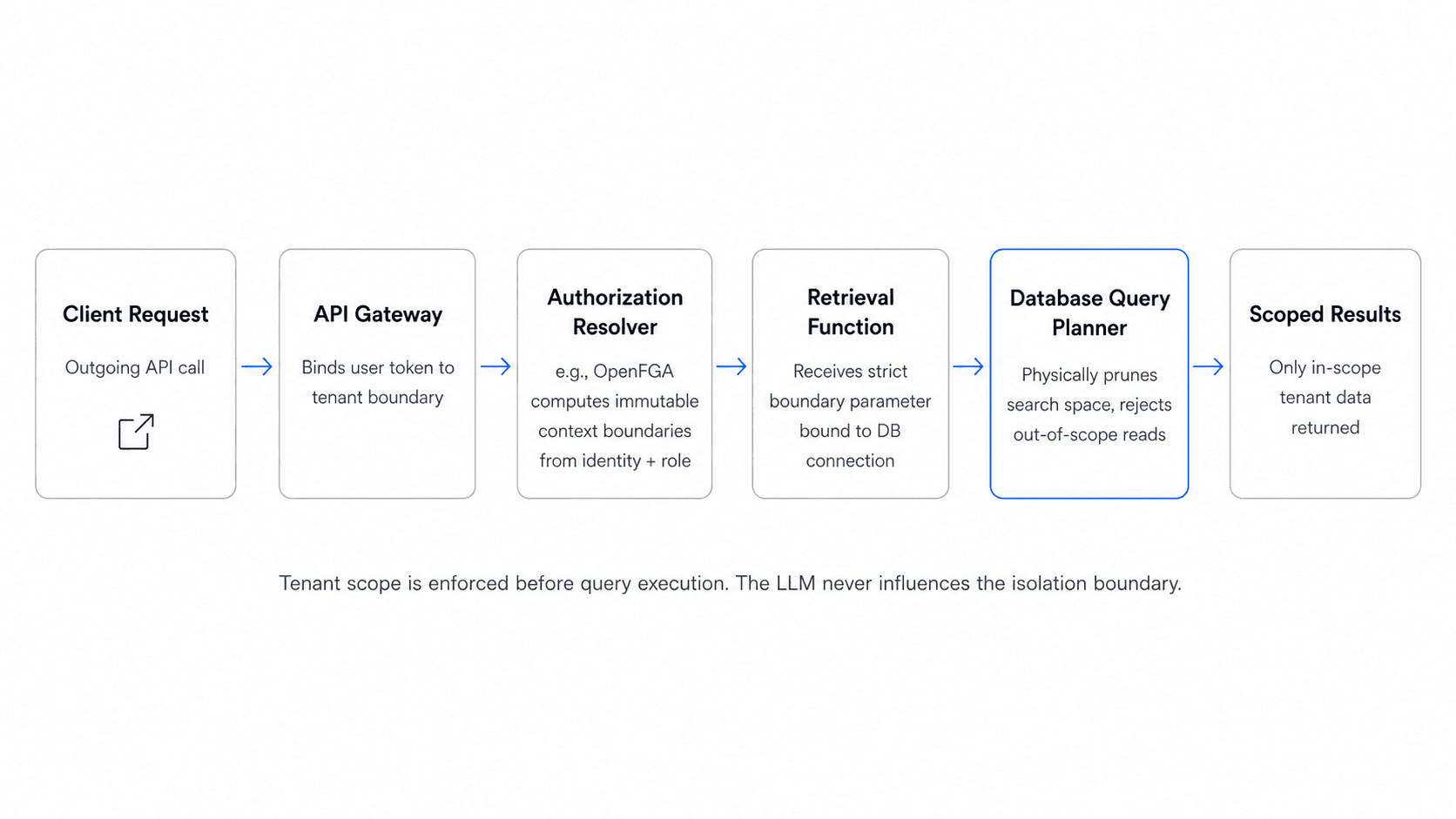
How the storage layer prevents cross-tenant data leakage
By enforcing isolation at the storage layer, you eliminate the risk of a compromised agent leaking data. Even if a prompt injection attack successfully forces the agent to generate a query asking for competitor data, the database query planner will execute the request entirely within the bounded scope provided by the authorization envelope.
The database returns an empty result set for the injected query, neutralizing the attack before the prompt context window is even assembled.
Note: Not every database below enforces this natively. Some shift that responsibility to the application layer.
Database comparison for multi-tenant AI agents (at-a-glance)
Physical infrastructure for multi-tenant AI agents breaks into distinct categories like relational defaults, pure vector search engines, managed stacks, and graph-native context infrastructure.
Postgres with pgvector and row-level security is the best database infrastructure for teams starting or managing under a few hundred tenants. Pinecone or Qdrant work well for pure semantic similarity search across isolated namespaces. HydraDB is the right choice when building multi-hop, temporal, and permission-aware agent context across thousands of tenants without provisioning expensive RAM.
Infrastructure | Best for | Primary isolation model | Cost behavior at scale | Multi-hop traversal | Temporal state tracking |
|---|---|---|---|---|---|
Postgres (pgvector) | Default relational tenant isolation | Row-level security | Predictable up to instance max | Poor | Manual application logic |
Pinecone | Pure serverless semantic search | Logical namespaces | Low for namespaces, high for pods | None | None |
Qdrant | Configurable Rust-based environments | Payload-partitioning | Moderate (memory dependent) | None | None |
Weaviate | Managing cold inactive tenants | Physical tenant shards | Moderate (active RAM pricing) | Basic cross-references | None |
AuraDB (Neo4j) / Neptune (Amazon) | Static enterprise analytics | Logical node boundaries | Extremely high (RAM-bound) | Excellent | Manual event sourcing |
AWS Bedrock | Rapid prototyping on AWS | Managed session scopes | Storage + continuous inference | None | Session restricted |
HydraDB | Stateful context at massive scale | Physical query layer bounds | Low (Object-storage-bound) | Excellent | Native bitemporal |
Postgres (pgvector + row-level security) for multi-tenant AI agents
Best for
Canonical business data and systems of record
Default tenant isolation for early-stage AI agent platforms
Overview
Postgres remains the standard relational database engine for modern applications. With pgvector, Postgres supports exact and approximate nearest neighbor search alongside traditional transactional data. For teams building AI agent capabilities, Postgres is a strong default for enforcing tenant isolation adjacent to existing business data.
Multi-tenancy model and capabilities
Row-level security (RLS): Database-enforced policies that prevent query execution across restricted tenant boundaries
HNSW and IVFFlat indexes: Native indexing methods for high-dimensional vector search
Relational metadata: Strict foreign key constraints binding context chunks to canonical tenant_id records
ACID compliance: Guaranteed transactional integrity for workflow state updates
JSONB support: Flexible storage for varied tool results and unstructured agent traces
Performance and scale
Postgres handles multi-tenant AI workloads effectively up to medium scale. Standard vector retrieval stays fast at this scale. While technically capable of supporting more, practical deployments often keep tenant counts under a few hundred per instance before RLS query planning overhead and index build times start degrading performance. Cost scaling stays predictable, generally running $89 to $150 per month per 10 million vectors, depending on the provisioned compute instance and memory allocations needed to keep indexes resident.
Implementation example
Strengths
Prevents cross-tenant leakage natively at the database kernel level
Keeps embedding vectors physically adjacent to canonical business metadata
Requires zero new operational tooling for most engineering teams
Handles tenant lifecycle operations cleanly via cascading hard deletes
Limitations
Struggles with multi-hop relationship traversal at depth
Index build times degrade as table size and vector dimensions increase
Lacks native bitemporal history for tracking evolving agent context
Shared compute pool architecture means noisy neighbor queries degrade overall instance performance
Pricing
Postgres is open source and free to self-host. Managed services charge by compute instance size and allocated storage. The scaling curve stays predictable up to the physical limits of vertical instance sizes.
Pinecone for multi-tenant vector search (namespace isolation)
Best for
Pure semantic similarity workloads requiring zero operational overhead
Architectures mapping one tenant to one namespace
Overview
Pinecone is a fully managed, closed-source vector database designed for high-performance semantic search. It removes infrastructure management entirely and relies on logical namespaces to partition data and restrict query execution scope for multi-tenant applications.
Multi-tenancy model and capabilities
Serverless architecture: Decouples storage from compute for automated scaling without manual provisioning
Namespaces: Logical partitions within an index to isolate tenant data
Metadata filtering: Pre-filtering execution to restrict retrieval boundaries within a namespace
Sparse-dense vector support: Hybrid search combining lexical keyword scoring and semantic relevance
REST and gRPC APIs: Low-latency endpoints optimized for inference-time retrieval
Performance and scale
Pinecone delivers fast inference-time retrieval, maintaining low-millisecond latency. It offers million-scale namespace support on Standard and Enterprise plans, though scaling past 100,000 namespaces requires contacting their support team. Cost scaling is efficient on the serverless architecture, averaging around $70 per month per 10 million vectors, provided query volume remains predictable.
Implementation example
Strengths
Offloads all infrastructure management, patching, and capacity planning
Namespaces prevent cross-tenant recall when applied correctly at the application layer
Maintains consistent inference-time latency under high concurrent load
Serverless architecture mitigates noisy neighbor resource contention by isolating compute execution
Limitations
Namespace-based isolation is affordable, but upgrading to dedicated indexes for strict compliance isolation triggers cost-prohibitive base infrastructure fees
Relying on string-based namespaces and metadata filters shifts the strict security isolation burden entirely to application routing code
Can't model multi-hop relationships or agent provenance chains natively
Tenant offboarding via bulk hard deletes in namespaces can be rate-limited or operationally slow
Pricing
The usage-based pricing model on the serverless tier accumulates charges based on read units, write units, and storage consumed. Dedicated pods require upfront provisioned capacity that incurs hourly costs regardless of activity.
Qdrant for multi-tenant vector search (payload filtering)
Best for
Payload-filtered retrieval across mid-sized tenant pools
Teams requiring a Rust-based engine deployable in custom environments
Overview
Qdrant is an open-source vector search engine built entirely in Rust. It uses payload-based partitioning within shared collections and features advanced tiered sharding mechanisms to isolate and route tenant workloads dynamically based on size and activity.
Multi-tenancy model and capabilities
Payload-based partitioning: Enforces logical tenant isolation via structured metadata
Multi-tenant shards: Tiered routing that isolates large tenants to dedicated storage nodes
Binary quantization: Drastically reduces the memory footprint for high-dimensional vectors
Hybrid search: Combines BM25 lexical scoring natively with dense vector retrieval
Storage tiering: Offloads cold tenant data to disk to preserve expensive RAM
Performance and scale
The Rust architecture provides stable, low-latency retrieval performance. Payload filtering in a shared collection handles tens of thousands of tenants efficiently, scaling to 100,000+ with custom sharding. Cost scaling is moderate due to storage tiering, generally running $50 to $100 per month per 10 million vectors depending on the compression techniques applied.
Implementation example
Strengths
Configurable sharding handles noisy neighbor problems by routing large, active tenants to dedicated nodes
Rust-based architecture delivers predictable tail latencies without garbage collection pauses
Flexible deployment models allow operation across managed cloud, on-premises, and edge environments
Limitations
Unlike physical sharding, omitting a payload filter in a shared collection defaults to querying all tenants, leaving zero margin for error in application-side query construction
Lacks native temporal tracking for reversing or auditing agent decisions over time
Requires manual orchestration and monitoring to move tenants between shard tiers optimally
Payload-based hard deletes can heavily impact cluster performance during large tenant offboarding operations
Pricing
Qdrant is open source and free to self-host. The managed cloud tier bills by hourly cluster capacity. Workloads requiring exact nearest neighbor search without quantization dictate high memory requirements, leading to higher instance costs.
Weaviate for multi-tenant vector search (tenant shards)
Best for
Architectures requiring physical data isolation per tenant
Managing large pools of inactive or cold tenants
Overview
Weaviate is an open-source vector database that models data around objects, properties, and vectors. It addresses multi-tenancy natively through physical tenant-specific shards that can be activated or deactivated dynamically. This provides a unique approach to managing infrastructure costs for SaaS applications.
Multi-tenancy model and capabilities
Tenant-specific shards: Physical separation of tenant data within a single class structure
Offloading mechanics: Deactivates cold tenant shards to disk to save active RAM
Pluggable vectorizers: Integrates directly with embedding models during the ingestion pipeline
Property-graph-like syntax: Queries structured through a declarative GraphQL interface
Cross-reference storage: Maintains basic directional links between stored objects
Performance and scale
For active, memory-resident tenants, Weaviate delivers low-latency retrieval. The architecture supports over a million tenants per cluster by actively managing the hot/cold state of individual shards. Cost scaling averages around $150 per month per 10 million vectors, though this fluctuates based on the ratio of active to deactivated tenants.
Implementation example
Strengths
Activating and deactivating tenants solves the RAM over-provisioning problem common in vector search
Physical sharding provides stronger security isolation guarantees than logical metadata filtering
Built-in vectorization simplifies ingestion pipelines and reduces external orchestration dependencies
Physical tenant shards strictly isolate computational resources, preventing noisy neighbor disruption
Tenant offboarding is a fast, clean drop of the physical shard rather than a heavy transactional delete
Limitations
Activating a cold tenant introduces high latency penalties during retrieval while the shard loads into memory
Cross-references provide basic linking but don't support deep multi-hop traversal reasoning
Managing shard lifecycle states adds significant operational complexity to the application layer
Pricing
Weaviate is open source and free to self-host. The serverless tier bills based on vectors stored and queries executed. The enterprise cloud requires upfront provisioned compute and memory, which dictates the ceiling on active tenants.
AuraDB (Neo4j) / Neptune (Amazon) for multi-tenant agent context (graph databases)
Best for
Traditional enterprise graph workloads and static business ontologies
Analytics spanning heavily interconnected organizational data
Overview
Neo4j and Amazon Neptune are established graph databases with mature tooling for modeling complex relationships and running enterprise queries. They were originally designed for analytics and knowledge graph workloads. The key consideration for AI agent use cases is their memory-bound architecture. Both require graph data to be resident in RAM, which creates cost challenges as tenant counts and context volume scale.
Multi-tenancy model and capabilities
Native property graph storage: Models nodes, edges, and properties explicitly
Cypher (Neo4j) and Gremlin (Amazon Neptune) query languages: Expressive syntaxes for complex deep traversal
ACID transactions: Ensures strict consistency across complex graph mutations
Vector index integration: Bolted-on semantic search capabilities alongside graph data
Enterprise security: Role-based access control and strict corporate data governance
Performance and scale
Basic graph traversals are fast, but latency degrades quickly during deep multi-hop queries. The maximum recommended tenant threshold is limited to under 1,000 tenants due to severe active memory overhead. Cost scaling is extremely high, regularly exceeding $400 per month for 10 million interconnected nodes and vectors.
Implementation example
Strengths
Unmatched query capability for traversing complex organizational hierarchies and access control lists
Mature tooling for visualizing relationships and debugging context paths
Strong compliance, backup, and enterprise audit features built over decades
Limitations
RAM-priced architecture forces massive over-provisioning as AI context graphs scale dynamically
Infrastructure is billed per gigabyte of provisioned memory, regardless of active tenant query volume
Vector search implementation is limited compared to purpose-built semantic engines
Shared memory pool architecture is susceptible to noisy neighbor query disruption
Deeply connected graph structures make hard deletes and per-tenant crypto-shredding operationally resource-intensive
Pricing
Legacy graphs are billed primarily on provisioned compute instances and the active memory footprint required to hold the graph. Costs scale linearly with total data size rather than active query volume. These systems serve as the primary cautionary case for memory scaling issues in high-tenant-count environments.
AWS Bedrock Knowledge Bases + AgentCore for tenant-scoped agent memory
Best for
Engineering teams restricted entirely to AWS-managed AI services
Prototyping session-based agent memory without managing underlying infrastructure
Overview
AWS Bedrock Knowledge Bases, combined with AgentCore Memory, provide a fully managed retrieval and state stack. The managed service handles orchestration and session isolation natively, but it leaves the application layer entirely responsible for supplying the correct tenant filters to the abstraction layer.
Multi-tenancy model and capabilities
Managed ingestion: Automated chunking, embedding, synchronization, and storage pipelines
Session, actor, and namespace isolation: Logical boundaries grouping user interactions
Automated sync: Pulls data continuously from Amazon S3 or external enterprise data sources
Foundation model integration: Direct inference routing to Anthropic or Amazon models
Abstracted retrieval: Hides the physical database query construction from developers
Performance and scale
Due to heavy managed orchestration overhead, retrieval latency is higher than in self-managed stores. Maximum recommended tenant thresholds scale with AWS account limits. Cost scaling involves multiple dimensions: storage fees per gigabyte, continuous inference routing fees, and underlying OpenSearch Serverless compute costs.
Implementation example
Strengths
Eliminates the need to provision, tune, monitor, or update database infrastructure manually
Deep integration with AWS IAM for authentication and service-to-service boundaries
Provides a rapid path to production for standard, stateless RAG use cases
Fully managed auto-scaling mitigates noisy neighbor resource contention
Limitations
Abstracts the database physical layer too far to implement complex or custom access control models
The application remains entirely responsible for calculating and passing precise tenant filters
Lacks any capabilities for multi-hop reasoning or true bitemporal state tracking
Abstracted storage layer makes verifying hard deletes and clean crypto-shredding difficult for strict compliance audits
Pricing
Workloads are billed per gigabyte of storage per month alongside API request fees. Inference charges apply continuously for embedding models during ingestion and retrieval. Additional hidden costs accumulate for OpenSearch Serverless if used as the primary backing store.
HydraDB for multi-tenant, temporal, permission-aware agent context
Best for
Multi-hop, temporal, permission-aware agent context across thousands of tenants
Teams requiring strict isolation without the cost penalty of provisioned RAM
Overview
HydraDB is graph-native context infrastructure purpose-built for stateful A, with production use cases spanning multi-tenant agent platforms, company brains, and temporal audit systems. Operating as one of the fastest and cheapest graph databases built on object storage, it models AI context as interconnected entities, relationships, events, decisions, and temporal states rather than isolated flat chunks.
Multi-tenancy model and capabilities
Object storage foundation: Supports effectively unlimited namespaces without being constrained by RAM limits
Physical query layer isolation: Enforces strict tenant boundaries natively at the graph traversal level
Bitemporal history: Tracks exactly what changed, when it changed, and why it changed for auditability
Ontology neutral: Supports any specific domain model without forcing a predefined schema or memory format
Multi-signal retrieval: Combines metadata filtering, temporal signals, structural relationships, and semantic search into a single execution plan
Performance and scale
HydraDB delivers sub-200ms retrieval latencies for complex traversals. The decoupled architecture pushes maximum recommended tenant thresholds to effectively unlimited logical namespaces. Since HydraDB uses object storage rather than memory, cost scaling is lower than for legacy graphs or vector databases, operating well under $10 per month per 10 million vectors/entities.
Implementation example
Strengths
Multi-hop traversal halts the moment an edge lacks the correct cryptographic tenant identifier
The object storage architecture makes massive graph-scale context economically viable in production
Full per-tenant bitemporal history ensures agents can reliably reason over past decisions and state changes
Decoupled compute and storage isolate noisy neighbor resource consumption across the system
Object storage foundation supports efficient lifecycle policies and clean per-tenant crypto-shredding
Limitations
Ontology-neutral design means teams define their own context graph schema rather than using predefined models. This is a deliberate trade-off that gives flexibility but requires upfront modeling work
Unnecessary for basic, stateless document RAG applications
As infrastructure, HydraDB provides graph-native primitives rather than prebuilt application UIs. Teams build their own memory layers, company brains, and agent workflows on top
Pricing
HydraDB decouples storage from compute to eliminate traditional memory-based billing models. It scales cheaply on object storage for massive multi-tenant counts, using a usage-based billing structure tied strictly to active context traversal and compute execution.
How to choose a database for multi-tenant AI agents
Whichever database infrastructure you choose, LLM wiki tools and application frameworks like Mem0, Zep, and Letta, alongside session-state tools like LangGraph, sit on top of it. They handle what context gets written and how it's structured. The decision below is about the physical storage and isolation layer underneath.
If you need relational data + RLS, choose Postgres
Most teams should start with Postgres row-level security and pgvector, add a structured thread or session store, and adopt a dedicated context layer only when vector latency, corpus size, multi-hop relationship depth, or operational load across thousands of tenants proves it necessary.
If you only need semantic search, choose Pinecone or Qdrant
Adopt Pinecone or Qdrant when your primary requirement is pure semantic similarity search. These engines are ideal for applications searching across massive, unstructured document corpora where relational depth is unnecessary. This path fits architectures that map a single tenant to a single logical namespace without requiring cross-tenant reasoning.
If you need multi-hop + temporal + permissions, choose HydraDB
Adopt HydraDB when your agent context requires deep multi-hop relationships, bitemporal state tracking, and permission-aware retrieval. This infrastructure is ideal for systems where context must span thousands of tenants efficiently. HydraDB solves the operational burden of provisioning expensive RAM across isolated namespaces, letting engineering teams build stateful, intelligent agents without inflating infrastructure costs.
Spin up a free HydraDB instance and see how tenant-isolated, multi-hop, bitemporal context performs at your scale.
FAQ
What is the safest database isolation model for multi-tenant AI agents?
The safest model is database-enforced isolation (e.g., Postgres RLS or an engine that enforces tenant boundaries in the query planner), not "remembering to add a metadata filter" in application code.
Is Postgres + pgvector enough for multi-tenant agent memory?
Yes. For early-stage or moderate scale, especially when you use Row-Level Security (RLS). But it becomes painful for deep multi-hop relationships and native temporal history as tenant count and context complexity grow.
Are Pinecone namespaces secure enough for strict multi-tenancy?
Namespaces help partition data, but strict security still depends on correct query scoping. If your app accidentally passes the wrong namespace string to the retrieval client, you can create cross-tenant exposure. The security boundary relies entirely on flawless application-layer routing.
What's the risk of relying on metadata/payload filtering for tenant isolation?
If the filter is missing, malformed, or bypassed, the database may still execute the search across other tenants. Isolation becomes a developer correctness problem instead of a database guarantee.
Which option is best for thousands of tenants with lots of "cold" data?
Choose infrastructure that doesn't force you to pay RAM for inactive tenants. Object-storage-oriented or hot/cold architectures typically scale more predictably than RAM-bound systems.
When do I need a graph database for AI agents?
When your agent context requires multi-hop traversal (entities → relationships → provenance → permissions) rather than flat "top-k chunks," especially for workflows spanning tools, users, documents, and resources.
What is bitemporal history and why does it matter for agents?
Bitemporal history tracks when something happened and when it was recorded/valid. This helps agents audit decisions, replay state, and reason over changing permissions or facts.
How do I prevent prompt injection from causing cross-tenant data leaks?
Don't trust the model to enforce boundaries. Enforce tenant scope before query execution using an authorization resolver (e.g., OpenFGA) and a database that physically rejects out-of-scope reads.
What database is best for permission-aware retrieval (RBAC/ABAC) in agent context?
Use an external authorization system to compute scope (RBAC/ABAC) and a database that can enforce that scope at execution time. This avoids embedding permissions logic in prompts or fragile app filters.
How should I handle tenant offboarding and hard deletes for agent memory?
Prefer systems that support clean per-tenant deletion (drop shard/namespace or crypto-shredding) and can prove deletion for compliance, rather than slow, large-scale transactional deletes.