9 min
Best graph databases for an AI company brain in 2026
Manveer Chawla
Updated on :

A company brain connects the knowledge spread across your organization, including information about people, projects, decisions, documents, and more. If your team decides to build rather than buy, you need a database that can organize this knowledge and retrieve the right context.
A graph database makes sense when answers depend on relationships, historical context, or information pulled from several connected sources. If you want a ready-made workplace search or chat experience, a packaged platform may be a better fit.
The right graph database depends on what you need most. HydraDB is a strong option for teams that want object-store-native graph storage, control over their graph structure, and managed retrieval that brings dense search and graph context together.
Key takeaways: which graph database is best for an AI company brain?
Choose HydraDB for object-store-native graph storage, control over your graph structure, and managed retrieval that blends dense search, BM25, and graph context.
Go for Neo4j for Neo4j-native Cypher behavior, APOC, GDS, or AuraDB.
Pick Neptune for AWS-managed governance or GraphDB for RDF and materialized inference.
Consider ArangoDB for document, graph, and vector workloads through AQL. Memgraph suits streaming ingestion or in-memory execution, while FalkorDB offers GraphBLAS, OpenCypher, and a GraphRAG SDK.
Let your dominant workload constraint drive the choice. This could be storage, authorization, temporal freshness, or operational trust.
Treat the graph database as infrastructure. Source ACL fidelity, citations, orchestration, and employee UX remain application or platform responsibilities.
Quick comparison of the best graph databases for AI company brains
As of September 2026, the right graph database depends on your workload and the exact product surface you’re evaluating. Storage, query, retrieval, authorization, and operating boundaries all vary across current options.
Option | Best fit | Storage model | Query/API | Retrieval and context support | Pricing and efficiency | Key tradeoff |
|---|---|---|---|---|---|---|
Organization-scale company brain where object-store-native graph state, customer-owned semantics, and managed context matter | S3-compatible object store is the durable source of truth. Memory and local NVMe serve as disposable caches | Practical OpenCypher subset over Bolt and HTTP | Managed v2 dense-plus-BM25 retrieval, exact filters, optional graph context, source-bearing results, and temporal facts | The open core is AGPL-3.0. Managed plans start free, then cost $25 per month for up to 2 GB or $399 per month for up to 10 GB. Durable graph storage and compute scale separately | Not a turnkey employee UX or Neo4j APOC equivalent | |
Neo4j-native Cypher behavior, APOC, GDS, AuraDB, and edition-scoped tooling | Disk-backed native graph with a configurable page cache | Cypher and Bolt. APOC and GDS are product- and edition-scoped | Vector and full-text indexes. GraphRAG composition remains application-specific | AuraDB Professional lists at $65 per GB-month of RAM and Business Critical at $146. Included storage is twice the RAM capacity. Page-cache, storage, and availability requirements drive sizing | RAM and I/O costs scale with the hot set. Capacity planning depends on topology and edition | |
AWS-managed graph operation with IAM and the required property-graph or RDF surface | Neptune Database cluster storage. Neptune Analytics is a separate in-memory engine | Gremlin and openCypher for property graphs. SPARQL for RDF | Analytics vector search and Bedrock GraphRAG are separate surfaces | Neptune Database meters instances or serverless capacity, storage, I/O, and transfer. Neptune Analytics is billed separately. Standard and I/O-Optimized configurations suit different I/O profiles | AWS-bound service with a multi-surface architecture | |
RDF/SPARQL, materialized inference, ontology-driven GraphQL, or Enterprise clustering | File-backed RDF repository. Enterprise supports a Raft cluster | SPARQL, RDF-star/SPARQL-star, and scoped GraphQL features | Semantic and full-text search. Embedding-based vector search uses Enterprise connectors | GraphDB offers a Free edition and custom Enterprise pricing. Inference rules, concurrent queries, licensed cores, and cluster topology affect resource requirements | RDF, SPARQL, and ontology-governance requirements | |
One AQL surface across document, key-value, graph, vector, and text-search workloads | RocksDB-backed multi-model engine with single-server and cluster deployment | AQL | ArangoSearch, inverted indexes, and vector indexes | Self-managed and managed options have deployment-specific pricing. Multi-model consolidation can reduce the number of systems, while sharding and replication affect infrastructure requirements | AQL lock-in and multi-model operational scope | |
Streaming ingestion, Cypher, graph algorithms, or in-memory transactional and analytical execution | In-memory transactional, in-memory analytical, and on-disk transactional modes | Cypher | Vector indexes on nodes and edges plus Kafka, Pulsar, and Redpanda connectors | Community Edition is free. Enterprise pricing is quote-based and scales with memory capacity. The selected storage mode determines the RAM, disk, and recovery profile | In-memory modes tie graph capacity to RAM costs. Mode-specific durability and recovery planning | |
GraphBLAS-based property graphs, OpenCypher extensions, or its GraphRAG SDK | GraphBLAS sparse-matrix graph with RDB and AOF persistence options | OpenCypher extensions over RESP and Bolt | Full-text, range, and HNSW vector indexes plus a GraphRAG SDK | Startup starts at $73 per month for 1 GB of RAM. Pro starts at $350 per month. Memory headroom, persistence, and high availability affect total cost | SSPLv1 licensing, with durability, high availability, and security features that vary by tier |
How to evaluate graph databases for a company brain
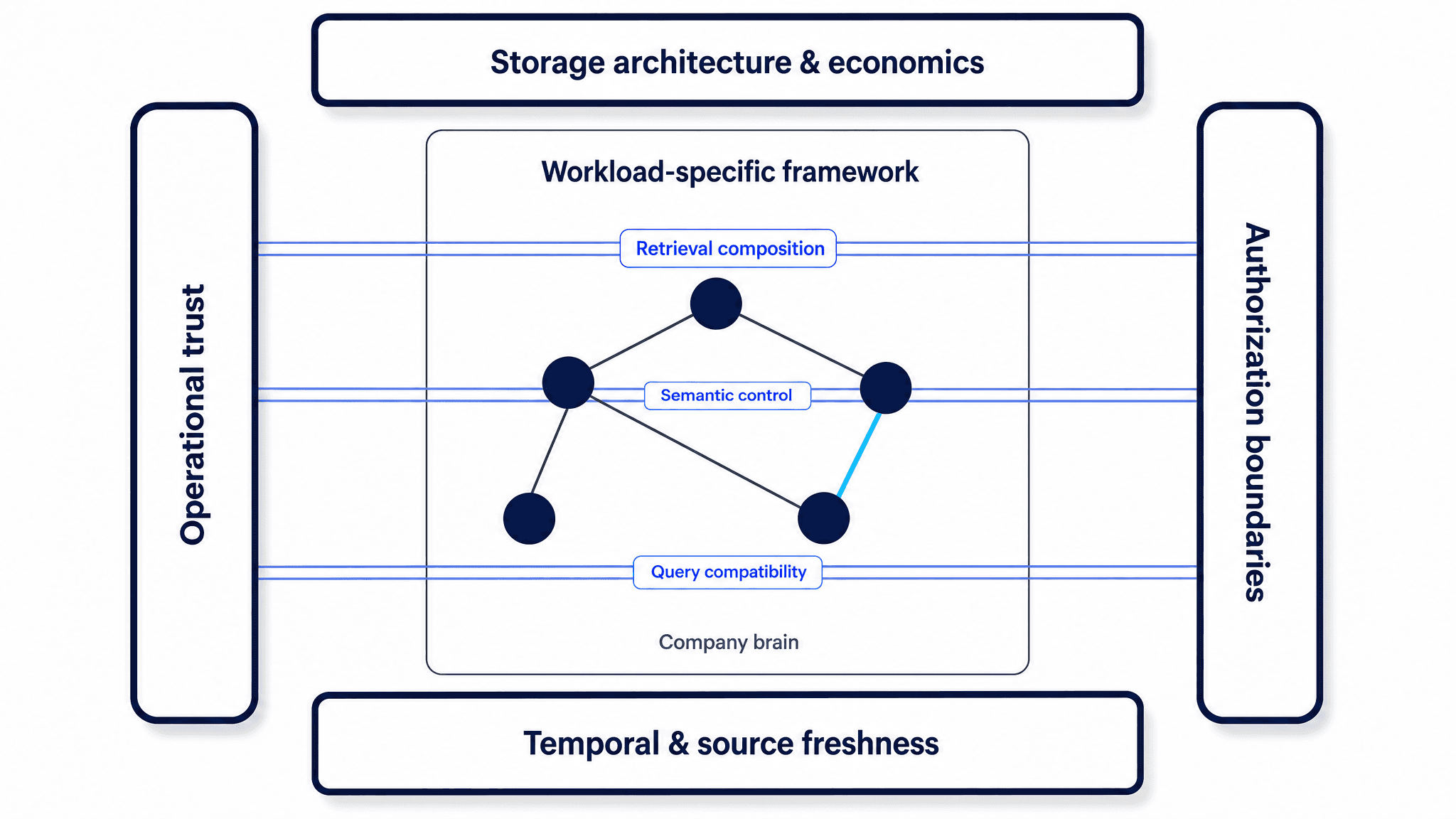
Evaluating graph databases for a company brain, GraphRAG pipeline, or enterprise knowledge graph requires a clear understanding of the workload. Generic benchmarks rarely reflect organizational data and retrieval patterns. Focus on five areas when comparing your options. These are storage architecture, cost and workload efficiency,, authorization boundaries, temporal and source freshness, and operational trust. Also compare retrieval capabilities, graph model control, and query compatibility.
Storage architecture for historical company context
A company brain accumulates context and relationships over time. Its graph grows as teams add more sources and retain historical versions. The pace of that growth depends on ingestion volume, retention policy, extraction behavior, and the data model.
Check how each deployment stores and serves hot and cold data. In-memory modes and page-cache-heavy workloads place different demands on RAM, disk, and I/O, although those mechanisms alone don’t determine latency or cost.
Object-store-native architectures can separate durable state from disposable local caches, while disk-backed native and multi-model engines handle persistence, caching, sharding, and replication their own way. Either way, compare the full cost of your planned deployment, including RAM, storage, I/O, backups, recovery, network, licensing, and operational work.
Cost and workload efficiency
A company brain's cost depends on both its total history and its active working set. Compare how each deployment charges for durable storage, RAM, compute, I/O, replicas, backups, network transfer, licensing, and support.
Normalize the comparison around the same graph size, read/write mix, hot working set, retention period, availability target, and region. A memory-priced service, an instance-priced managed database, and an open-core self-hosted system cannot be compared by list price alone.
Efficiency is workload-specific. Measure hot and cold query latency, throughput, cache behavior, recovery time, and the infrastructure required to meet the same service target. Use vendor benchmarks to understand each architecture, then test the shortlisted products with your own data and topology.
Authorization boundaries
Security in a company brain means separating infrastructure access from application policy. Graph databases offer their own controls, like database or repository boundaries, RBAC, IAM integration, or product-specific logical scopes. Those controls don’t reproduce the permission models of upstream SaaS applications.
Full source-ACL fidelity for end-user answers usually means enforcing permissions outside the database's generic role model. The surrounding system must carry source permissions into retrieval and apply them before context reaches the LLM. Depending on the architecture, this can happen during ingestion, through query middleware, or within the buyer-owned application. Database RBAC alone doesn’t automatically mirror changing permissions in Google Workspace, Slack, Salesforce, Zendesk, Okta, or Entra ID.
Time-aware company context
A company brain needs to track when each fact was valid, not just that it appeared in a document at some point. Reporting lines change, project statuses shift, and policies become outdated.
Check how the database handles incremental ingestion, versioned facts, source attribution, and time-aware relationships. Some systems have managed temporal features that track how long facts remain valid. Others require you to model time through timestamp properties, event nodes, or RDF named graphs.
Without clear temporal modeling, your AI system may return outdated information.
Operational trust for enterprise AI workloads
Evaluate the production readiness of the specific product and deployment model you intend to use. A fully managed cloud platform and a self-hosted core offer different operational capabilities.
Review disaster recovery, point-in-time backups, query observability, and data portability. Consider query language lock-in and how you would migrate if your infrastructure needs changed. Deployment options and vendor support shape how much operational work falls on your team.
Database, managed-platform, and application responsibilities
Each layer handles a different part of the system. Here's how the responsibilities split.
Layer | Owns | Examples |
|---|---|---|
Database layer | Durable graph storage, graph query execution, indexes, persistence, and documented database-level controls | Entities, relationships, properties, timestamps, source references, database or repository boundaries, and product-specific logical scopes |
Managed platform layer | Optional ingestion, enrichment, retrieval APIs, temporal and source attribution | Connectors, chunking, entity resolution, dense retrieval, BM25, metadata filters, and graph expansion |
Buyer-owned application layer | Final user experience, orchestration, policy enforcement, and end-user authorization | Chat and search UI, workflow automations, tool routing, source-ACL enforcement, and citations |
Graph database security and authorization comparison
Deployment and access-control boundaries dictate exactly where database capabilities end and application responsibilities begin.
Option | Deployment boundary | Database authorization | Fine-grained graph authorization | Identity and audit surface | Source-ACL fidelity for end-user answers |
|---|---|---|---|---|---|
HydraDB | Separate managed databases. Collections are logical scopes | Managed controls are contract-specific | Open-core graph-scope authorization for bounded operations | Managed controls are contract-specific | Buyer-owned application |
Neo4j | Database controls are product and edition scoped | RBAC in Enterprise, AuraDB Business Critical, and AuraDB Virtual Dedicated Cloud | Label, relationship-type, and property privileges on those surfaces | SSO and audit behavior is deployment and plan specific | Buyer-owned application |
Amazon Neptune | One graph per cluster. Use separate clusters or application partitioning | IAM policies and resource controls | Tenant filtering inside a shared graph is application-enforced | IAM, VPC, and CloudTrail | Buyer-owned application |
GraphDB, from Graphwise | Repository and server boundaries | Enterprise role controls | Enterprise fine-grained access control | OAuth, OpenID, and audit behavior is edition and configuration specific | Buyer-owned application |
ArangoDB, from Arango | Database and collection boundaries (deployment specific) | Enterprise and platform controls | Collection or document enforcement is edition- and design-specific | SSO and audit behavior is edition and platform specific | Buyer-owned application |
Memgraph | Multiple databases in Enterprise | Enterprise RBAC | Enterprise label-based access control | Enterprise SSO and audit logging | Buyer-owned application |
FalkorDB | Cloud multi-graph and multi-tenancy (tier-specific) | Cloud graph access control. Redis ACLs for self-managed operation | Verify rule granularity on the target tier | TLS, VPC, monitoring, and support vary by Cloud plan | Buyer-owned application |
HydraDB: object-store-native company brain infrastructure
HydraDB is an open-source, object-store-native graph database that separates compute from storage. It provides graph-native context infrastructure for AI applications that require relationship modeling, multi-hop traversals, and temporal context.
When to choose HydraDB
Choose HydraDB when you need durable graph storage, control over your own graph structure, and managed hybrid context retrieval across an organization. It suits teams whose graph context has outgrown a comfortable in-memory or local-disk footprint and who want to retain ownership of their ontology and domain model.
Which HydraDB product surface is evaluated?
Surface | What it covers | Keep separate |
|---|---|---|
Open AGPL-3.0 graph database core | Object-store-native graph storage, traversal, OpenCypher subset, and Bolt-compatible driver surface | Doesn’t natively provide managed hybrid retrieval, ingestion pipelines, or finished application user experience |
Managed v2 context/retrieval platform | Ingestion, context enrichment, retrieval APIs, and temporal and source-attributed context | Platform features shouldn’t be attributed to the open core database alone |
HydraDB strengths for company-brain workloads
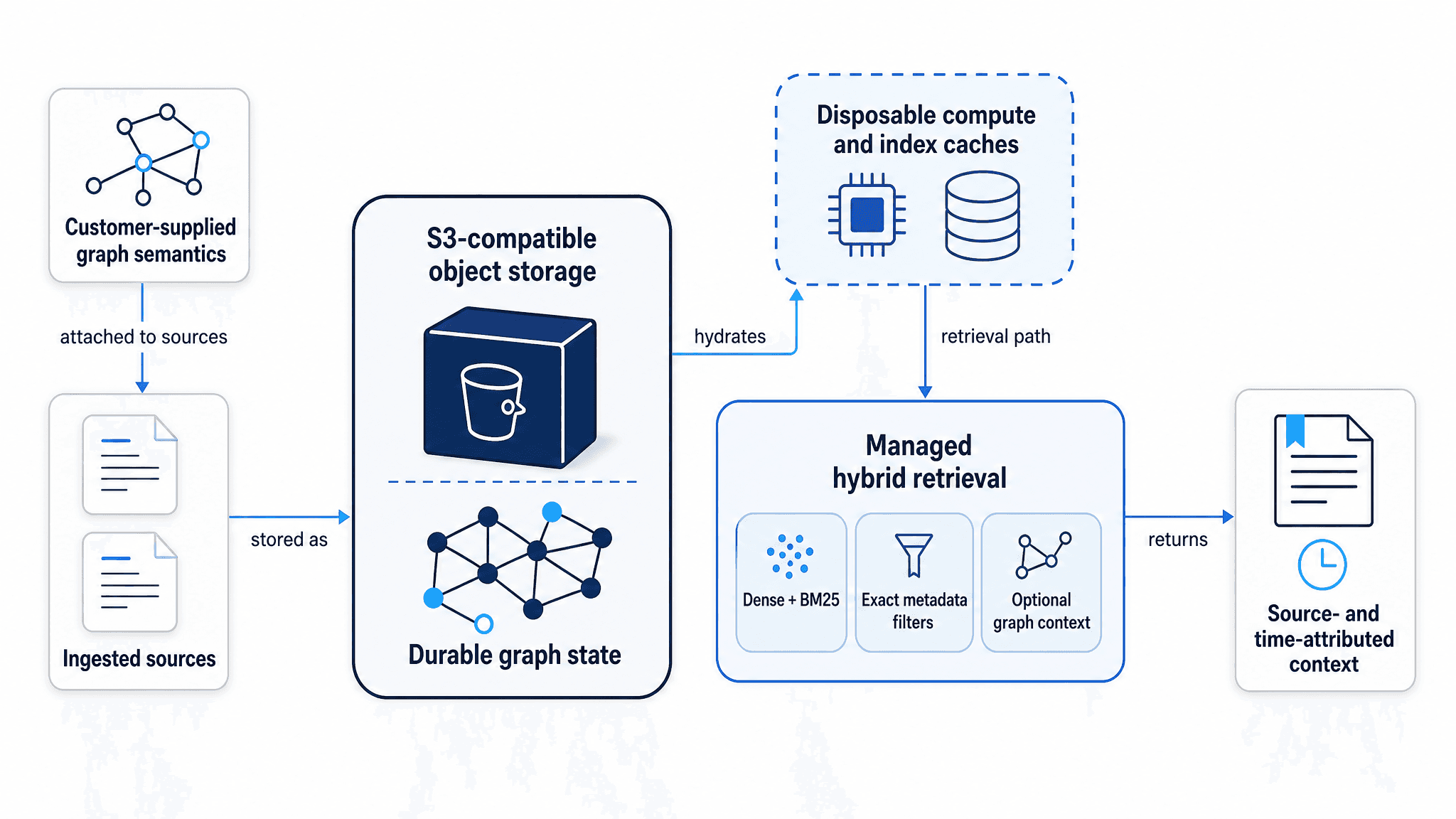
HydraDB's architecture uses S3-compatible object storage as the durable source of truth for the graph. Compute nodes and indexers keep disposable state in memory and on local NVMe SSDs. This separation decouples graph storage costs from compute costs. The durable graph can grow independently of compute provisioning, unlike RAM-provisioned databases where graph growth directly increases memory costs. Latency and elasticity depend on the workload and cache sizing.
The managed v2 platform retrieves Knowledge (shared documents and sources) and Memories (per-user context) using dense search and BM25. It applies exact metadata filters before ranking and can include graph context, source information, and temporal facts.
The Bring Your Own Graph capability lets you attach your own entities, relations, and optional temporal details directly, instead of relying on LLM graph extraction. HydraDB stores and returns that graph through the same retrieval API used for other ingested context. The open core supports a practical OpenCypher subset and documented Bolt-compatible drivers.
HydraDB tradeoffs for company-brain workloads
HydraDB is an infrastructure layer without a turnkey employee user experience or a finished ontology. It’s not a drop-in replacement for workloads that rely heavily on proprietary Neo4j APOC procedures. Source-ACL fidelity and per-fact permission enforcement remain the responsibility of the buyer-owned application layer.
Neo4j: Cypher, GDS, APOC, and AuraDB requirements
Neo4j is a native property graph database built around Cypher, with drivers, procedures, and analytics available across self-managed editions and its AuraDB managed service.
When to choose Neo4j
Neo4j fits when you need Neo4j-native Cypher behavior, APOC, Graph Data Science, AuraDB, or the tooling and operating model offered by a specific edition.
Which Neo4j product surface is evaluated?
The evaluated surfaces are Neo4j Enterprise for self-hosted deployments and Neo4j AuraDB for managed cloud operation. GraphRAG composition happens at the application layer.
Neo4j strengths for company-brain workloads
Neo4j supports vector indexes and full-text indexes alongside graph traversal. AuraDB backup, point-in-time recovery, high availability, and support all vary by tier. Verify the purchased AuraDB plan to confirm the included features.
The Neo4j Graph Data Science library provides graph algorithms and machine-learning procedures over projected graphs.
Neo4j tradeoffs for company-brain workloads
Neo4j stores graph data on disk and loads data and indexes into its page cache on demand. For large historical workloads, size the hot set, page cache, filesystem cache, disk, and I/O against the intended access pattern. Use a workload-equivalent model for any cost comparison.
You must model temporal state and source provenance explicitly through properties, event nodes, validity intervals, and strict application conventions. Neo4j offers strong database-level permissions, but mapping complex source-system ACLs into these policies remains the application layer's responsibility.
Amazon Neptune: AWS-managed graph infrastructure
Amazon Neptune is a fully managed graph database that supports property graphs, RDF graphs, and multiple query languages within the AWS ecosystem.
When to choose Amazon Neptune
Amazon Neptune makes sense when you want an AWS-managed graph service that works with IAM, VPC networking, CloudTrail, or Bedrock Knowledge Bases. Evaluate Neptune Database, Neptune Analytics, and Bedrock as separate services.
Which Amazon Neptune product surface is evaluated?
The comparison covers Amazon Neptune Database, including Neptune Serverless, and Neptune Analytics. Capabilities and compute models differ across these surfaces.
Amazon Neptune strengths for company-brain workloads
Neptune supports property graphs through openCypher and Gremlin and RDF graphs through SPARQL. Teams can choose the graph model that fits their ontology requirements.
Neptune integrates with AWS IAM, VPC networking, backups, and monitoring. Neptune Analytics is a separate memory-optimized engine with vector search and graph algorithms. Review its capacity, data-loading path, and query semantics separately from Neptune Database.
Amazon Neptune tradeoffs for company-brain workloads
Building a comprehensive company brain on AWS may require Neptune Database for transactional storage and Neptune Analytics for vector search and graph algorithms. Using both can complicate data freshness and cost planning.
Lexical retrieval often depends on other AWS services. Your exit plan should account for graph export, query-language differences, and the migration of IAM, VPC, and Bedrock integrations. AWS's Neptune migration guidance documents important compatibility differences. Temporal provenance must be modeled explicitly through RDF named graphs or property-graph properties.
GraphDB, from Graphwise: RDF and semantic knowledge graphs
GraphDB is a scalable semantic graph database and RDF triplestore built to manage structured knowledge models, ontologies, and data based on W3C semantic standards.
When to choose GraphDB
Choose GraphDB when regulated, scientific, compliance, or metadata-heavy workloads require RDF, SPARQL, OWL inferencing, and formal semantic modeling.
Which GraphDB product surface is evaluated?
GraphDB 11.5 documentation anchors this comparison, covering Free and Enterprise database editions and the Enterprise managed service. GraphQL endpoints, LLM tools, semantic similarity, and Enterprise connector-backed vector search vary by edition and add-on.
GraphDB strengths for company-brain workloads
GraphDB's forward-chaining reasoner materializes statements derived from selected RDFS, OWL, or custom rules.
RDF named graphs and metadata can represent provenance, source attribution, and temporal validity when the application models them.
GraphDB tradeoffs for company-brain workloads
Adopting GraphDB requires RDF data modeling and SPARQL-based query workflows. Consider the migration effort and available expertise if your current stack uses property graphs, SQL, or JSON.
RDF and ontology deployments require teams to define vocabularies, rulesets, and governance practices that fit their domain. Temporal validity is represented through explicit RDF data patterns. Confirm the available retrieval features for the edition and add-ons you plan to use.
ArangoDB, from Arango: multi-model graph, search, and vector workloads
ArangoDB is a native multi-model database that combines document, key-value, and graph data access through a single database core and query language.
When to choose ArangoDB
ArangoDB is worth choosing when you want one AQL surface for JSON documents, key-value access, graph traversal, vector indexes, and text search. It may also fit when you are considering the broader Arango Contextual Data Platform.
Which ArangoDB product surface is evaluated?
This comparison focuses on ArangoDB Enterprise and the Arango Managed Platform (AMP), formerly ArangoGraph Insights Platform. It also considers ArangoSearch and ArangoDB vector indexes. The broader Contextual Data Platform remains a separate Arango surface.
ArangoDB strengths for company-brain workloads
ArangoDB can store JSON documents, serve key-value access, run AQL graph traversals, and use vector indexes in one database product. This may reduce the number of databases in your architecture, depending on the workload and surrounding services.
The proprietary ArangoDB Query Language (AQL) can combine document filtering, vector matching, and graph traversal logic in a single query. For distributed workloads, ArangoDB provides SmartGraphs and clustering features designed to shard graph data and reduce network hops during traversal.
ArangoDB tradeoffs for company-brain workloads
If deep, multi-hop traversal over connected organizational context is your dominant workload, benchmark ArangoDB and the shortlisted graph-focused engines using the same data model, shard locality, topology, concurrency, and queries. The multi-model design alone does not establish a latency advantage or penalty.
AQL-specific application queries require translation when moving to another database. Arango's Cypher-to-AQL translation service is experimental, and it doesn’t make AQL portable to OpenCypher. In ArangoDB itself, temporal state and historical provenance require explicit modeling. Arango's broader Contextual Data Platform documents separate temporal-state capabilities.
Memgraph: streaming and in-memory graph workloads
Memgraph is a C++ graph database built for streaming and in-memory workloads. It supports in-memory transactional and analytical modes, an on-disk transactional mode, Cypher, and a library of graph algorithms alongside vector indexes.
When to choose Memgraph
Choose Memgraph when your workload depends on Kafka, Pulsar, or Redpanda ingestion, Cypher, graph algorithms, or in-memory transactional or analytical execution. Evaluate its on-disk transactional mode separately when the dataset exceeds your RAM budget.
Which Memgraph product surface is evaluated?
The compared surfaces are Memgraph Community Edition, licensed under the Business Source License, and the separately licensed Memgraph Enterprise and Memgraph Cloud.
Memgraph strengths for company-brain workloads
Memgraph's Kafka, Redpanda, and Pulsar connectors support streaming ingestion into the graph. Mutation and traversal latency will depend on the storage mode, data shape, concurrency, and durability settings, so test the intended workload.
The MAGE library provides graph algorithms and query modules. Memgraph Enterprise adds RBAC, label-based access control, SSO options, multi-tenancy, and audit logging. Confirm the availability of these controls for Community and your selected Cloud plan.
Memgraph tradeoffs for company-brain workloads
In Memgraph's in-memory modes, graph data consumes RAM. Memgraph also supports an on-disk transactional mode backed by RocksDB. Compare the RAM, disk, durability, and recovery requirements of the selected mode on your dataset.
Long-lived temporal history and source provenance still require explicit data modeling. Source-ACL fidelity remains an application responsibility. Memgraph documents vector indexes on nodes and edges. Evaluate lexical retrieval and any fused-ranking path separately rather than assuming database-level vector search replaces a complete hybrid-retrieval system.
FalkorDB: GraphBLAS, OpenCypher, and GraphRAG SDK workloads
FalkorDB is a property-graph database from the RedisGraph lineage. It uses a SuiteSparse GraphBLAS-based sparse adjacency-matrix representation and supports OpenCypher extensions over RESP and Bolt.
When to choose FalkorDB
FalkorDB is the better fit if you want its GraphBLAS-based property-graph engine, OpenCypher surface, Redis-oriented operating model, or packaged GraphRAG SDK.
Which FalkorDB product surface is evaluated?
The comparison spans FalkorDB's SSPLv1-licensed self-managed database and its managed Cloud tiers.
FalkorDB strengths for company-brain workloads
FalkorDB represents graph adjacency with GraphBLAS-backed sparse matrices. That mechanism doesn’t establish a general latency or throughput advantage, so test traversal and analytical performance using representative queries, data, topology, concurrency, and durability settings.
FalkorDB documents HNSW vector indexes on nodes and relationships, plus full-text and range indexes. Its GraphRAG SDK composes vector search, full-text search, Cypher generation, and relationship expansion. Measure its resource footprint and performance on your selected deployment.
FalkorDB tradeoffs for company-brain workloads
FalkorDB’s durability includes RDB snapshots, AOF logging, and combined persistence options. Compare memory, persistence, recovery, and Cloud-tier costs for hot and historical data. Current documentation doesn’t establish a universal hot-versus-cold cost ranking.
Developers interact with FalkorDB through OpenCypher with proprietary extensions over RESP and Bolt. Don’t assume full compatibility with Neo4j-specific Cypher, APOC, drivers, or tooling. Current documentation lists Cloud graph access controls and multi-graph operation. Confirm that the purchased tier supports the clauses, procedures, and observability you need.
How to test graph databases for a company brain proof of concept
Don’t rely only on pristine synthetic datasets. Organizational data is messy, incomplete, and permissioned. Build the proof of concept around the evaluation areas using sanitized data that reflects your actual sources. Synthetic fixtures can still help test correctness, edge cases, and failure behavior.
How to test cost and workload efficiency
Load data from documents, Slack threads, Jira tickets, CRM notes, and code repositories. Measure latency and throughput when retrieving recent context and context from two years earlier. Record the RAM, compute, durable storage, local cache, I/O, replicas, backups, network transfer, licensing, and operator time required by each deployment.
How to test authorization boundaries
Run the same query using the credentials of an executive, an engineering manager, and a new hire. Confirm that the application filters the graph context according to each user's permissions in the source systems.
How to test temporal freshness
Ask time-aware questions that require historical context.
"What was the exact status of the payments migration six months ago?"
"Who approved the Project Atlas delay, and what specific source documents prove it?"
Validate whether the system returns source-attributed facts with clear timestamps or validity windows.
How to test operational trust
Test incremental re-ingestion and verify how the system handles deleted or modified source documents. Run backup and restore procedures and test data export paths. Review query observability metrics and measure the vendor's support response times.
Example company-brain query for graph database evaluation
"Trace this customer escalation across Zendesk, Slack, Salesforce, and Jira through to the final resolution commit. Cite the sources and return only the information this employee is allowed to access."
Workload routing for company-brain databases
When evaluating graph databases for your company brain, route your shortlist by your workload's single dominant requirement.
Dominant requirement | Shortlist first | Why |
|---|---|---|
Durable organization-scale company brain with managed hybrid context | HydraDB | Object-store-native durable graph storage, Bring Your Own Graph semantics, and managed retrieval layer |
Neo4j-native Cypher behavior, APOC, GDS, AuraDB, or tooling requirements | Neo4j | Product-specific query, procedure, analytics, managed-service, and tooling surface |
AWS standardization and Bedrock/IAM alignment | Amazon Neptune | Native AWS governance, networking, audit, and managed service integration |
RDF/SPARQL, ontology inferencing, and semantic standards | GraphDB, from Graphwise | W3C semantic graph and formal reasoning surface |
Document, graph, and search/vector in one unified engine | ArangoDB, from Arango | Multi-model operational consolidation through AQL |
Streaming ingestion, in-memory transactional or analytical execution | Memgraph | Kafka, Pulsar, and Redpanda connectors, Cypher, graph algorithms, and in-memory modes |
GraphBLAS-based OpenCypher with a packaged GraphRAG SDK | FalkorDB | Sparse-matrix graph engine, RESP and Bolt clients, and GraphRAG tooling |
Notable alternatives to dedicated graph databases for AI company brains
Depending on your architecture, a GenAI workload may fit one of these alternatives to a dedicated, centralized graph database:
Stardog: Choose Stardog when you need semantic data virtualization and federated queries across existing enterprise sources. It lets you query data where it lives rather than ingesting everything into a primary company-brain storage substrate.
Zep or Mem0: Choose an agent-memory service when your main requirement is managed agent memory and persistent context across sessions. They package memory behavior behind APIs, reducing the amount of database infrastructure your team must design.
Conclusion: choose the best graph database for your company-brain workload
The best GraphRAG or enterprise knowledge graph database depends on what your workload needs most. Weigh storage architecture, cost and workload efficiency, authorization, temporal freshness, and operational trust during your evaluation. Also consider retrieval capabilities, control over the graph structure, and query compatibility.
If HydraDB fits your priorities, review the architecture documentation and test representative organizational data against the managed v2 API.
Frequently asked questions about graph databases for company brains
What should I look for when evaluating databases to build a company brain?
Evaluate five primary walls, including storage, cost and workload efficiency, authorization boundaries, temporal and source freshness, and operational trust. Treat retrieval composition, semantic control, and query compatibility as cross-cutting requirements. A graph database should support the required connected-retrieval patterns, while the surrounding platform and buyer-owned application determine ingestion logic, permission mapping, AI orchestration, and the user experience.
How do I build a multi-tenant company brain?
Use only the isolation mechanisms documented for the selected surface, such as separate databases or repositories, clusters, IAM boundaries, RBAC, or product-specific logical scopes. Treat tenant IDs and HydraDB collections as logical partitions unless a documented enforcement boundary says otherwise. Propagate and enforce source-system permissions outside generic database RBAC so answers include only authorized context.
Why use a graph database for a company brain?
Use a graph database when relationships materially affect retrieval or reasoning. A graph can preserve modeled connections and time properties for multi-hop traversal, while source-attributed answers additionally require source references, retrieval logic, and citation handling in the managed platform or application.
What would I build a Perplexity-style brain for my own company on?
Use a platform that combines dense and lexical retrieval, graph context, metadata filtering, source attribution, and permission enforcement. Choose HydraDB when object-store-native graph storage and managed hybrid retrieval are priorities, or shortlist Neptune, GraphDB, ArangoDB, Memgraph, or FalkorDB for AWS alignment, RDF inference, an AQL surface, streaming ingestion, or GraphBLAS, respectively.