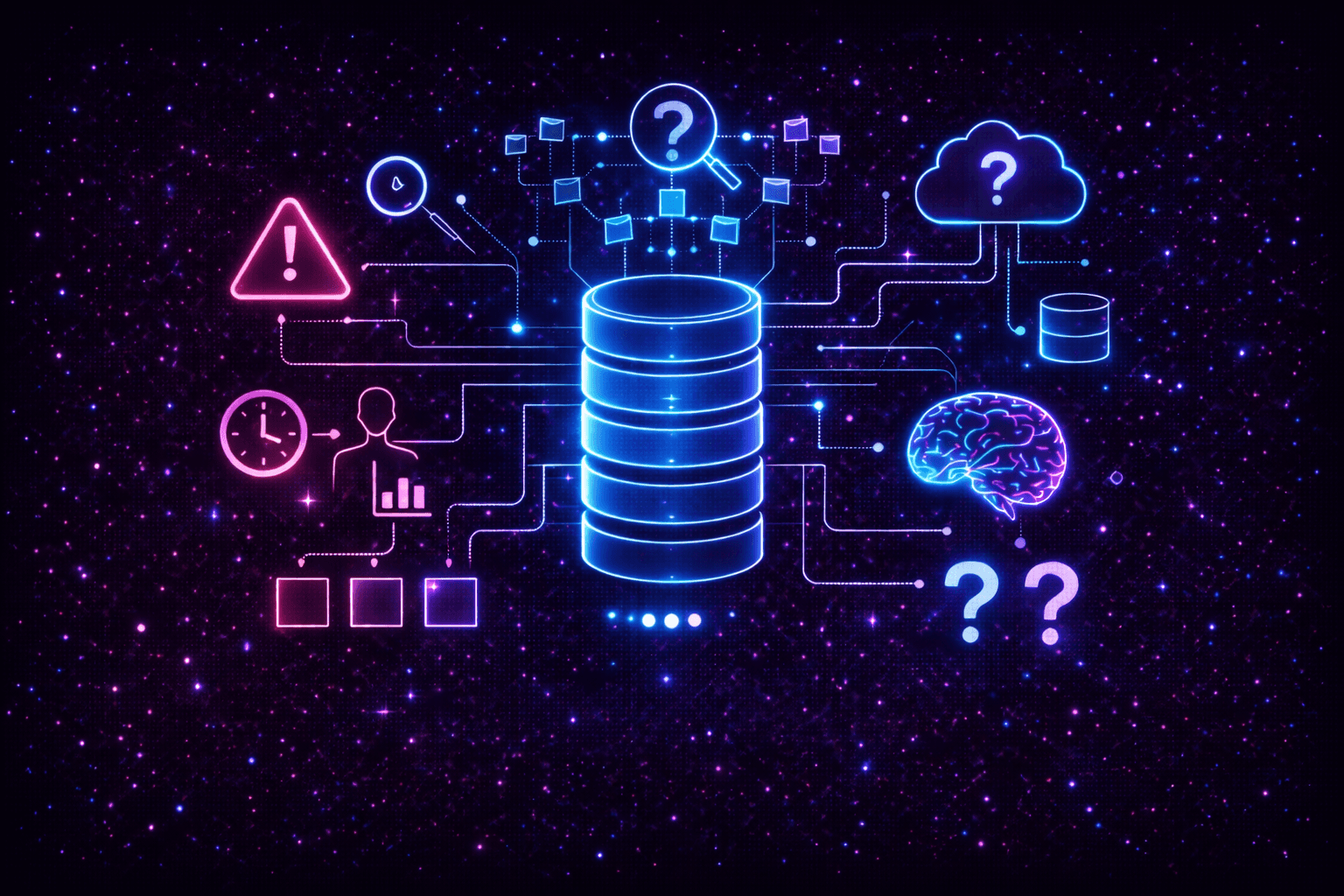
Vector databases were a breakthrough. They gave AI systems the ability to search by meaning instead of keywords, and that unlocked an entire generation of retrieval-augmented applications.
But meaning and usefulness are not the same thing. And as teams push AI agents into production, the gap between what vector databases do and what agents actually need has become impossible to ignore.
The core issue is architectural. Vector databases store high-dimensional embeddings and retrieve the nearest neighbors to a query vector. That is similarity search. It works well for finding documents that are semantically close to a question. It does not work well for understanding when something happened, why it matters to a specific user, or how pieces of information relate to each other across sessions.
This article breaks down where vector databases fall short for production AI agents. Not because they are bad technology — they are excellent at what they were designed for — but because the requirements of stateful, long-running AI agents go far beyond similarity search.
Time Is Invisible to Vector Search
Embeddings have no concept of time. A fact from three years ago and a fact from this morning produce vectors in the same space with no temporal signal.
This creates real problems in production. If a user says "I moved to Austin" in January and "I moved to Denver" in March, a vector database stores both statements as semantically similar embeddings about location. When the agent asks "Where does this user live?", both results surface with roughly equal relevance.
The correct answer requires understanding that time changes which facts are current. Without temporal reasoning, the agent retrieves contradictory information and either hallucinates a response or picks arbitrarily.
Some teams work around this by attaching timestamps as metadata and filtering at query time. But metadata filters are binary — they can exclude old results, but they cannot model the nuanced relationship between when something was true and whether it is still true. Knowledge evolution requires an architecture that versions facts over time, not one that stores static vectors.
Retrieval Succeeds but the Agent Still Fails
One of the more counterintuitive failures is when the right document is in the result set but the agent still produces a wrong answer. This is the lost-in-the-middle problem, and it affects every system that relies on retrieving the right data without considering how it is assembled.
Vector databases return a ranked list of chunks. The agent's context window gets filled from that list. Research has shown that LLMs pay disproportionate attention to the beginning and end of their context windows, with information in the middle being effectively ignored.
So a vector database can do its job perfectly — return the correct chunk at position 4 out of 10 — and the agent still misses it. The retrieval was accurate. The context assembly was not.
This is not a vector database bug. It is a fundamental limitation of treating retrieval as a "fetch and dump" pipeline. Production agents need systems that understand not just what to retrieve but how to structure and prioritize what gets placed into the context window.
User Preferences Drift and Vectors Do Not Follow
Static embeddings capture the meaning of text at a single point in time. But user preferences change constantly. Someone researching JavaScript frameworks today might shift to Rust next month. A customer who preferred budget options six months ago might now prioritize premium features after a promotion.
Vector databases cannot track this evolution natively. They store what was said, not what it means in the context of a user's changing behavior. Every query hits the same static index, returning results based on semantic similarity to the query — not relevance to the current user state.
Building real personalization on top of vector search requires a separate user modeling layer, a way to weight recent behavior over historical patterns, and logic to deprecate outdated preferences. Most teams either skip this entirely or build fragile custom pipelines that break under edge cases.
Similarity Is Not Relevance
This is the foundational flaw that underlies many of the other limitations. Vector similarity measures how close two embeddings are in high-dimensional space. Relevance measures how useful a piece of information is for a specific task, user, and moment.
These two things overlap sometimes but diverge constantly in production. A customer support agent handling a billing dispute does not need every document that is semantically similar to "billing." It needs the specific policy that applies to this customer's plan, the history of their previous disputes, and the resolution options available in the current quarter.
Vector databases return the twenty most similar chunks. A relevance-aware system returns the three pieces of context that actually answer the question. The difference in agent accuracy between these two approaches is enormous — and it compounds with every additional query in a conversation.
No Learning Loop Exists
Vector databases are stateless retrieval systems. They do not learn from outcomes. If an agent retrieves five chunks and the user finds the answer in chunk four, nothing changes. The next time a similar query arrives, the same five chunks return in the same order.
This means retrieval quality never improves from usage. Every query starts from scratch, optimized only by whatever the initial embedding model captured. There is no feedback loop between retrieval outcomes and future retrieval quality.
Production AI agents serve thousands of queries daily. Each interaction contains signal about what worked and what did not. Architectures that capture this signal — adjusting retrieval weights, reranking strategies, and relevance scoring based on actual outcomes — deliver measurably better results over time. Platforms like HydraDB build self-improving retrieval into the core architecture, so quality compounds rather than staying flat.
Embedding Collapse Degrades Results at Scale
As embedding models process more and more content within a domain, something counterproductive happens: the vectors start clustering together. Technical documentation, product specs, internal memos — they all land in the same region of the vector space.
This is embedding collapse, and it means that cosine similarity scores become less and less meaningful as your corpus grows within a narrow domain. When every chunk has a similarity score between 0.82 and 0.88, the ranking is essentially arbitrary.
Retrieval systems that rely solely on vector distance degrade precisely when you need them most — at scale, within specialized domains where precision matters. Hybrid approaches that combine vector search with keyword matching, metadata filtering, and graph-based relationships maintain discrimination even when embeddings converge.
Multi-Step Reasoning Requires More Than Retrieval
Many real-world agent tasks require chaining multiple pieces of information together. "What was the quarterly revenue trend before and after we launched the new pricing model?" requires finding revenue data, identifying the pricing change date, and comparing the two periods.
Vector databases handle each retrieval as an independent similarity lookup. There is no mechanism for the first retrieval to inform the second, or for the system to understand that these two queries are steps in a single reasoning chain.
Agents working with vector databases must implement all multi-step logic at the application layer. This works for simple cases but creates increasingly brittle pipelines as reasoning chains grow longer. Systems that model relationships between facts — not just their semantic similarity — can support these chains natively.
Flat Storage Cannot Model Relationships
Vector databases store embeddings as points in high-dimensional space. Every chunk is a node with no edges. There is no native way to represent that Document A contradicts Document B, that Fact X superseded Fact Y, or that User Z's preference connects to Conversation W.
This flat storage model forces all relationship logic into application code. Teams build custom graph overlays, maintain separate relationship tables, and write glue code to join vector results with structured data. The result is a fragmented architecture where the "memory" of the system is scattered across multiple databases and services.
Knowledge graphs and temporal relationship models solve this by making connections between facts a first-class data structure. When an agent can traverse relationships directly — not just search by similarity — it can answer questions that require understanding how pieces of information connect.
Updating Memory Is an Afterthought
Most vector databases are optimized for read-heavy workloads. Writing new embeddings is straightforward. Updating existing knowledge — changing a fact, deprecating an old preference, merging duplicate entities — is far more complex than it should be.
There is no native concept of "this fact replaces that fact." Teams must implement deletion-and-reinsertion logic, manage embedding versioning manually, and build reconciliation pipelines to keep the index consistent. In practice, many teams skip this entirely and let stale data accumulate.
For AI agents that operate over weeks and months, memory that cannot be efficiently updated is memory that decays. The write path matters as much as the read path — and vector databases were not designed with this in mind.
Latency Grows With Scale
Vector search requires computing distances across an index. As that index grows into hundreds of millions or billions of vectors, query latency increases even with approximate nearest neighbor algorithms.
Teams compensate with index partitioning, aggressive pre-filtering, and tiered storage. These mitigations work but add operational complexity and can reduce recall. The fundamental tradeoff between index size, query speed, and result quality is inherent to the vector search paradigm.
Memory-first platforms that filter and scope before computing similarity — rather than searching the entire corpus first and filtering after — avoid this scaling wall. HydraDB's metadata-first approach, for example, achieves sub-50ms p50 latency even at scale by narrowing the search space before any vector computation happens.
Cross-Session Agents Lose Continuity
Vector databases are sessionless. Each query arrives with no awareness of what happened in previous conversations, what the agent already knows about this user, or what context was established earlier in the day.
For AI agents that interact with the same users across multiple sessions, this creates a memory loss problem. The agent cannot build on previous conversations, remember commitments it made, or maintain a coherent understanding of the user over time.
Adding session awareness on top of vector search requires a separate memory store, session indexing logic, and retrieval pipelines that merge current-session context with historical context. It is doable but architecturally fragile — and it is solving a problem at the application layer that should be solved at the infrastructure layer.
Bad Input Produces Confidently Wrong Output
The final limitation is perhaps the most dangerous: vector databases amplify the quality problems in your data. If your ingestion pipeline produces poorly chunked, decontextualized, or outdated embeddings, similarity search will faithfully return the most similar bad results.
There is no quality gate in the retrieval path. A chunk with incorrect information that happens to be semantically close to the query will rank highly. The agent then presents this incorrect information with full confidence, because the retrieval step — from its perspective — succeeded.
Context-preserving ingestion pipelines that maintain source attribution, entity resolution, and temporal markers significantly reduce this risk. When the system understands where a fact came from, when it was last validated, and how it relates to other facts, it can make quality judgments that pure similarity search cannot.
Frequently Asked Questions
Are vector databases useless for AI agents?
No. Vector databases are excellent at what they were designed for — finding semantically similar content quickly. They remain a valuable component in many architectures. The limitation is in treating vector search as the complete retrieval solution for production agents that need temporal awareness, relationship modeling, learning loops, and cross-session memory.
Can I add these missing capabilities on top of a vector database?
You can build some of them. Teams add metadata filtering for time, graph overlays for relationships, and custom pipelines for session memory. But each addition increases architectural complexity, operational burden, and the surface area for bugs. At some point, the custom stack around the vector database becomes more complex than the vector database itself.
What is the alternative to vector-only retrieval?
Hybrid architectures that combine vector search with knowledge graphs, temporal models, structured filtering, and feedback loops. Some platforms — like HydraDB and Zep — build these capabilities natively rather than requiring teams to assemble them from separate components.
How do I know if my vector database is the bottleneck?
Look at agent accuracy in production, not retrieval precision in isolation. If your retrieval metrics look good but end-to-end agent performance is mediocre, the issue is likely in context assembly, temporal handling, or relationship modeling — all areas where vector databases have structural limitations.
Should I migrate away from my vector database?
Not necessarily. Evaluate whether your production requirements include temporal reasoning, cross-session memory, personalization, or multi-step reasoning. If they do, consider augmenting or replacing your vector search layer with a more complete memory and retrieval platform. If your use case is straightforward semantic search, a vector database may be exactly what you need.
Conclusion
Vector databases solved a real problem. They made semantic search accessible and fast, and they powered the first wave of RAG applications that proved retrieval-augmented generation could work.
But production AI agents have moved beyond what similarity search alone can deliver. They need to understand time, model relationships, learn from outcomes, maintain memory across sessions, and assemble context with precision — not just retrieve the nearest vectors.
The teams building the most capable AI agents today are not abandoning vector search. They are recognizing it as one layer in a much deeper stack — and they are choosing infrastructure that handles the full complexity of memory, context, and retrieval natively.
The question is not whether your vector database works. It is whether it is enough.