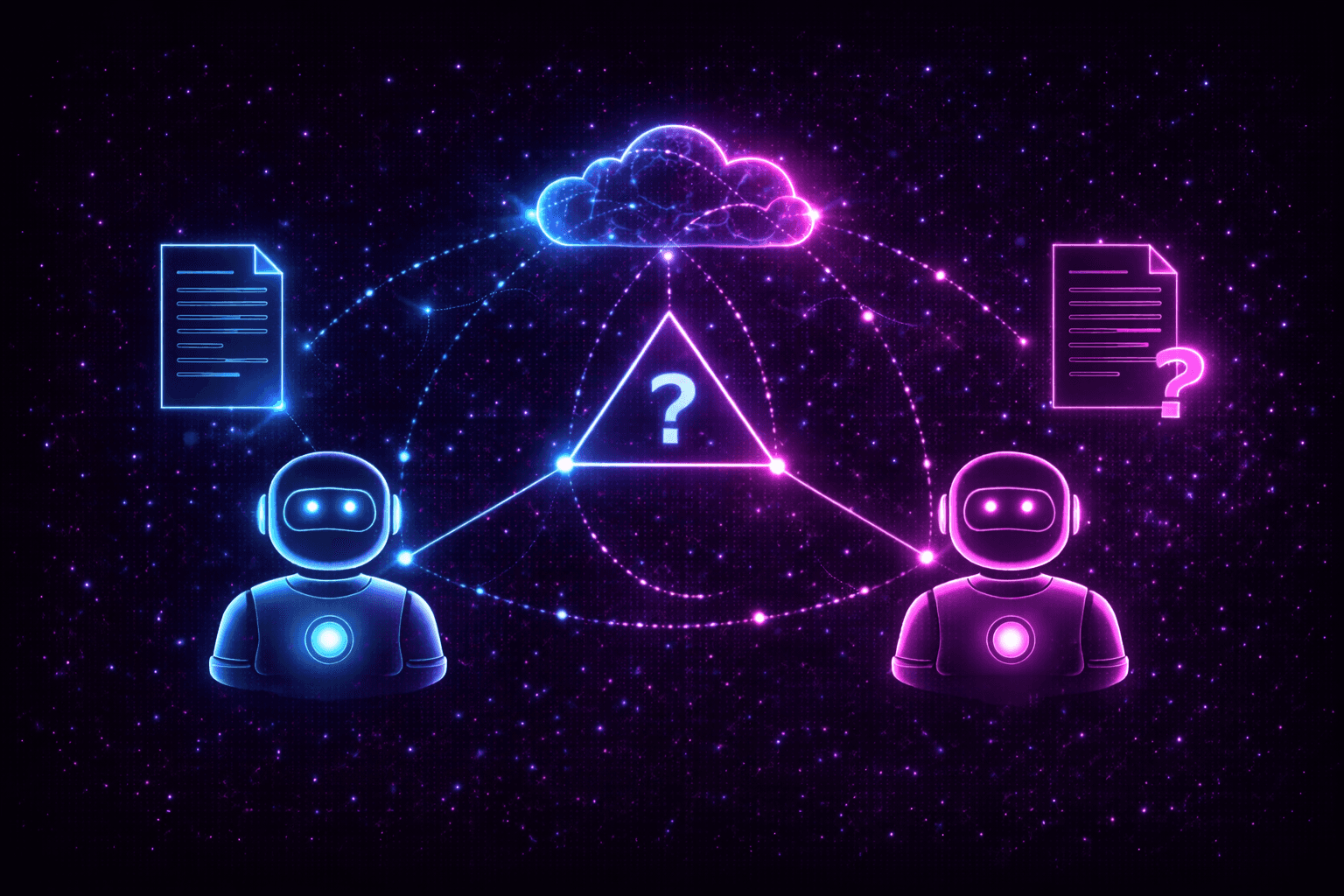
You've deployed a multi-agent system. Agent A handles customer research. Agent B writes proposals. Agent C manages follow-ups. But the handoffs keep producing inconsistent outputs and contradictory information.
Your instinct is to debug individual agent logic. The real problem is almost always context.
When agents operate in isolation, each one rebuilds its understanding from scratch. Agent A finds context about customer needs, but that context doesn't flow cleanly to Agent B. Maybe it gets summarized, maybe it gets lost, maybe Agent B's retrieval pulls contradictory information about the same customer. By the time Agent C arrives, there's no shared ground truth.
The breakdown looks like this: Agent A determines the customer cares about compliance over cost. Agent B retrieves the same profile but gets different priority rankings. Agent C finds a cached decision from six months ago, before the customer's needs shifted. Each agent reasons correctly within its own context. But their contexts are diverging, so their decisions diverge too.
Multi-agent systems that work treat shared context as infrastructure, not an afterthought. They maintain a single source of truth. They pass explicit context state between agents. They version decisions so downstream agents can verify they're working from current understanding.
You can't engineer around bad context sharing with better instructions. If Agent B doesn't have access to what Agent A learned, no chain-of-thought prompting will fix it.
The production consequence is that quality degrades the more stages your pipeline passes through. The first agent does reasonable work. By the fourth, it's compounded context loss.
The fix starts with building context as a contract between agents. Define what Agent A must output. Define what Agent B expects as input. When Agent A finishes, it passes the result plus the context it used, plus explicit statements about remaining uncertainty.
Implement a context store all agents can access safely. When Agent A learns something, it writes to shared state with a timestamp and source attribution. When Agent B queries for the same entity, it retrieves the most recent, most authoritative version.
This connects directly to why similarity is not context. Multi-agent systems relying on similarity-based retrieval for shared context are especially vulnerable — each agent gets a different top-K result set, and divergence compounds. You'll also want to examine how agents need better context assembly and understand the hidden cost of irrelevant context to see why even minor divergence causes production failures.
FAQ
Should agents share one retrieval system or have their own? Shared context sources with clear versioning beat isolated systems. If agents need specialized retrievers, implement a reconciliation layer preventing conflicting information from propagating.
What if agents genuinely need different context? Fine, but make it explicit. Document which agent uses which context source and why. Version both views and tag which agent used which.
Conclusion
Multi-agent failures rarely trace to flawed agent logic. They trace to context that diverges as it passes through stages. Each agent is smart — they're just smart in different contexts.
Fix the context flow. The agents stay the same. The difference is they're finally reasoning from shared ground truth.