19 min
What's the Best Way to Replace Manual Prompt Stuffing and Markdown Files for AI Agents in 2026?
Manveer Chawla
Updated on :

You start by manually curating CLAUDE.md, AGENTS.md, or SKILL.md files to guide your system's behavior. During early prototyping, this works great. It's frictionless and fits into your existing Git workflows.
But as your system scales from a single coding assistant to multiple agents handling real workflows, that manually managed context falls apart fast.
The reason is straightforward: agents in 2026 do more than answer questions. They take autonomous actions, update database records, and execute multi-step workflows across enterprise tools. A coding agent that only needs style guidelines is one thing. An agent that books meetings, updates CRM records, and triages support tickets across Slack, Jira, and your internal API needs to know what changed since its last run.
That means they need to track evolving state and know what a user preferred yesterday, how a coding standard changed this morning, and which internal API endpoints were deprecated last week. Manually editing markdown files can't support that kind of ongoing state, and stuffing entire session histories and sprawling rule lists into the prompt wastes a huge amount of tokens.
More critically, large prompts trigger the "lost-in-the-middle" problem: models recall information placed at the beginning and end of the context window far more reliably than information placed in the middle, creating a U-shaped accuracy curve. When instruction files push past thousands of tokens, this means agents start missing operating rules buried midway through the prompt.
This guide traces that architectural journey, from flat text files and prompt stuffing, to vector databases, to managed memory applications, and finally to graph-native context infrastructure. The goal is to help you identify which approach fits your specific agent framework.
TL;DR
Markdown files (AGENTS.md, CLAUDE.md) work for small, static, single-session instructions, but break with context rot and are lost-in-the-middle at scale.
Vector DB / flat RAG is best for static document Q&A and token reduction, but struggles with temporal state and multi-hop relationships.
Managed memory apps (Mem0, Zep, etc.) are fastest for generic user memory, but can be black-box, costly, and limiting for enterprise controls.
Graph-native context infrastructure (HydraDB) fits multi-agent, stateful systems needing custom ontology, permissions/RBAC, provenance, and time-aware state.
Rule of thumb: if agents must act on the latest truth across tools, use graph-native context. Otherwise, choose the simplest tier that meets requirements.
Tier 1: Markdown files and prompt stuffing for agent context
What is tier 1 markdown-based context?
This tier relies on manually curating context in files like AGENTS.md, .github/prompts/*.prompt.md, and SKILL.md. At runtime, orchestration frameworks inject these instructions alongside conversational histories directly into the LLM payload on every turn.
When should you use markdown files for agent memory?
Plain text context works well for solo developers or small internal teams building single-purpose, stateless agents. It's effective for enforcing static instructions, like coding standard guidelines, that rarely change.
Benefits of markdown-based agent context
Plain text won early adoption because it uses native version control via Git. Developers can audit and edit it easily, and the format fits into existing workflows like GitHub Copilot.
It also has zero infrastructure cost and no latency overhead for retrieval. It’s portable across different IDEs and agent orchestration frameworks.
Limitations of markdown-based agent context
At scale, flat text hits hard technical breakpoints, often forcing teams to evaluate dedicated LLM wiki tools for persistent agent knowledge.
Lost-in-the-middle recall degradation
Large payloads suffer from the U-shaped recall degradation known as the "lost-in-the-middle" problem. Models fail to retrieve rules buried midway through a prompt.
Prompt caching doesn't fully solve it
While modern prompt caching mechanisms from OpenAI and Anthropic reduce static prefix read costs by up to 90%, that discount only holds while the cached prefix stays stable. Editing content inside the prefix forces a cache miss, and on Anthropic, writing the new cache entry costs more than standard input tokens. For flat files that change often, those repeated misses erode the savings.
Context rot from missing temporal markers
Flat files also suffer from context rot because they have no concept of current versus outdated information. They accumulate contradictory rules over time. Without versioning or temporal markers, agents cannot distinguish the latest instruction from a deprecated one, which leads directly to conflicting behavior and hallucinations.
Multi-agent state collisions
In a multi-agent environment, manual files break immediately. The moment multiple agents need to share and update the same evolving context at once, state collisions happen. Stuffing raw text also leaves systems vulnerable to memory poisoning and prompt injection if user inputs aren't rigorously sanitized.
Signs you've outgrown markdown prompt stuffing
You need to move beyond this tier when you notice the model ignoring critical rules in the middle of your prompt, when token costs from injecting static text on every turn become significant, or when you require agents to track user-specific preferences across distinct sessions and parallel workflows.
Tier 2: Vector databases (flat RAG) for context retrieval
What is flat RAG with a vector database?
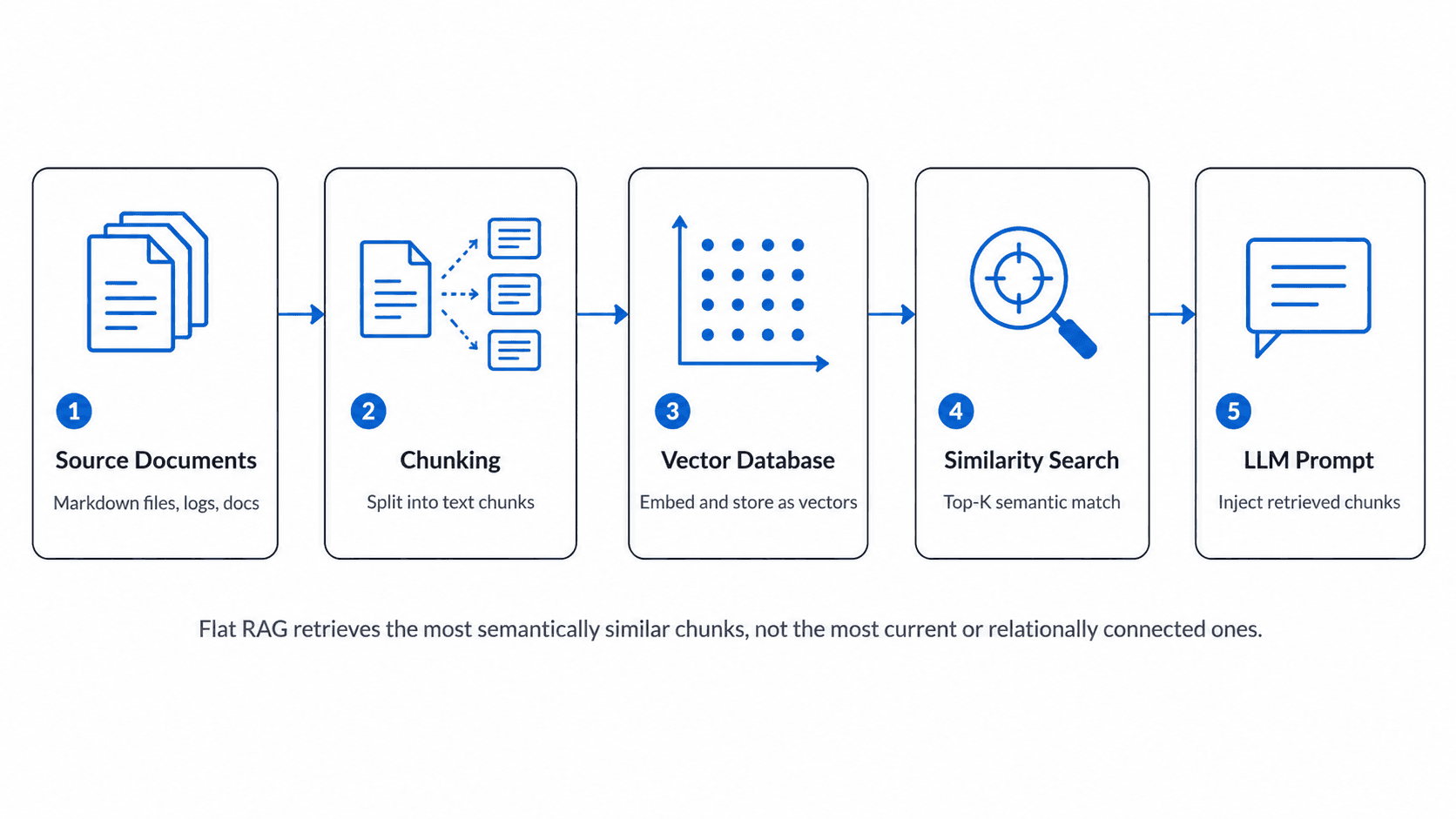
This architecture involves chunking markdown files, historical logs, and static documents into embeddings. These numerical chunks get stored in vector databases like Pinecone, Qdrant, or Weaviate. The system then uses semantic similarity search to retrieve only the top-K chunks most relevant to the current user prompt.
When is a vector database the right choice for agent context?
Vector infrastructure makes sense when you're injecting knowledge from massive document libraries for classic question-and-answer functionality.
It's the right choice when your primary goal is reducing token payload size, and the agent doesn't need to understand complex, evolving relationships between different extracted facts.
Benefits of vector search for RAG
Flat retrieval-augmented generation solves the payload size issue by dynamically injecting only relevant context. Every major orchestration framework supports vector search, including LangChain and LlamaIndex.
Vector databases also deliver fast retrieval speeds and cheap storage compared to passing full markdown files on every turn.
Limitations of flat RAG for long-term agent memory
Creating flat chunks discards much of the relationships, provenance, and hierarchy present in the source material.
Vector databases also lack native temporal state. If a user's preference changes, the database holds two conflicting embeddings without knowing which supersedes the other.
This architecture is also weak at multi-hop reasoning, like connecting a Slack message to a Jira ticket and then tracing that connection to an open pull request. That kind of reasoning falls apart.
When should you move beyond flat RAG?
You need to upgrade when your agent reliably retrieves the semantically closest chunk but repeatedly acts on outdated information.
You also need to graduate when your agent has to take actions across multiple applications and understand how entities relate, not just what they mean.
For example, your support agent retrieves a chunk saying a customer is on the Enterprise plan. But the customer downgraded to Starter last week, and a separate chunk recorded that change. The vector database returned the semantically closest match to the query, not the most recent one. The agent then offers Enterprise-only features to a Starter customer. This is the kind of temporal state problem that versioned graph architectures are designed to solve.
If you already know your system needs temporal state tracking, custom ontologies, or multi-agent coordination, skip ahead to Tier 4: Graph-native context infrastructure.
Tier 3: Managed agent memory tools (Mem0, Zep, Supermemory, Letta)
What are managed agent memory tools?
Managed memory layers are out-of-the-box, API-driven memory products such as Mem0, Zep, Supermemory, and Letta. These tools operate as intermediate services that automatically extract memories from conversational exhaust, update underlying profiles, and inject that context back into future sessions.
When should you use a managed memory layer?
These applications work well when fast time-to-market is your highest priority for building generic agent memory, like when deploying a personalized B2C chatbot.
They fit when your team lacks the engineering capacity to build complex extraction and retrieval pipelines, and you don't require strict multi-tenant data isolation or granular control over how ingestion pipelines operate.
Benefits of managed memory layers
Managed memory drastically reduces the boilerplate code required for memory extraction and summarization. These services handle per-user memory partitioning automatically, keeping individual user state separated.
Many newer entrants also include capable built-in temporal features. Zep, for example, uses a temporal knowledge graph to track how specific information changes over successive conversations.
Risks and trade-offs of managed memory tools
The primary trade-off is control. These tools handle extraction, conflict resolution, and deployment behind vendor infrastructure, which limits visibility into cost, accuracy, and how memories get merged or forgotten.
Compare these constraints against what infrastructure-level control provides:
Capability | Managed memory apps | Graph-native infrastructure |
|---|---|---|
Pipeline control | Vendor-managed extraction on every message | You define extraction triggers and logic |
Temporal state | Basic to vendor-dependent | Native versioning with valid_from, supersedes |
Ontology ownership | Predefined schema | Bring your own domain model |
Conflict resolution | Opaque merge logic | Explicit rules you control |
Deployment options | Mostly cloud-hosted | Self-hosted, VPC-isolated, or cloud |
Cost visibility | Opaque per-message pricing with baked-in LLM costs | Storage-based pricing, no hidden extraction fees |
If your team has strict data governance requirements, verify whether your context infrastructure supports self-hosted, single-tenant, or VPC-isolated deployment before committing sensitive operational context.
When do you need infrastructure instead of a memory app?
You should graduate from managed memory apps when your core product actually is the context itself, like proprietary company brains, enterprise ontologies, and deep multi-agent orchestrations.
If you need to model custom relationships, enforce granular role-based permissions, and manage evolving state using a domain-specific schema, you need underlying infrastructure rather than a generic memory application.
Why the 'vector DB + routing + memory app' stack breaks down
When engineering teams hit the operational limits of flat markdown files, common industry advice tells them to build a complex Frankenstein stack. Deploy vector retrieval to replace flat files, write a dynamic context-routing layer for just-in-time injection, and integrate a third-party agentic memory service for long-term state.
These capabilities don't have to come from three separate products. A unified graph-native context layer combines entity resolution, temporal state tracking, and multi-signal retrieval in a single infrastructure layer, removing the fragile glue code needed to stitch together separate databases and external APIs.
Architecture comparison: Fragmented stack vs. unified context graph
The fragmented stack: You have to integrate and maintain three separate systems: a vector database, a Python routing script, and a managed memory API.
The unified substrate: Graph-native context infrastructure combines retrieval, temporal state, and entity relationships in one layer.
When you model knowledge as versioned, time-aware state, you reduce synchronization failures and the latency boundaries that cripple multi-agent systems.
Tier 4: Graph-native context infrastructure for stateful agents
What is graph-native context infrastructure?
Graph-native context infrastructure, like HydraDB, represents the foundational database layer for stateful AI. HydraDB is a graph-native database built on object storage, designed for high-throughput AI context workloads.
Rather than flattening data into isolated embeddings or hiding data behind black-box memory services, graph-native infrastructure treats context as a strictly defined graph of entities, relationships, events, decisions, and temporal history.
When should you use a context graph for agent memory?
This tier is mandatory when building stateful AI applications that require complete ontology ownership, like proprietary company brains or cross-app autonomous agents.
Graph-native infrastructure makes sense when you require multi-signal retrieval, which combines graph traversal, metadata filtering, semantic search, and temporal queries to help agents act on the current state.
It's also the right choice for enterprise teams building an in-house memory layer that needs a durable, scalable database substrate.
Benefits of graph-native context for temporal and relational memory
The defining advantage is bringing your own ontology. You model relationships, permissions, and workflows as they exist in your specific business domain.
Graph infrastructure also provides strong temporal state handling. Agents natively query what changed, when, and why. This capability is grounded by HydraDB's LongMemEval-s benchmark results, which show 90.79% overall accuracy, 90.97% temporal reasoning, and 97.4% knowledge update.
Building this infrastructure on object storage makes it economically viable at massive scale as your contextual data grows.
Graph-native infrastructure can also model provenance and permissions as first-class properties of the context graph, giving teams the primitives to enforce access control, isolate context per tenant and sub-tenant, and prevent untrusted inputs from overwriting shared system state.
Trade-offs of graph-native context infrastructure
Deploying graph-native infrastructure means modeling your domain and ontology as part of standard integration. Teams building for stateful retrieval anticipate this architectural shift rather than treating it as overhead, because it is what lets the system enforce structure, permissions, and temporal state that schemaless tools cannot.
Graph infrastructure isn't a simple drop-in memory application. It's foundational database infrastructure that requires dedicated system integration.
Total cost of ownership at scale for graph-native context
By treating context as a core database primitive rather than an application-layer service, graph infrastructure can reduce the operational overhead of stitching together multiple managed services, each with its own cost model and extraction logic.
Consider what the fragmented stack costs at scale. A managed vector database charges per embedding stored and per query. A context-routing layer requires compute for every agent invocation. A managed memory API charges per API call, with LLM extraction costs baked into opaque per-message pricing. Each service adds its own latency boundary, monitoring overhead, and vendor contract.
Graph-native infrastructure built on object storage consolidates these into a single cost dimension: storage. Object storage runs roughly 5x cheaper per GB than traditional database storage ($0.023/GB/month for S3 Standard vs. $0.115/GB/month for RDS), and scales linearly without requiring index rebuilds or shard rebalancing. When context volume grows from gigabytes to terabytes, that unit-economics gap compounds.
How to choose the right AI agent memory architecture
Selecting the correct context architecture early in your development cycle prevents costly database migrations later.
If your active context stays under a few thousand tokens, is static, and operates within a single developer session, stick with plain text markdown files.
If you're building static knowledge bases from PDFs with no requirement for complex relationship tracking or state updates, deploy a standard vector database.
For generic chat interfaces and straightforward copilots that need fast, out-of-the-box user-preference memory, managed memory applications provide the most efficient path to market.
But if you're orchestrating complex multi-agent systems, company brains, or cross-app agents that require custom ontologies, high temporal accuracy, and rigorous role-based access control, you need graph-native context infrastructure.
Comparison table: Markdown vs RAG vs managed memory vs context graph
Architecture | Best for | Ontology control | Temporal state tracking | Security & provenance | Retrieval method | Infrastructure cost at scale |
|---|---|---|---|---|---|---|
Plain text markdown | Single-session, static rules | None | No | None | Full file injection | Token-heavy |
Vector DBs (RAG) | Static document Q&A | None | Poor | Low | Semantic search | Grows with embedding volume |
Managed memory apps | Generic B2C chat memory | Medium | Basic to Advanced (Vendor-dependent) | Medium | Vendor-managed hybrid | Variable API cost |
Graph-native infra | Multi-agent, company brains | High | Advanced | High (RBAC) | Multi-signal (graph + semantic) | Object-storage economics (~5x cheaper per GB than traditional DB storage) |
How to migrate from AGENTS.md to a context graph
Moving from brittle manual text files to a durable context graph requires fundamentally shifting how you model, store, and retrieve agent instructions.
Schema shift: From markdown rules to versioned graph nodes
Brittle AGENTS.md snippet:
Context graph node schema definition:
Step 1: Extract rules and map them to an ontology
Stop treating your CLAUDE.md file as a single, unmanageable text blob.
Parse your existing rules into discrete, typed entities, such as a coding standard, an API route, or a user preference. Once isolated, define the causal and hierarchical relationships between them.
HydraDB's core concepts documentation covers how to model these entities as nodes and relationships in a context graph.
Step 2: Ingest data and build hybrid indexes
Move historical session data and your extracted markdown rules into the graph database.
Build hybrid indexes that combine node metadata, temporal markers, and vector embeddings so rules are searchable across multiple dimensions.
HydraDB's quickstart guide walks through ingestion using the Python or TypeScript SDK.
Step 3: Route retrieval with just-in-time context queries
Replace the hardcoded file injection step currently living inside your orchestration framework.
Instead of passing an entire file blindly in LangChain or AutoGen, implement a dynamic query step directly before model invocation. Your application layer should execute a multi-signal query that fetches only the active, non-deprecated rules related to the current task before constructing the prompt.
HydraDB's recall API handles this multi-signal retrieval in a single query, combining graph traversal, semantic search, and temporal filtering.
Step 4: Write continuous updates as temporal events
Implement a continuous extraction loop where agent actions, system outcomes, and user feedback get written back to the graph as new event nodes.
When a rule changes, you write a new node instead of manually deleting underlying text. This naturally deprecates older rules via temporal state updates. You maintain a complete, auditable history of how your system's rules have evolved without destroying previous context.
Key takeaways: Choosing and scaling AI agent memory
Markdown files are fantastic starting points for rapid prototyping, but they're not production infrastructure for stateful AI.
As token payloads grow and multi-agent systems interact, relying on flat text inevitably causes context rot and multi-tenant state collisions.
And don't default to building a fragmented Frankenstein stack if your core product requires the deep relationship mapping of a unified context graph.
Evaluate your current token payload carefully, calculate how many tokens you're wasting on injecting static text, and track how often your agents hallucinate due to outdated context retrieval.
If you need to own the ontology and manage temporal state for complex workflows, explore HydraDB. Built on object storage, HydraDB delivers fast, economical graph-native context infrastructure for stateful AI applications.
Related reading
Best Neo4j Alternatives in 2026: An Honest Developer's Guide
Agents Are Just State Machines: Rethinking Memory as an Immutable Event Log
How To Build A Company Brain For Your AI Agent In 30 Minutes
Every AI Company Needs a Context Graph. None of Them Need the Same One.
FAQ
What is the best memory system for AI agents in 2026?
The best system depends on the workload: use markdown for small static rules, vector RAG for static document Q&A, managed memory apps for fast generic user memory, and graph-native context infrastructure when you need temporal state, permissions, and custom ontologies for multi-agent systems.
When should I move beyond AGENTS.md or CLAUDE.md?
Move on when prompts regularly exceed a few thousand tokens, the model ignores mid-prompt rules ("lost-in-the-middle"), or you need cross-session and multi-agent shared state without conflicts.
Are vector databases enough for agent memory?
Vector DBs retrieve relevant text well, but they don't reliably handle time/versioning, conflict resolution, or entity relationships, which stateful agents commonly require.
What's the difference between RAG and agent memory?
RAG retrieves external knowledge to answer a question, while agent memory must track state over time (preferences, decisions, tool outcomes) and ensure the agent acts on the current truth.
When should I use a managed memory tool like Mem0 or Zep?
Use managed memory when you want fast time-to-market with a predefined memory model and don't need deep control over ingestion, conflict resolution, or enterprise-grade isolation/governance.
Why use a graph for AI agent context?
Graphs preserve relationships (who/what/depends-on), support multi-hop retrieval, and can model temporal changes so agents query the latest valid state instead of conflicting historical snippets.
How do I store temporal state so agents don't use outdated instructions?
Store instructions and facts as versioned records with timestamps (e.g., valid_from, supersedes) and query only the currently active nodes for the task.
What's the simplest migration path from markdown prompts to a context graph?
Extract rules into typed entities, ingest them into the graph with metadata and timestamps, add just-in-time retrieval before each model call, and write new events/updates back as append-only changes.
How do I prevent prompt injection or memory poisoning in long-term memory?
Use provenance, role-based permissions, and write policies so untrusted user inputs can't overwrite global rules. Store user claims as separate, attributed events rather than "truth."
Do I need graph-native infrastructure if I only have a chatbot?
Not usually. If you only need lightweight personalization, a managed memory layer or simple storage can work. Graph-native context infrastructure becomes important when you're building products that require multi-agent workflows, tool coordination, auditable evolving state, or a custom domain model. In those cases, context is core infrastructure, not a feature checkbox.