Semantic Memory for AI: How Agents Understand Context Like Humans
Humans don't remember every word spoken to us. We extract meaning, relationships, and patterns. When your friend says "I love that Italian place downtown," you don't store audio waveforms—you link preferences, cuisines, and locations. This is how your brain works. This is how semantic memory in AI should work too.
Most AI agents today are pattern-matching machines. They ingest tokens, compare probabilities, and output text. But they forget context between conversations. They miss relationships across data. They can't reason about what wasn't explicitly stated. The solution isn't more parameters or longer context windows—it's teaching agents to build and navigate semantic memory the way humans do.
Semantic memory is the difference between an AI that answers questions and an AI that understands your world. It's the layer that transforms stateless chatbots into reasoning partners. In this article, I'll walk you through how semantic memory works, why it matters for AI agents, and how to build systems that leverage it.
What Is Semantic Memory?
Semantic memory is where meaning lives. It's not about storing raw information—it's about storing relationships, concepts, and patterns that enable reasoning. In humans, semantic memory is why you know Paris is a capital city without remembering when you learned it. In AI agents, it's the difference between lookup and understanding.
Beyond Raw Storage—Episodic Memory vs Semantic Memory
Here's the distinction that matters: Episodic memory stores specific events. "User X booked a flight to Paris last month." Semantic memory stores generalized facts. "Paris is a European capital."
Episodic memory is temporal and contextual. It answers "what happened?" Semantic memory is abstract and timeless. It answers "what is true?"
For AI agents, both types matter. Episodic memory (often implemented as conversation logs) gives you event context. Semantic memory (implemented as knowledge graphs or embeddings) gives you reasoning power. Most modern systems focus on episodic memory—logging every interaction—and ignore the semantic layer. That's why they can't connect dots across conversations or reason about unstated facts.
Semantic vs Syntactic—Meaning vs Characters
Here's the gap most databases miss. Syntactic storage is character-by-character. "John loves pizza" is stored as a string: J-O-H-N-L-O-V-E-S-P-I-Z-Z-A. Semantic storage extracts relationships: {person: John} {preference: loves} {object: pizza}.
This distinction changes everything. With syntactic storage, your AI can only search for exact character matches. With semantic storage, it can reason. It understands that John probably enjoys Italian restaurants. It knows pizza is food. It grasps the unstated preference pattern.
Real semantic memory breaks text into entities (people, places, concepts) and relationships (loves, works_at, depends_on). Then it links them in a way that enables multi-hop reasoning.
Why Agents Need Semantic Memory
Three reasons semantic memory is non-negotiable for modern agents:
Reasoning across disconnected facts. Your agent has 50 customer conversations. One mentions "Sarah prefers low-cost options." Another mentions "Sarah works in tech." Semantic memory links these. It surfaces that tech workers with budget constraints might care about your pricing tier.
Generalizing from examples. Episodic memory is isolated. "User X liked product A." Semantic memory generalizes: "Users in X industry like products with A feature." This is how your agent moves from memorization to insight.
Understanding implicit context. A customer says "we moved offices." Semantic memory extracts entities and relationships. It updates the knowledge graph. Next time you mention their address, your agent already knows they moved. It doesn't repeat outdated information.
Without semantic memory, every conversation is starting from scratch.
How Semantic Memory Works in AI
The technical layer. Three components make semantic memory work: embeddings, knowledge graphs, and graph traversal. Most projects get one or two right. The best ones combine all three.
Vector Embeddings as Semantic Space
An embedding is a way to represent meaning as numbers. Imagine a 768-dimensional space where each dimension captures some aspect of meaning—sentiment, topic, entity type, relationship strength. "John loves pizza" becomes a point in that space.
Here's the magic: similar meanings are close together. "Sarah enjoys Italian food" maps nearby. "Mike dislikes pizza" maps far away. This enables semantic similarity search: find meanings close to your query without exact matches.
LLMs use embeddings internally. But most teams don't extract and store them. They process text, generate embeddings, then throw them away. Semantic memory systems keep them, index them, and enable similarity search across historical context.
Most production embeddings are 768-4096 dimensions. More dimensions capture finer nuance but cost more to store and search. The vector space itself becomes a form of long-term memory. It's searchable, scalable, and enables approximate matching—crucial when you're reasoning about concepts, not facts.
Knowledge Graphs as Relationship Maps
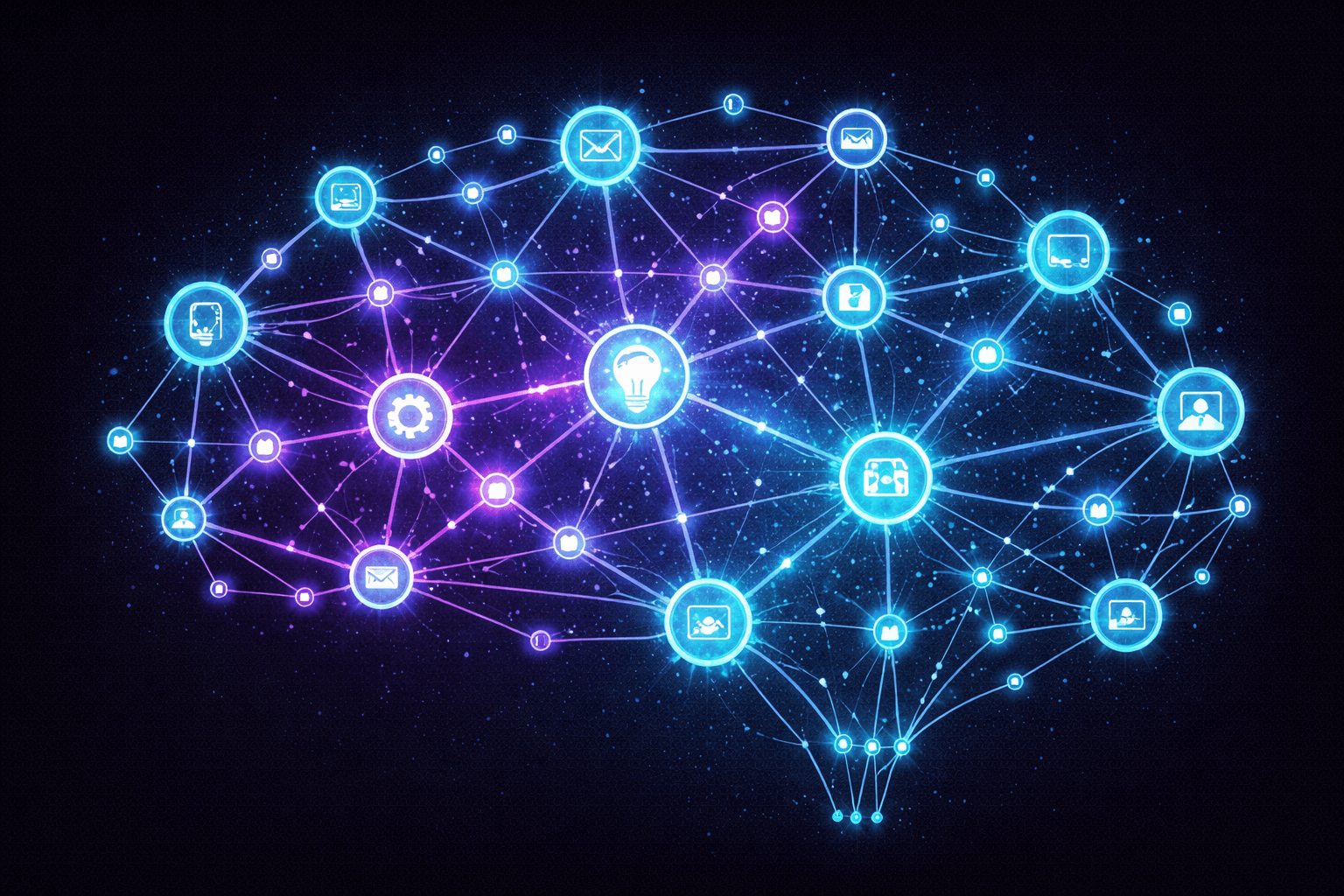
A knowledge graph is a network. Entities are nodes. Relationships are edges. Properties decorate both.
Example: Your support agent has handled 1,000 tickets. A new customer asks about downtime. With episodic memory alone, you search the ticket log. With a knowledge graph, you traverse: Customer → reports → Issue → impacts → Feature → depends_on → Infrastructure. You surface related downtime patterns the customer didn't ask about.
Knowledge graphs excel at multi-hop reasoning. They're transparent—you can see why the agent recommended something. And they scale: adding new entities or relationships doesn't degrade performance the way adding new training data does.
The downside: knowledge graphs require structure. You have to define entity types and relationship types upfront. They're less flexible than raw embeddings. This is where context graphs come in.
Context Graphs—HydraDB's Approach
Context graphs automate the painful part. Instead of manually defining ontology, they extract entities and relationships from raw text using LLMs. They organize them hierarchically. They maintain temporal evolution—tracking when facts changed. And they support multi-modal recall: find information by semantic similarity, recency, relationship strength, or explicit traversal.
Context graphs are knowledge graphs optimized for AI agent consumption. They reduce hallucinations by grounding responses in extracted facts. They reduce token bloat by selecting relevant context dynamically. And they enable agents to reason the way humans do—linking concepts across time and conversations.
Unlike static knowledge graphs, context graphs track how facts evolve. They maintain provenance—where each fact came from. They support both prescribed ontology (you define entity types upfront) and learned ontology (the system discovers patterns). When you ask your agent a question, it doesn't retrieve all historical data—it assembles the relevant context graph on-the-fly.
HydraDB's approach includes automatic entity deduplication, relationship inference, and temporal tracking. The system learns that "Michael Johnson" and "Mike Johnson" refer to the same person. It infers relationships: if A depends_on B and B depends_on C, then A indirectly depends_on C. It tracks temporal provenance: this fact was true in March, updated in June.
This is what production semantic memory looks like.
Building Semantic Memory Systems
The process is four steps: extract, structure, query, and evolve. Each step builds on the last.
Step 1: Extract and Embed
Parse your conversation, documents, or logs for entities. Tools like spaCy identify named entities (people, organizations, locations) automatically. Sentence-transformers generate embeddings for each sentence or entity mention.
You end up with structured data: entities with embeddings, ready for storage and search. This is the foundation.
Step 2: Build Relationships
Entities alone don't create meaning. Relationships do. Use an LLM or rule-based extraction to identify relationships. "John works at Microsoft" → entities: {John, Microsoft}, relationship: {type: "works_at"}.
Define your relationship types based on your domain. Support agents might track {reported_issue, resolved_issue, customer_feedback}. Coding assistants might track {imports_from, depends_on, implements}. These types become searchable.
Step 3: Query with Semantics
When your agent needs context, convert the query to an embedding. Search your embedding index for semantically similar entities. Then traverse relationships to find connected context. Optionally combine with recency scoring—recent facts usually matter more.
This is where graph databases shine. Neo4j, Memgraph, or specialized graph stores like Zep enable efficient traversal. You're not scanning your whole memory—you're walking the relevant path.
Step 4: Learn and Evolve
Semantic memory isn't static. Merge duplicate entities over time (the system learns "Michael" and "Mike" refer to the same person). Update embeddings as context deepens. Track temporal evolution—did preferences shift? Did relationships change?
This is the difference between static knowledge bases and living semantic memory. Your system improves as it processes more data.
Real-World Semantic Memory Applications
Three use cases where semantic memory transforms agent capability:
Recommendation Systems
Store customer preferences semantically—not just "User liked Product A," but why. Extract features: price point, category, brand, review sentiment. Embed them in semantic space.
When recommending, find products with similar feature embeddings. Then reason about unstated preferences. "This customer likes premium brands under $100. This product is premium but $150. But I see they're price-sensitive in tech products specifically. I'll flag the price but recommend it."
Semantic memory turns crude collaborative filtering into nuanced reasoning.
Support Agents
Support is where semantic memory shines. A new ticket lands. Extract entities: customer, product, issue type, urgency. Query your context graph for similar issues this customer reported. Surface patterns: "You've had three connection issues in the past month. Let me check your infrastructure dependencies."
Connect episodic memory (ticket history) with semantic memory (issue patterns, customer profile, product architecture). The agent becomes genuinely helpful, not just searching a database.
Coding Assistants
Coding assistants need context about your project—imports, dependencies, architectural patterns, naming conventions. Episodic memory logs every file you've opened. Semantic memory extracts structure: which modules depend on which, what patterns you prefer, where you've added custom logic.
When you ask for help, the assistant traverses your code's semantic graph. It finds related functions, consistent patterns, and implicit constraints. It's not just autocomplete—it's architectural understanding.
Semantic Memory vs Traditional Retrieval
The comparison that matters: semantic memory vs RAG (Retrieval-Augmented Generation).
RAG—Keyword and Semantic Search for Documents
RAG is a retrieval layer. You index documents, embed them, then retrieve relevant chunks when answering queries. It's fantastic for knowledge bases: find the exact paragraph about your product's refund policy.
RAG is fast, simple, and works well for lookup tasks. Limitations: it doesn't extract relationships across documents. It can't reason about what wasn't explicitly written. If your policy says "14-day refund window" and your shipping docs say "2-3 days to arrive," RAG won't automatically conclude "customers effectively have 11-17 days."
Semantic Memory Systems
Semantic memory extracts meaning and relationships across all interactions. It's better for long-term understanding, complex reasoning, and cross-domain patterns. Limitations: it requires upfront structure. You need to define what matters—entity types, relationship types, domain concepts.
When to Use Each
Use RAG for knowledge base lookups. "What's your pricing?" Use semantic memory for understanding. "What products suit this customer's constraints?" The best systems use both: RAG retrieves initial context, semantic memory reasons about it.
Frequently Asked Questions
Isn't this just a fancy database?
Not quite. A database stores and retrieves data. Semantic memory extracts meaning, links concepts, and enables reasoning. You could build it on top of a database, but the extraction and reasoning layer is what matters. Databases alone don't do semantic reasoning—agents do.
How much does semantic memory cost?
It depends on scale. For small teams, open-source tools like spaCy and Neo4j Community Edition are free. For production systems, you're paying for storage, embeddings (if using external APIs), and graph traversal. Semantic memory is usually cheaper than retraining models or adding context windows—you're just organizing existing data smarter.
Can semantic memory hallucinate?
Yes, but less often. Semantic memory grounds responses in extracted facts. It's harder to hallucinate when your context came from parsed entities and validated relationships. But LLMs can still misinterpret text or misidentify relationships. The solution: validate extracted facts before storing them, and surface your reasoning so users can verify.
The Future of Agent Intelligence
Semantic memory is how AI agents move from pattern matching to understanding. According to VentureBeat's 2026 enterprise AI predictions, contextual memory will become table stakes for operational agentic AI—not a novelty, but an expectation. Agents that track context across interactions will outcompete stateless models.
The technical stack is clear: embeddings for semantic similarity, knowledge graphs for relationships, and graph traversal for reasoning. Tools like Graphiti and Zep are building this layer. But the real differentiator is how you extract entities, maintain relationships, and serve context to your agent.
The agents that win won't be the ones with the most parameters. They'll be the ones that understand their users, remember patterns, and reason across time. That's semantic memory.
Why Semantic Memory Matters Now
Modern LLMs make it cheap and fast to parse unstructured data—conversations, emails, documents, logs—and extract what matters. Five years ago, building a knowledge graph meant hiring engineers to manually define schema. Today, LLMs do semantic extraction automatically.
For teams building production AI agents, semantic memory isn't optional anymore. Your users expect context. They expect the agent to remember preferences, constraints, and past issues. Without it, you're rebuilding context in every conversation—expensive in tokens, frustrating for users.
The competitive advantage goes to teams that combine episodic memory (what happened) with semantic memory (what it means). That's how you build agents that understand instead of just pattern-match.
Implementation Challenges
Building semantic memory systems is straightforward in concept, messy in practice. Real challenges:
Entity deduplication. "Michael Smith," "Mike Smith," "Michael S." all refer to the same person. Your system has to learn this. Start with fuzzy matching on name+context, escalate to manual review for borderline cases, track confidence scores.
Relationship validation. LLMs extract relationships but hallucinate. Your best defense: validate against ground truth (internal CRM, knowledge base). For uncertain relationships, surface them with confidence scores.
Temporal decay. Facts change. "Sarah is VP of Engineering" becomes "Sarah is CTO." Track temporal provenance—when was this fact extracted? What's the most recent version?
Scaling embeddings. As your memory grows to millions of entities, search gets slow. Use approximate nearest neighbor search, partition your vector space, or hierarchical clustering.
Integrating with RAG. Most teams want both. RAG retrieves document chunks, semantic memory retrieves entity context. Combine intelligently.
These are solvable problems but require planning.
Semantic Memory in Practice
Teams deploying semantic memory in 2026 share patterns. From research on AI agent memory:
Small, quality datasets beat large, messy ones. A graph with 1,000 validated entities outperforms 100,000 noisy ones. Start small, validate aggressively, scale carefully.
Temporal context matters. "Recent" usually beats "relevant." Combine semantic similarity with recency scoring. Weight recent facts higher in graph traversal.
Transparency builds trust. Show users how the agent assembled context. "I found this based on your past purchases and budget." Agents that explain reasoning get more trust.
Active learning works. When uncertain, ask users for clarification. Store feedback as training signal. Your memory improves with every interaction.
Want to build semantic memory systems for your AI agents? HydraDB provides context graphs optimized for agent reasoning. Start with our open-source tools or explore our enterprise platform.