9 min
Best shared memory layers for ChatGPT, Claude, and AI agents in 2026
Manveer Chawla
Updated on :

Multiple AI agents increasingly share one workflow. You might use Cursor or VS Code for application logic, Claude for architectural brainstorming, and ChatGPT for data analysis. Each tool has its own memory features, but those stay within their supported scopes, so context doesn't move on its own between the interfaces you use.
An external shared context store is one way to address that gap by connecting your agents through supported connectors or MCP. MCP standardizes tool exchange and defines an optional authorization framework for HTTP transports, but it doesn't supply the store itself, memory policy, or conflict resolution.
That leaves you to decide what it stores, how fresh it stays, who can update it, and how it enforces access to sensitive knowledge. This guide compares your options so you can match the architecture to the context you need to share.
Key takeaways: best shared memory layers for AI agents
Choose the best shared memory layer for AI agents based on the context you need to share.
Notion MCP: For team policies, project notes, and shared documentation you need people to inspect and edit.
Mem0, Zep, or Supermemory: For packaged agent memory and recall. Compare each product’s identity scopes, update behavior, deletion controls, and deployment options.
Git-backed Markdown: For engineering docs, prompts, and runbooks where reviewable changes and version history matter more than immediate updates.
SQLite or Postgres behind a custom MCP server: For structured records with control over schemas, queries, access policies, and deployment.
HydraDB: For company brains and shared context graphs where multi-hop relationships, provenance, and changing state shape retrieval.
Before committing, confirm that every agent you plan to use can connect on the required plans and use the necessary read and write tools.
Shared memory layer comparison for ChatGPT, Claude, and AI agents
Setup effort estimates the work to connect two agents and get a basic governance model in place. Relational and temporal depth describes native modeling and query support, not measured retrieval quality.
Approach | Best for | Setup effort | Client coverage | Storage model | Write governance | Portability and self-hosting | Relational and temporal depth |
|---|---|---|---|---|---|---|---|
Notion with official Notion MCP | Human-readable team knowledge and lightweight shared context | Low | Depends on client support, plan, and connector surface | Pages, databases, blocks | Aligns with existing Notion permissions, MCP write tools, and admin controls | Partial. Export and workspace portability depend on Notion capabilities | Limited. Page and database-centric |
Agent-memory services (Mem0, Zep, Supermemory) | Turnkey personal or agent memory with opinionated retrieval and update behavior | Low to medium | Varies by vendor and managed MCP path | Vendor-defined memory objects, sessions, users, spaces, or graphs | Vendor-specific and reliant on vendor scoping, read-only modes, and write controls | Varies materially by vendor export, backup, and self-hosting capabilities | Varies by vendor and requires evaluating policy and data-model fit |
Git-backed Markdown repository | Engineering docs, prompts, runbooks, and auditable context | Medium | Depends on client transport support | Versioned text files | Pull-request review can govern writes when branch protection and reviewer rules are configured | Supports plain text and Git-compatible workflows. Host metadata and non-text assets need separate migration planning | Low unless paired with an external indexing or graph layer |
DIY MCP over SQLite or Postgres | Structured application context, data residency, and custom policy | High | Depends on a custom MCP server and client support | Relational tables with optional vector extensions | Application-owned tool and policy layer. PostgreSQL can enforce RLS. SQLite policy normally sits in the service | Supports self-hosted or portable standard-database deployments | Relational SQL supports recursive traversal. Graph-native systems can reduce modeling and query work for dense or variable-depth paths |
HydraDB-backed context graph via MCP plugin | Relationship-aware context, multi-hop retrieval, and provenance | High | Depends on client surface, transport, and plan | Distributed graph database built on S3-compatible object storage | Application owns principal mapping, ontology semantics, approval workflows, and compliance controls | AGPL-3.0 open core: self-hostable. Enterprise: BYOC or fully self-hosted. Scale: option to self-host under license | Supports graph relationships, changing state, and GraphRAG retrieval |
How shared AI memory works across agents
A shared memory architecture moves durable state out of individual AI agents and into a central system.
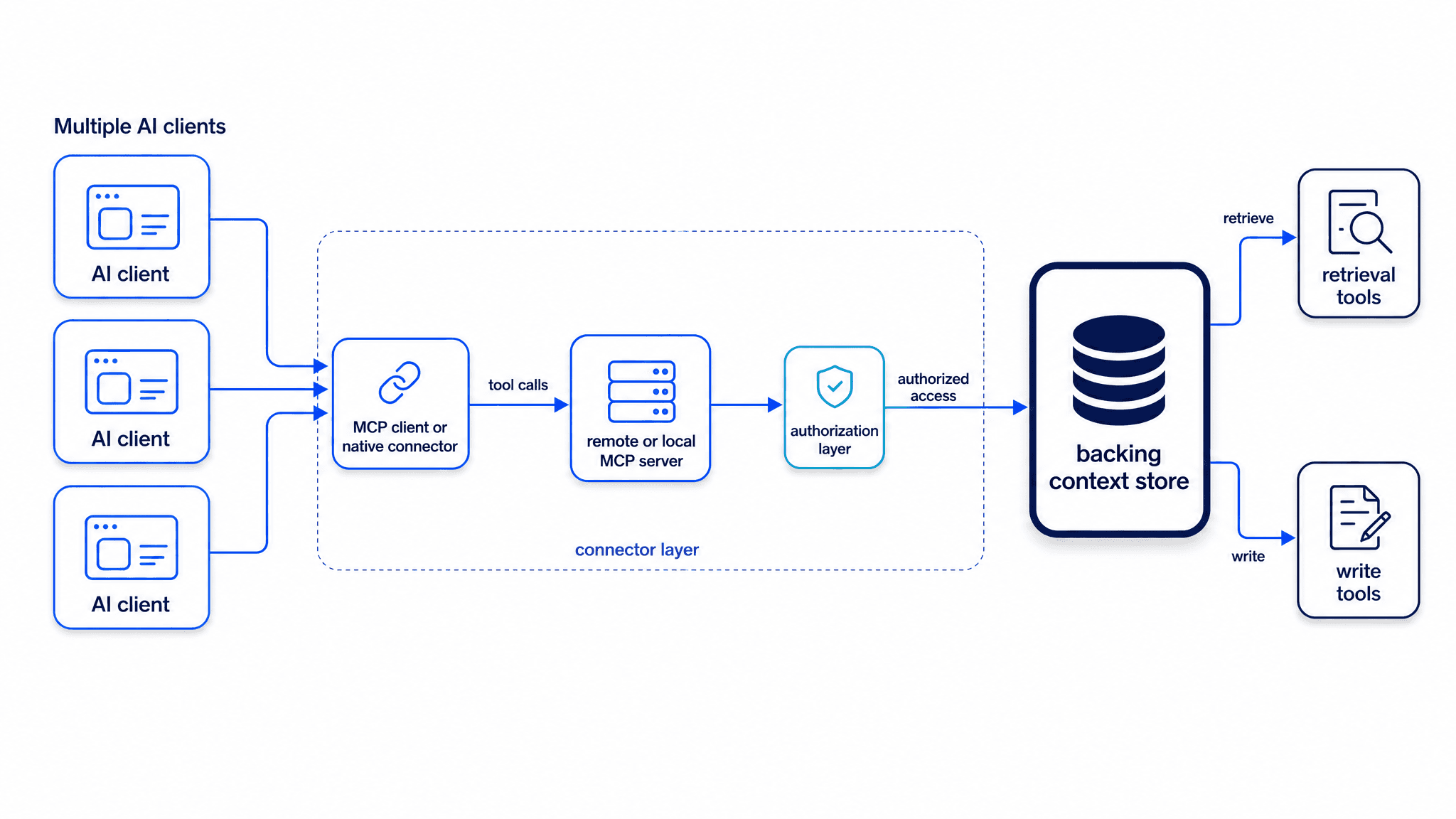
The AI client must support the required connector and transport. The server then gives the agent tools to search, read, create, update, delete, summarize, or propose changes to information. The backing store determines how it saves, organizes, consolidates, and removes that information.
MCP facilitates tool calls between the client and server. Its optional HTTP authorization flow can standardize part of the connection, but you still need to map authenticated users and clients to application identities. You are also responsible for memory policies, resource permissions, synchronization, conflict handling, and deletion.
The architecture you choose shapes how your organization stores, accesses, and governs shared AI context.
Connector and client requirements for shared AI memory
Whether you can use a shared memory layer depends on the agent, interface, plan, and transport. ChatGPT can connect to remote custom MCP apps, though write support is restricted by plan and surface. Claude also supports custom remote MCP servers across its current plans, but organization and plan controls still apply.
Shared memory compatibility by agent and vendor
Approach or vendor | MCP client coverage | Important boundary |
|---|---|---|
Notion MCP | Notion MCP supports ChatGPT, Claude, Cursor, Codex, and VS Code. Other compliant clients can use its hosted endpoint | Access is bounded by Notion workspace permissions and the page, database, and block data model. |
Mem0 | The Mem0 MCP server supports Claude, Claude Code, Codex, Cursor, Windsurf, VS Code, and OpenCode | Memory behavior and scoping follow Mem0's memory model. Self-hosted workflows use Mem0 Open Source rather than the managed MCP service. |
Zep | The Zep MCP server supports Claude, ChatGPT, Claude Code, Codex, Cursor, and other compatible remote clients | Writes are enabled by default. Administrators can enforce read-only mode or disable writes. |
Supermemory | The Supermemory MCP server supports ChatGPT, Claude, Cursor, Windsurf, VS Code, and other compatible remote MCP clients | Memory access and organization follow Supermemory's spaces and identity model. Self-hosting is available on Scale tiers. |
Git-backed Markdown | Coverage depends on the selected filesystem or Git MCP server and each client's supported transport | Git provides the store and version history. The selected MCP server determines retrieval tools, authentication, and write behavior. |
DIY MCP over SQLite/Postgres | Any client compatible with the custom server's transport and authentication | Authentication, memory behavior, and client compatibility are application-owned rather than database features. |
HydraDB MCP plugin | The HydraDB MCP plugin supports Claude Code, Claude Desktop, Cursor, VS Code, OpenCode, Codex, and Windsurf | HydraDB scopes MCP tools by database and, where applicable, collection; per-fact authorization, ontology semantics, and domain policy remain application-owned. |
Agent connector restrictions by product and plan
Product and client | Current availability | Transport and surface boundary | Control boundary |
|---|---|---|---|
ChatGPT custom MCP apps | Business, Enterprise, and Education have full MCP read/write beta access. Pro custom apps are read/fetch-only. Plus is not listed | Remote custom servers on ChatGPT web. Agent mode doesn't use custom apps, and deep research limits them to read/fetch | Workspace administration, RBAC where documented, and possible user confirmation for write actions |
Claude custom remote connectors | Free, Pro, Max, Team, and Enterprise. Free is limited to one connector | Remote connectors are available from Claude web, mobile, Cowork, and Desktop | Team and Enterprise owners add connectors. Users still authorize connections and tool actions |
Claude local MCP | Claude Desktop and Claude Code | Local STDIO servers and Desktop extensions run on the user's machine | Local client configuration and tool permissions apply |
Claude API MCP connector | Available through the Claude API's MCP connector | Remote HTTP from API workflows | The API caller owns credentials, tool configuration, and application policy |
Codex MCP | Codex CLI and IDE workflows | Local STDIO or remote streamable HTTP servers configured at user or project scope | Codex sandbox, approval, and MCP configuration govern tool use |
How to evaluate shared memory layers for AI agents
Evaluation criteria for shared AI memory layers
Agent coverage: Support for the agents you use, subject to specific plan, transport, admin, and interface restrictions.
Freshness and sync drift: How quickly one agent can retrieve another agent’s update and how the system handles conflicting changes.
Scope and isolation: The available context boundaries, including personal, team, workspace, tenant, project, repository, or database scopes, and whether the selected product enforces isolation between them.
Authorization and revocation: Server-side controls that determine which users or clients can read or write specific records, plus the ability to revoke connector or user access when permissions change.
Write governance and auditability: Controls over who or what can create, update, summarize, or delete durable context, including review requirements and records of who made each change, its source, and the resulting state.
Security boundary: Server-side security controls that restrict returned context to the authorized scope, separate retrieval from destructive operations, and reduce the risk of prompt injection and data exfiltration.
Portability and self-hosting: Options for exporting data, migrating schemas, and replacing the underlying layer.
Relational and temporal depth: The ability to represent multi-hop relationships, changing state, source provenance, and time-bound facts.
Compliance boundary: Which data retention and security controls belong to the AI client provider, connector layer, backing store, and application owner.
Which architecture fits each shared context model?
Context pattern | Best-fit architecture | Why |
|---|---|---|
Human-readable policies, notes, project docs, and team knowledge bases | Notion with official Notion MCP | Simple, editable, and visible to non-technical users |
Personal preferences, lightweight recall, or agent and user facts | Agent-memory services | Purpose-built memory APIs and retrieval behavior, varying by vendor |
Engineering docs, prompts, runbooks, and auditable text changes | Git-backed Markdown | Version history, pull-request review, and plain-text portability |
Structured business records or transactional app context | DIY MCP over SQLite or Postgres | Application control over schema, access, and data residency |
Entities, events, documents, relationships, provenance, and temporal state | HydraDB-backed context graph | Relationship-aware infrastructure behind GraphRAG and multi-hop retrieval |
Option 1: Notion MCP for shared AI agent memory
Best use cases for Notion MCP
Teams that already use Notion as their primary knowledge base.
Human-curated shared context that non-technical users need to read, audit, and edit.
Low-friction workflows where the context source needs to remain highly visible.
How Notion MCP works as a shared context layer
Notion provides a standard shared context option. Its official MCP endpoint uses Streamable HTTP at https://mcp.notion.com/mcp, with OAuth authorization.
Once connected, a supported AI client can read and update content accessible in the authorized Notion workspace. Access follows the workspace’s existing permissions. Notion MCP supports ChatGPT, Claude, Cursor, Codex, and VS Code, along with other clients that support remote MCP connections.
Key Notion MCP features for shared memory
OAuth authorization for remote MCP connections.
Pages, databases, and blocks serve as the human-readable system of record.
Tools for searching, reading, creating, and updating accessible content.
Administrators and workspace owners govern connections and manage workspace permissions.
Notion MCP pricing considerations
Notion's current US prices are $10 per member per month for Plus and $20 per member per month for Business when billed annually. Enterprise pricing is custom. Current billing and usage terms are available on the Notion pricing page.
Strengths of Notion MCP for shared AI context
Requires minimal initial setup effort.
Easy for human operators to inspect, review, and correct context.
Fits shared documentation, corporate policies, and lightweight team memory.
Limitations of Notion MCP for AI memory
Notion doesn't offer built-in agent-memory behavior such as automatic fact extraction or semantic filtering. Those functions require another application layer.
Standard Notion API request limits apply across a user's Notion MCP calls, so high-volume multi-client workflows require testing.
Notion MCP exposes Notion's page, database, and block model. Applications that need typed relationship traversal, temporal facts, or memory consolidation must add those behaviors outside Notion MCP.
Option 2: Agent-memory services for shared AI memory
Best use cases for Mem0, Zep, and Supermemory
Teams that want packaged memory behavior instead of building custom extraction, update, and deletion pipelines.
Personal agent recall, user preference management, lightweight agent memory, and developer-tool memory workflows.
Use cases where a vendor's specific data model matches the required scopes and governance controls.
How agent-memory services manage shared agent context
Mem0, Zep, and Supermemory offer packaged memory APIs with managed MCP connections. They differ in data models, identity scopes, write controls, and portability.
Before choosing a service, compare its authentication, deletion controls, export capabilities, self-hosting options, and administrative controls. MCP tools and write behavior also differ across vendors.
Product | Best fit | MCP support | Memory model | Governance notes |
|---|---|---|---|---|
Mem0 | Hosted personal or agent memory, with self-hosted workflows via Mem0 Open Source | Managed hosted MCP at https://mcp.mem0.ai/mcp. Mem0 Open Source provides self-hosted execution | Vendor-defined memory objects and scoping | Offers cloud authorization, scoping, and admin controls. Mem0 Open Source supports self-hosted operation |
Zep | Agent and user memory using temporal and user graph models | Managed MCP at https://api.getzep.com/mcp. OAuth 2.1 with PKCE | Temporal Context Graph and user graphs | Writes are enabled by default. Administrators enforce read-only modes or disable writes |
Supermemory | Shared memory isolating identity, documents, and teams | Managed MCP at https://mcp.supermemory.ai/mcp with OAuth | Spaces, memories, and identity model | Search, add, forget, list, space, and identity tools. Self-hosting on scale tiers |
Key features of packaged agent-memory services
Each service handles memory differently. Mem0 provides managed memory operations, Zep builds temporal context graphs, and Supermemory includes memory, recall, identity, and space tools.
MCP tool sets vary by vendor rather than sharing one contract for searching, updating, and deleting memory.
Identity and scope models vary across users, sessions, projects, spaces, and vendor-defined graph objects.
Authentication, read-only modes, administrative write controls, and deletion behavior vary by product and plan.
Agent-memory service pricing considerations
Mem0's Hobby tier is free. Starter costs $19 per month, Pro costs $249 per month, and Enterprise pricing is custom.
Zep offers a free tier. Flex costs $125 per month, and Flex Plus costs $375 per month.
Supermemory offers a Free plan. Pro costs $19 per month, Max costs $100 per month, and Scale costs $399 per month.
Strengths of agent-memory services for AI agents
Removes the need to design a custom memory stack.
Fits workloads where vendor-supplied memory behavior matters more than low-level storage control, as long as the product's identity, update, and deletion model fits the application.
Reduces engineering work for common memory and recall tasks.
Limitations of packaged agent-memory services
Requires adopting vendor-specific schemas, API behaviors, and governance controls.
Relationship modeling, temporal tracking, and exportability vary widely by vendor.
Portability varies by product and edition. Review the available export and deletion APIs, data-model dependencies, and self-hosting options.
Option 3: Git-backed Markdown for shared AI context
Best use cases for Git-backed Markdown memory
Workflows requiring portable text, reviewable version history, and explicit state-change workflows.
Shared prompt libraries, architecture decision records, runbooks, and documentation used as AI context.
Teams that prioritize human-reviewed write governance over real-time autonomous agent updates.
How Git-backed Markdown works as shared AI context
You can connect AI agents to a Git repository through a filesystem or Git MCP server, creating a shared text-based context layer. Memory exists as version-controlled Markdown or structured text.
Supported clients can index and retrieve the files locally or through a remote server. Repository structure and configuration files help define the operational context available to each agent.
Key features of Git-backed Markdown for AI memory
Commit history is auditable but can be rewritten. Protected branches and repository rules determine how well history is preserved.
Pull requests and required reviewers can govern writes when the repository host and branch rules are configured accordingly.
Git branches separate lines of development, but they are not access-control or data-isolation boundaries.
Markdown reduces content lock-in. Attachments, repository metadata, and host-specific automation can still require separate migration work.
Git-backed Markdown pricing considerations
This approach may add no new software costs when your team already uses Git hosting. Standard platform fees for GitHub, GitLab, or Bitbucket apply.
Strengths of Git-backed Markdown for shared context
Provides data portability and auditability.
Readable to human operators and language models.
Fits stable, documentation-heavy context.
Limitations of Git-backed Markdown for AI memory
Frequent commits, reviews, and indexing can make this approach too slow for memory that updates after every interaction.
Concurrent edits to the same lines can create merge conflicts. Branching, serialization, and file partitioning can reduce them.
Semantic retrieval requires an external search index or retrieval pipeline.
Git doesn't natively provide graph traversal. Applications need an additional index or database for relationship queries.
Option 4: DIY MCP over SQLite or Postgres for shared AI memory
Best use cases for DIY MCP with SQLite or Postgres
Deployments requiring direct control over data residency, schemas, and write policies.
AI context designed to live directly alongside transactional application data.
Structured business records where relational modeling covers the query requirements.
How DIY MCP servers use SQLite or Postgres for context
Your team can build custom MCP servers using official SDKs to expose precise retrieval and write tools to AI clients. For local or single-node requirements, SQLite with the FTS5 extension adds full-text search over stored data. For team and cloud deployments, Postgres provides role-based access control, row-level security, and recursive queries.
Key features of DIY SQL-backed MCP memory
Custom tools can govern specific operations, such as adding project status or updating customer context.
PostgreSQL supports server roles and row-level security. SQLite normally relies on the surrounding MCP service for caller-level policy enforcement.
Both databases support transactions. Backup automation, high availability, and operational security depend on the selected deployment.
Retrieval extensions can add full-text or vector search, but setup and availability vary by database and extension.
DIY MCP infrastructure cost considerations
Costs can include database hosting, server compute, model or embedding usage, observability, backups, network transfer, security operations, and engineering time.
Strengths of SQL-backed MCP memory
Gives the application team direct control over schema design, query behavior, and data-access policy.
Aligns well with structured, transactional enterprise context.
Integrates with existing enterprise identity and data systems.
Limitations of DIY SQL-backed MCP memory
Requires substantial initial and ongoing engineering effort to design, secure, and maintain.
Changes to normalized schemas or constraints may require planned migrations. JSON fields and backward-compatible additions can reduce migration frequency, at the cost of weaker structure.
The application team owns conflict resolution, summarization pipelines, semantic indexing, and deletion semantics.
Recursive SQL can answer multi-hop questions, but dense or variable-depth relationship traversal may require more schema, join, indexing, and query work than a graph-native model.
Option 5: HydraDB-backed context graph for shared AI memory
Best use cases for HydraDB-backed AI memory
Relationship-aware context, graph traversal, and GraphRAG-style retrieval workflows.
Company brains, context graphs, knowledge graphs, and cross-application workflows where entities, events, documents, and actions are closely connected.
Workloads requiring graph database infrastructure while retaining control over application logic, memory policy, authorization, and ontology semantics.
How HydraDB powers graph-based shared AI context
For workloads that repeatedly traverse variable-length relationships and need to preserve changing state and source provenance, graph-native modeling can reduce the join and path-management work required by document or relational designs. HydraDB is an object-store-native graph database. It uses S3-compatible object storage as the durable source of truth and disaggregates compute from storage.
HydraDB's managed platform provides infrastructure behind a shared context or memory layer rather than a turnkey personal memory application, ontology product, or drop-in Neo4j replacement.
HydraDB's open-core graph database supports an OpenCypher subset, Bolt 5.1 through 5.4, and HTTP APIs. The managed platform provides an official remote MCP endpoint with OAuth or API-key authentication and tools scoped by database and, where applicable, collection. hydradb_ingest sends Knowledge or Memories through asynchronous ingestion. hydradb_query retrieves relevant source content and can add related graph context. Separate OpenCypher tools handle graph reads and writes.
Your application still owns per-fact authorization, domain-specific policies, compliance workflows, and regulatory controls. HydraDB provides the execution engine and storage primitives.
Key HydraDB features for graph-based AI memory
Object-store-native distributed graph database architecture.
S3-compatible object storage acts as the durable source of truth, disaggregating storage from compute.
OpenCypher subset, Bolt 5.1 through 5.4 protocol support, and HTTP APIs support query execution.
The HydraDB MCP plugin provides tools for managing memories and retrieving context with optional knowledge-graph enrichment.
Database creation and database-scoped asynchronous ingestion of Knowledge or Memories.
hydradb_query can return graph-enriched context, while separate OpenCypher graph tools handle explicit graph traversal and mutation.
HydraDB pricing considerations
HydraDB's Ship plan is free. Surge costs $25 per month for up to 2 GB of graph storage, with overage at $0.50 per GB per month. Scale costs $399 per month for up to 10 GB of graph storage, with overage at $0.25 per GB per month. Scale also offers an option to self-host under license.
Enterprise pricing is custom and includes BYOC or fully self-hosted deployment. Current plan terms are available on the HydraDB pricing page.
Strengths of HydraDB for shared context graphs
Models entities, events, documents, accounts, actions, and their relationships as a graph.
Fits workloads where repeated multi-hop traversal, changing relational state, and source provenance are core requirements.
The managed platform supplies MCP, ingestion, query, and optional graph-enrichment primitives above the graph-database core.
Limitations of HydraDB for shared AI memory
Introduces unnecessary complexity for small, static, or strictly document-based context layers.
Provides infrastructure and requires a separate application layer for a complete memory experience.
Doesn't function as a finished ontology product or a fully compatible Neo4j replacement.
Requires the surrounding application to implement identity mapping, per-fact authorization, deletion policy, and write-governance design.
Choosing a shared memory layer
Notion fits when a team requires a human-readable context source and already uses Notion for operational documentation.
Agent-memory services fit when a team needs packaged memory APIs, vendor-managed extraction, and a vendor data model that matches its scoping requirements.
Git-backed Markdown fits when shared context is documentation-heavy and heavily reviewed, and when portability matters more than real-time automated updates.
DIY MCP over SQLite or Postgres fits when strict enterprise control, highly structured schemas, data residency, and application-owned policies define the operational limits.
HydraDB-backed graph infrastructure fits when context depends on complex multi-hop relationships, provenance, time-bound facts, and GraphRAG-style retrieval, and the application team is prepared to own the application semantics.
Tests to run before choosing a shared memory layer
Client coverage: Connect at least two target agents, such as ChatGPT and Claude or Cursor and VS Code, using the specific plans, administrative settings, and production interfaces.
Write path and auditability: Confirm which tools can write and whether those writes require user or administrator approval, use pull requests, or allow automated writes. Verify that durable changes record who made them, their source, and the resulting state.
Sync drift: Have one agent write a fact to the context store, then measure how long another agent takes to retrieve the updated context correctly.
Deletion and forget behavior: Validate how the system removes specific raw records, indexes, embeddings, and downstream caches. Confirm the retention and deletion rules for operational logs and backups.
Unauthorized access: Attempt to read or modify context outside the authenticated user's permitted scope and confirm that the backing system rejects the request server-side.
Revocation: Revoke a user's or connector's access and confirm that subsequent reads and writes fail.
Conclusion: choosing a shared AI memory layer
The right option depends on how much control your product needs. A packaged service reduces upfront work when its identity, update, and deletion behavior already fits your application. Infrastructure keeps those decisions within your product, but your team must design and operate the memory layer.
HydraDB provides graph infrastructure for applications where context depends on relationships, provenance, and changing state. Your application still owns domain semantics, memory policy, and write governance.
You can evaluate that fit with a representative context model and two or three questions that require relationship traversal.
Book a HydraDB demo to discuss your retrieval requirements and how HydraDB could fit your architecture.
Frequently asked questions about shared AI memory
What is the best shared memory layer for multiple AI agents?
No universal best option exists. Notion fits editable team knowledge, agent-memory services fit turnkey recall, Git fits auditable engineering docs, SQL fits controlled structured records, and HydraDB fits workloads where graph relationships and provenance drive retrieval quality.
Does MCP provide shared memory by itself?
No. MCP standardizes tool exchange and can define an optional HTTP authorization flow, but it doesn't provide durable memory, synchronization, conflict handling, deletion policy, or application-level resource permissions. Those come from the server, backing store, and surrounding application.
What is an MCP memory server?
An MCP memory server is an MCP server exposing explicit tools for retrieving or writing external context data. The precise memory behavior, schema, and policy enforcement depend entirely on your backing store and application logic, not on the MCP protocol.
How do I share memory between ChatGPT and Claude?
Both agents can connect to the same external context source through supported connectors or MCP servers. The connection requires verification of plan availability, remote and local transport support, admin settings, surface restrictions, and whether each client can read and write to the identical data scope.
Can Notion be my AI agent's memory?
Yes, provided the official Notion MCP server and the target agent are supported and configured. This approach provides a human-readable system of record rather than a highly automated, real-time agent memory engine.
How do I stop copy-pasting context between AI tools?
A shared context layer can use Notion, an agent-memory service, a Git repository, a SQL database, or a graph-backed context store. AI agents connect to the central store through documented client connectors, MCP servers, APIs, or custom integration paths.
Is there a self-hosted way to run shared memory across agents?
Yes. Standard options include maintaining a local filesystem or Git setup, engineering a custom MCP server backed by SQLite or Postgres, or deploying self-hosted graph infrastructure behind an organization's internal authorization and policy layers.
When should I use a graph database for AI agent memory?
Use a graph database when context depends on connected entities, events, documents, sources, or time-bound facts that require multi-hop traversal or GraphRAG-style retrieval.
Can HydraDB be used for AI agent memory?
Yes. HydraDB can back a shared context graph through MCP, managed ingestion, query, and graph tools. You still own identity mapping, authorization, ontology, write governance, deletion, and compliance.
What should teams test before choosing a shared memory layer?
Confirm whether your target agents can connect on your actual plans, whether writes are allowed and governed, how quickly updates sync across tools, and whether records can be fully forgotten.