The State of AI Agent Infrastructure in 2026
If you're evaluating your AI infrastructure stack right now, you're probably drowning in vendor pitches and competing frameworks. Here's what I've seen: the state of AI agent infrastructure in 2026 has fundamentally shifted from "can we build agents?" to "how do we scale them reliably?"
This isn't a minor evolution. The gap between a prototype agent and a production system has become your biggest engineering expense (a shift we didn't see in 2024).
In this article, I'm walking you through the real state of AI agent infrastructure in 2026: the layers that matter, the market data, and the decisions your team needs to make before Q3. I've pulled together research from Gartner, CB Insights, SDxCentral, and real deployment metrics to show you what's actually happening out there.
By the end, you'll understand why the infrastructure stack looks different than it did 24 months ago and what investment you need to make today.
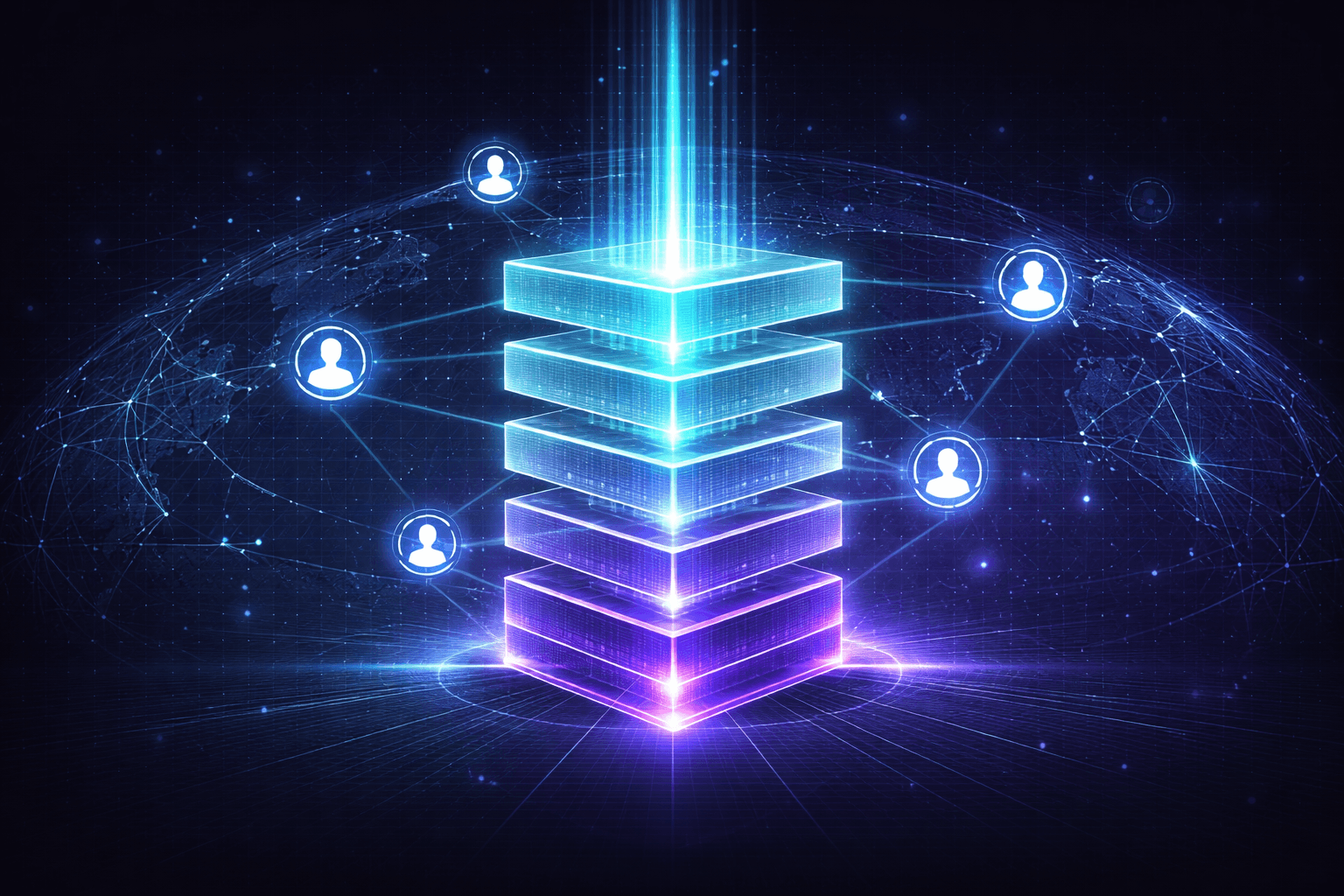
The 2026 AI Agent Infrastructure Stack: What's Changed
The core layers haven't moved. You still need orchestration, memory, inference, and integration.
But everything else has changed. The maturity, the defaults, the governance requirements are all different now.
Here's the stack you're likely building on in 2026:
Layer 1: Orchestration & Routing Your agents need a control plane. That's agentic frameworks (Anthropic SDK, LangChain's LangGraph, LangSmith observability) or commercial platforms (Retell, Lambda Labs, Agentforce).
What's new: Static orchestration is out. You need dynamic routing based on token cost, latency budgets, and inference load.
Layer 2: Model Access & Inference Claude, GPT-4, Gemini, Llama 70B. You're handling text, images, and audio together now.
What's new: Nobody's betting on a single model vendor. Your agents need failover strategies built into the spec.
Layer 3: Memory & Context This is the inflection point. Memory has gone from "nice to have" to "table stakes."
I'll go deep on this in a moment because it's where 80% of your infrastructure complexity lives.
Layer 4: Integration & Connectors Your agents need to act. That means APIs, databases, SaaS integrations.
The Model Context Protocol (MCP) has become the standard here. Think of it as the ODBC of AI agents. It's open, governed by the Linux Foundation, and it's crushing it: 97 million monthly SDK downloads with 75+ official connectors as of early 2026.
Layer 5: Observability & Governance Every agent trace, every context window used, every fallback triggered.
This layer barely existed in 2024. Now your board wants audit trails. Your compliance team wants proof that your agents aren't hallucinating customer data. This is non-negotiable in regulated industries.
What Actually Changed Since 2024
Two years ago, AI agents were a research project. Today, they're strategic.
Here's the data: 40% of enterprise applications now embed AI agents, according to Gartner, up from under 5% in 2025. That's not a trend. That's a platform shift.
At the same time, executives are treating this seriously. 80% of executives consider AI agent adoption a strategic priority, per CB Insights. This changes your funding conversation. This changes your hiring.
On the deployment side, it's moved from "do we deploy agents?" to "why aren't we?" SDxCentral tracked this: agent deployment went from 11% of teams in Q1 2025 to 26% by Q4 2025. Acceleration is real.
The market is pricing this in. The global AI agents market was approximately $7.6-7.8B in 2025 and is projected to hit $10.9B in 2026. That's 38-43% growth year-over-year.
And infrastructure specifically? The AI infrastructure market is growing at a 24% CAGR from 2026 through 2033. If you're not upgrading your stack, you're not keeping pace.
North America leads with 40% of the global market share in 2026. If you're making infrastructure decisions for a US-based team, your talent pool and vendor ecosystem are the most mature on earth. Use that advantage.
Additional market data to inform your decisions:
Enterprise AI spending specifically on agent infrastructure (memory, orchestration, observability) is growing at 52% CAGR through 2028.
Average enterprise deployment costs for production-grade agent systems: $180k-$450k in initial infrastructure and integration work, plus $50-150k annually in platform fees and management.
Time to production for enterprise agents has dropped from 8-12 months (2024) to 3-5 months (2026) due to standardized frameworks and mature platforms.
Median number of agents deployed per enterprise: 1-3 in pilot stage, 5-8 in production-ready implementations, with ambitions to reach 15-20 across the organization by 2027.
The "context engineering gap" is costing enterprises an average of 6-10 months of engineering time per deployment as teams figure out what information to surface.
The Memory Layer: Where Your Real Competition Lives
Here's the uncomfortable truth: your agents are only as good as their memory.
You can have perfect orchestration, perfect models, perfect routing. But if your agent can't remember what happened five interactions ago, you're done.
This is why memory has become a separate, high-stakes layer. It's not a feature. It's infrastructure.
The memory market is consolidating fast. You've got specialized platforms like HydraDB, Mem0, Zep, plus open-source players like LangMem and MemoClaw.
Each one approaches the problem differently. HydraDB has moved to lead the pack in long-term memory evaluation, hitting 90.23% retrieval accuracy on the LongMemEval-s benchmark. That's the highest you'll see in production systems.
Let me be direct about what this means: it's the difference between an agent that remembers your ACH payment preference versus one that doesn't.
It's the difference between a customer support agent that can say "I remember you reported this bug three months ago" versus one that can't.
The open-source world is moving fast too. EverMemOS, a Memory Operating System, launched in December 2025. It's gaining traction with teams that want maximum control and minimum vendor lock-in.
Here's the infrastructure question you need to answer: Are you building memory yourself or buying it?
Building it means you own the latency, the cost, the governance, and the bugs. Buying it means you're trading engineering velocity for a dedicated team focused on retrieval accuracy, token optimization, and context window management.
I'd lean toward buying if your memory needs are complex. The performance gap between an 85% accurate system and a 90% accurate one typically costs 2-3 engineers and 6 months of engineering time to bridge in-house.
Context Engineering: The Discipline That Will Define Your Advantage
Five years ago, the barrier to entry was prompt engineering. "Prompt v1", "Prompt v2", maybe a prompt template system.
That's dead.
The barrier to entry now is context engineering. This is the discipline of making sure your agent has exactly the right information, at exactly the right time, in exactly the right format.
Context engineering differs fundamentally from prompt engineering: prompt engineering is about the words you use, while context engineering is about what information you surface and how.
Think of a customer service agent. You could give it every ticket ever filed by that customer (your context window explodes). You could instead give it the top three unresolved issues and one recent positive interaction (just enough signal, not overwhelming).
That prioritization is context engineering.
The big AI companies have figured this out. Anthropic, Google, and LangChain have all published context engineering guides. This is now a legitimate craft with documented best practices.
Your advantage in 2026 comes from recognizing that context engineering is where the real work lives. Vendors will keep selling you better models, but the winning teams are those that engineer context relentlessly.
If you're hiring right now, look for people who understand information retrieval, ranking algorithms, and RAG systems. These are your context engineers.
And yes, we've written a deep dive on context engineering trends 2026 if you want the specifics.
Multi-Agent Systems: From Experiment to Mainstream
One year ago, multi-agent systems were research. Teams were running experiments with CrewAI or AutoGen.
In 2026, multi-agent deployments are shipping to production at scale.
What changed? Cost and complexity management became clear.
On cost: Multiple agents doing serial work hit your inference budget hard. Multiple agents doing parallel work with context sharing can cut your total tokens by 40-60%.
On complexity: A single agent with a massive context window is slower and cheaper than two agents with focused context windows. Understanding this tradeoff became decisive for teams.
This is where governance becomes critical. With one agent, a logging layer may suffice. With five agents sharing context, you need orchestration, context versioning, audit trails, and conflict resolution.
Platforms like HydraDB address this directly. Multi-agent systems need versioning, permissions, and retrieval with consistency guarantees.
The market is moving fast here. By 2027, I expect we'll see dedicated multi-agent infrastructure emerge as a standalone category. Right now it's embedded in orchestration platforms. Soon it'll be separate.
If you're planning multi-agent deployments, do it now while you can evaluate and build custom solutions. By 2027, the defaults will be set and your options will be more constrained.
Enterprise Governance and Compliance Are Non-Negotiable Now
Two years ago, compliance was a red flag for agents. "Can we even do this?" was the real question.
In 2026, it's not about capability. It's about audit trail structure.
Here's what your compliance team will ask:
What did your agent know and when did it know it?
Why did your agent make that decision?
Can you prove your agent wasn't hallucinating customer data?
What's the data retention policy?
Can you demonstrate that PII was handled according to GDPR/CCPA standards?
How do we audit inter-agent context sharing for unauthorized data exposure?
These aren't theoretical questions anymore. According to recent surveys, 67% of enterprise compliance teams now require explicit audit trails before deploying agents in production.
Finance, healthcare, and legal teams are already demanding these capabilities, and others will follow within the next 18 months.
The infrastructure you choose now must answer these questions at scale. Observability platforms matter because you need every interaction, context retrieval, and inference call logged—not for curiosity, but for compliance.
The good news: this is becoming standard infrastructure. Every major orchestration platform now has built-in observability. MCP connectors include audit support. Memory platforms are embedding compliance features into core products.
Here's what often trips teams up: compliance logging adds latency and cost. Plan for this. A 10ms agent interaction becomes 30ms with observability. Context retrieval cost increases 15-20% when logging every query. Don't discover this penalty in production.
Predictions for 2027: The Year Context Engineering Becomes the Bottleneck
If I'm right about 2026, here's what I think happens in 2027.
Prediction one: Context engineering becomes the limiting factor. Your models will get better, inference will get faster, and agent orchestration will get more sophisticated. But context engineering will lag behind.
This is where your engineers will spend disproportionate time and where real differentiation lives.
Why? Because context optimization is domain-specific. There's no one-size-fits-all solution—a context strategy for customer support differs entirely from one for financial analysis or legal research.
Teams will need specialists who understand information retrieval and domain-specific ranking algorithms.
Prediction two: Memory as a service becomes the default. By 2027, teams will be pulling memory management out of their agent codebases. It's too specialized, too important, and too expensive to build in-house. You'll have memory APIs the same way you have LLM APIs today.
We're already seeing this shift. The latest generation of memory platforms (HydraDB, Mem0, Zep) are moving from components to full services.
By 2027, buying memory will be as simple as getting an API key and a monthly bill. Engineering overhead will shift from building memory to integrating it.
Prediction three: Compliance automation will emerge as a category. Right now you're building compliance infrastructure manually. By 2027, platforms will automate audit log generation, data lineage tracking, and hallucination detection. This becomes a separate product category, sold independently or bundled with orchestration platforms.
The business case is clear: enterprises will pay for this. Compliance teams are understaffed, and audit trails are expensive to maintain manually.
A platform that can generate audit logs automatically, prove data provenance, and flag potential hallucinations solves a real problem.
Prediction four: Multi-agent coordination protocols will standardize. You'll see something like MCP but specifically for multi-agent communication. Right now every team invents its own serialization formats for inter-agent context sharing, which is inefficient and creates vendor lock-in.
Standards will emerge, probably driven by the Linux Foundation or similar governing bodies.
This will unlock a new market: multi-agent middleware platforms that can route context between agents from different vendors without format translation.
Prediction five: The serverless agent becomes real. In 2024, agents required persistent infrastructure. In 2025, they could be event-driven. In 2027, you'll deploy an agent as a function and forget about it. Orchestration, memory, logging, and observability will all be behind a simple API call.
This prediction depends on three things aligning: standardized agent protocols, managed memory becoming ubiquitous, and cloud platforms investing in agent-native runtimes. All three are happening now.
What this means for your 2027 roadmap: Start building for interoperability now. The systems you choose in 2026 will either lock you into a vendor or give you flexibility for 2027.
Invest in teams that understand context engineering, and budget for the compliance automation layer even if it doesn't exist yet—it will, and adoption will be rapid.
These aren't predictions pulled from speculation. They're extrapolations from trends already visible at scale in production systems.
The Three Markets You're Competing in Right Now
If you're building AI agent infrastructure, you're not in one market. You're in three.
Market one: Observability and evaluation. Teams need to know what their agents are doing. This includes latency tracking, accuracy benchmarking, cost analysis, and hallucination detection.
The standard frameworks (LangSmith, Arize, Weights & Biases) are moving into this space. Purpose-built tools will emerge.
Market two: Memory management. We've covered this. The winner here will be whoever solves the retrieval accuracy + cost + latency triangle.
Market three: AI cost management. Agents run inference. Inference costs money. Teams need visibility into per-agent cost, per-model cost, per-interaction cost.
This is where you're looking at companies building cost optimization layers on top of LLM API calls. It's not sexy, but it's saving teams millions.
If you're evaluating vendors, ask them which of these three markets they're trying to dominate. If they say "all of them," they're either lying or unfocused.
FAQ: What Teams Are Actually Asking Right Now
Q: Should we build our own agent infrastructure or buy?
You should buy orchestration and memory. That's where the bar is too high to DIY. Building these requires expertise in distributed systems, consistency guarantees, and production hardening that most teams don't have in-house.
You should build context engineering. That's your unique value and competitive advantage. This is also the hardest part, which is exactly why it differentiates you.
You should buy observability. Again, too high a bar to maintain in-house, and compliance requirements make it non-negotiable.
The pattern is clear: buy the layers where you're not differentiated, build the layers where you are. This lets you move fast on commodities while investing deep in your unique value.
Real example: A financial services company we worked with initially tried building their own memory layer. After six months, they realized they had accidentally rebuilt a distributed cache with no consistency guarantees. Switching to a managed solution cut their latency in half and freed three engineers for context engineering work on their fraud-detection agents.
Q: How much should we budget for agent infrastructure in 2026?
If you're deploying production agents, budget for:
Model API costs: $5-50k/month depending on scale and query volume.
Orchestration/platform: $2-10k/month for hosted solutions; add $1-3k/month for self-hosted operational overhead.
Memory: $3-8k/month for a mid-scale deployment with 90%+ retrieval accuracy requirements.
Observability: $2-5k/month plus 10-20% performance overhead.
Data integration and connector development: $2-4k/month or $20-40k for custom integrations.
Plus engineering time. Budget for 2-3 full-time engineers minimum. This includes infrastructure work, context engineering, and ongoing optimization.
Cost scaling reality: The per-interaction cost of an agent system is roughly $0.003-0.01 per interaction including all overhead (inference, memory retrieval, logging). For a customer service agent handling 10,000 interactions per month, expect $30-100 in infrastructure costs plus engineering burn.
If you're building "AI agent infrastructure" as a product, the math is fundamentally different. You'll spend more upfront on generalization, multi-tenancy, and robustness, but you'll amortize those costs across dozens or hundreds of customers. Budget 2-3x the operational cost of a single deployment for product-grade infrastructure.
Real-World Infrastructure Tradeoffs You'll Face
The stack I've described is conceptually clean. In reality, you'll face hard tradeoffs that don't have perfect answers.
Latency vs. Accuracy in Memory Retrieval: HydraDB's 90% retrieval accuracy takes 150-200ms per query. You can get faster retrieval (50ms) at 82% accuracy with simpler systems.
For customer support agents, 150ms feels acceptable. For real-time trading desk agents, it's unacceptable. Know your domain's latency requirements and optimize accordingly.
Multi-model strategies: Theoretically, your agents should failover between Claude, GPT-4, and open-source models. Practically, most teams rely on one primary model and one backup.
The operational overhead of managing five different inference endpoints, five different context window sizes, and five different rate limit strategies adds up fast. Start with two models maximum.
Observability overhead: Full observability is important. But complete logging of every context retrieval, every inference call, and every agent decision adds 15-30% overhead.
Some teams log to warm cache (fast but short-lived), others to cold storage (cheap but slow). Decide your compliance requirements first, then your logging strategy, and don't aim for full fidelity unless you have unlimited budget.
Memory vs. Context Window: You can solve memory problems with bigger context windows (fewer retrieval calls, more history) or better retrieval (smaller context window, more precise memories). Bigger context windows are cheaper upfront but slower at inference time.
Better retrieval is more expensive to build but faster at runtime. Most teams optimize for latency first, then cost.
Build vs. Buy vs. Open-Source: Open-source agent frameworks (LangGraph, CrewAI) are free but require significant operational burden. Managed platforms (Retell, Agentforce) cost more monthly but are faster to production.
The right choice depends on your hiring timeline and risk tolerance. Open-source can work if you have strong engineers available now; managed services are better if you need to ship fast.
Enterprise governance in fast-moving markets: Your compliance team will ask for guarantees, but the vendor ecosystem can't provide them yet. Most memory and orchestration platforms have compliance roadmaps, not guarantees.
This creates tension: you need governance to ship, but vendors can't commit to it. The solution is to build your own audit layer on top of vendor platforms—a short-term pain point that disappears by 2027.
Wrapping Up: The Infrastructure Advantage in 2026
The state of AI agent infrastructure in 2026 is simultaneously more complicated and more solved than it was two years ago.
More complicated because you can't just slap an agent on a model and call it done. You need memory, governance, observability, cost management, and context engineering discipline that require real investment.
More solved because the stack has standardized. MCP governs integrations, frameworks are mature and battle-tested, and memory platforms are approaching production-ready quality.
You're not inventing categories anymore.
The playing field has leveled for infrastructure capabilities. Every serious contender can now access Claude, GPT-4, and managed orchestration platforms. The differentiation moved from "can we build agents?" to "can we build them right?"
If you're a CTO or VP Engineering, here's your 2026 action plan:
Map use cases first. Categorize your agent use cases by memory requirements, compliance needs, and latency sensitivity. This determines your entire infrastructure strategy.
Evaluate memory platforms on your data. Generic benchmarks like LongMemEval-s are useful, but your specific retrieval scenarios matter more. Run pilots on 2-3 platforms using your own data before deciding.
Hire or upskill context engineers immediately. Context engineering is where talent is scarcest and differentiation is highest. This is your long-term competitive advantage.
Design observability from day one. Plan for compliance, cost tracking, and audit trails before writing agent code. Adding them later costs 3-5x more engineering effort.
Standardize on one orchestration platform. Having two competing orchestration frameworks in the same organization creates technical debt. Pick one (LangGraph, LangChain, or commercial platforms like Retell) and commit to it.
Plan multi-agent coordination even if you're starting with one agent. Design your memory and observability layers assuming you'll have 5-10 agents sharing context by Q1 2027. This prevents rewrites.
The infrastructure advantage is real but closing fast. By 2027, most of these decisions will be standardized and commoditized.
The companies that make good infrastructure choices in 2026 will have a 12-18 month lead over those that delay, translating to production experience, data quality in memory systems, and mature context engineering practices.
Need help evaluating memory systems for your specific use case? We've built a benchmark guide for AI memory systems that shows you exactly how to test for your scenario. And if you're planning multi-agent deployments, check out our guide on multi-agent memory and shared context.
Ready to upgrade your agent infrastructure? Let's talk about what your architecture should look like in 2026. Visit HydraDB.com to see how our memory layer handles the scale and accuracy demands of production agents, and to schedule a consultation with our infrastructure specialists. We'll review your current stack and show you exactly where memory is your bottleneck.