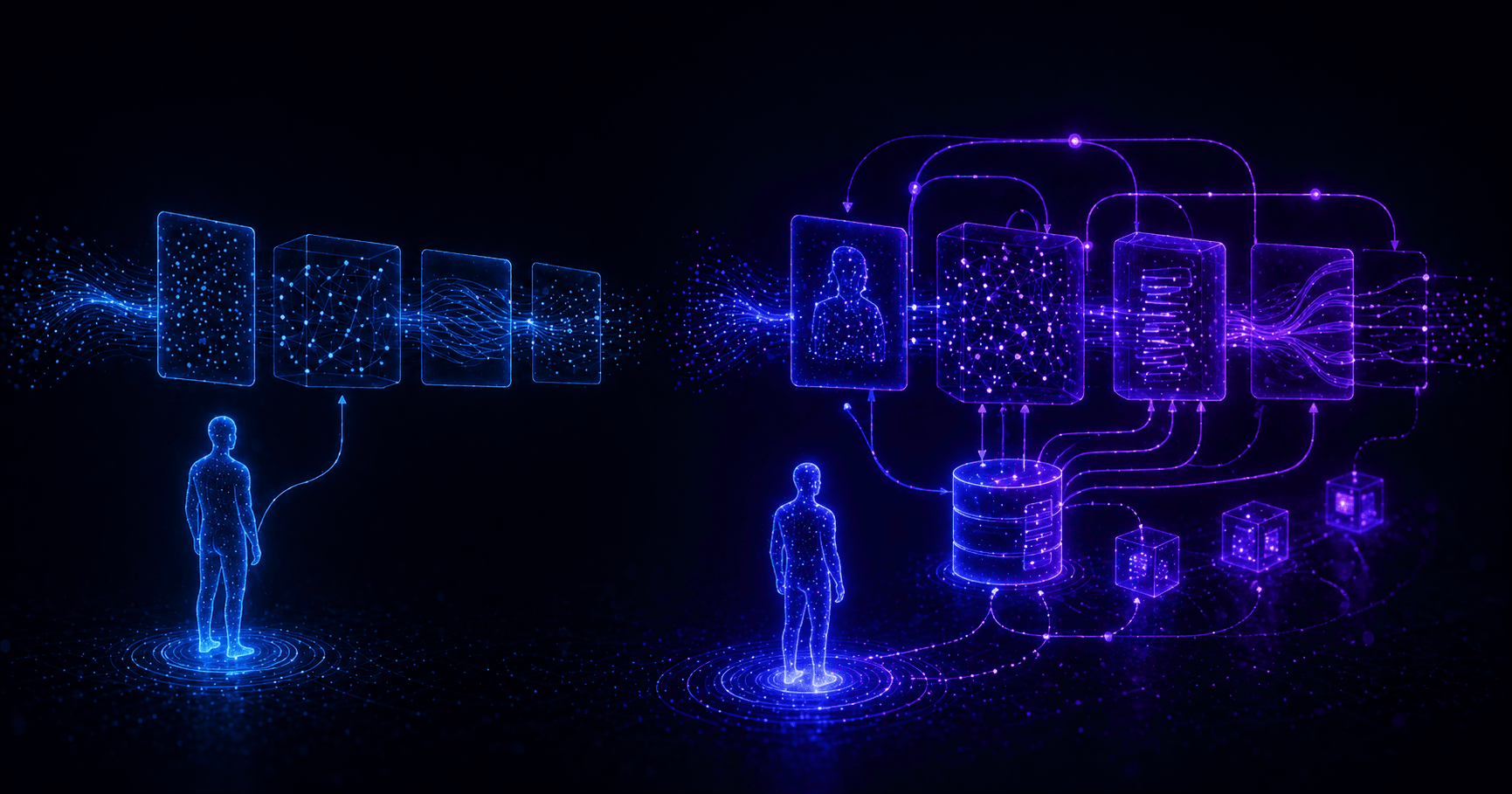
The difference between stateful and stateless AI agents is not a feature toggle. It is an architectural transformation that affects every layer — from how queries are processed to what happens after the user leaves.
Understanding this matters because it determines what an agent can and cannot do in production.
The Stateless Pipeline
A stateless agent follows a simple path: query arrives, context is retrieved, response is generated, interaction ends. No state is saved. The next query starts fresh.
This pipeline is clean and easy to scale. Each request is independent, so load balancing is straightforward. There are no user-specific resources to manage, no state synchronization issues, and no persistence layer to maintain.
The trade-off is that the agent treats every user identically and every session as a first session. It cannot learn or maintain continuity.
The Stateful Pipeline
A stateful agent adds persistence at multiple points. The pipeline becomes: query plus user state flows into retrieval scoped by user context, then context assembly prioritized by history, then generation, then response plus state update.
Each interaction both uses and contributes to accumulated knowledge. The agent loads the user's profile, scopes queries by relevance to their history, and extracts new facts to persist after the conversation.
This enables capabilities impossible in stateless systems — multi-turn reasoning, personalization, consistency, and progressive improvement.
What Changes at Each Layer
Retrieval shifts from corpus-wide similarity search to user-scoped, history-aware retrieval. The agent prioritizes information relevant to this user's context.
Context assembly changes from "retrieve top-k chunks" to intelligent prioritization. Recent interactions and active decisions take precedence over generic knowledge.
Generation benefits from richer input — user preferences, prior decisions, and structured conversation history enable responses that build on established context.
Post-response processing is entirely new. After each interaction, the agent extracts facts, updates profiles, and persists decisions. This write path is where memory formation happens.
The Complexity Trade-off
Stateful architecture is more complex to build. User state must be stored, retrieved, and kept consistent. Memory extraction adds processing. The persistence layer introduces new failure modes.
This complexity is justified when agents serve returning users who expect continuity, personalization, and consistency. For single-turn question answering with anonymous users, stateless architecture is simpler and sufficient. The decision is not which is better in the abstract — it is which matches the production requirements and user expectations.
Frequently Asked Questions
Can I incrementally add state to a stateless agent?
You can, but expect it to touch every layer. Adding profiles requires scoped retrieval. Adding memory requires extraction pipelines. Each addition is feasible but the cumulative result is a different architecture.
What infrastructure does stateful architecture require?
A persistence layer for user state, extraction logic, context assembly incorporating history, and state update pipelines. Platforms like HydraDB provide these natively.
Conclusion
Stateful and stateless are different architectural paradigms with different capabilities, complexities, and trade-offs. The choice depends on whether your agent needs to remember — and production agents serving returning users almost always do.