Temporal Knowledge Graphs: Tracking How AI Context Evolves Over Time
Introduction
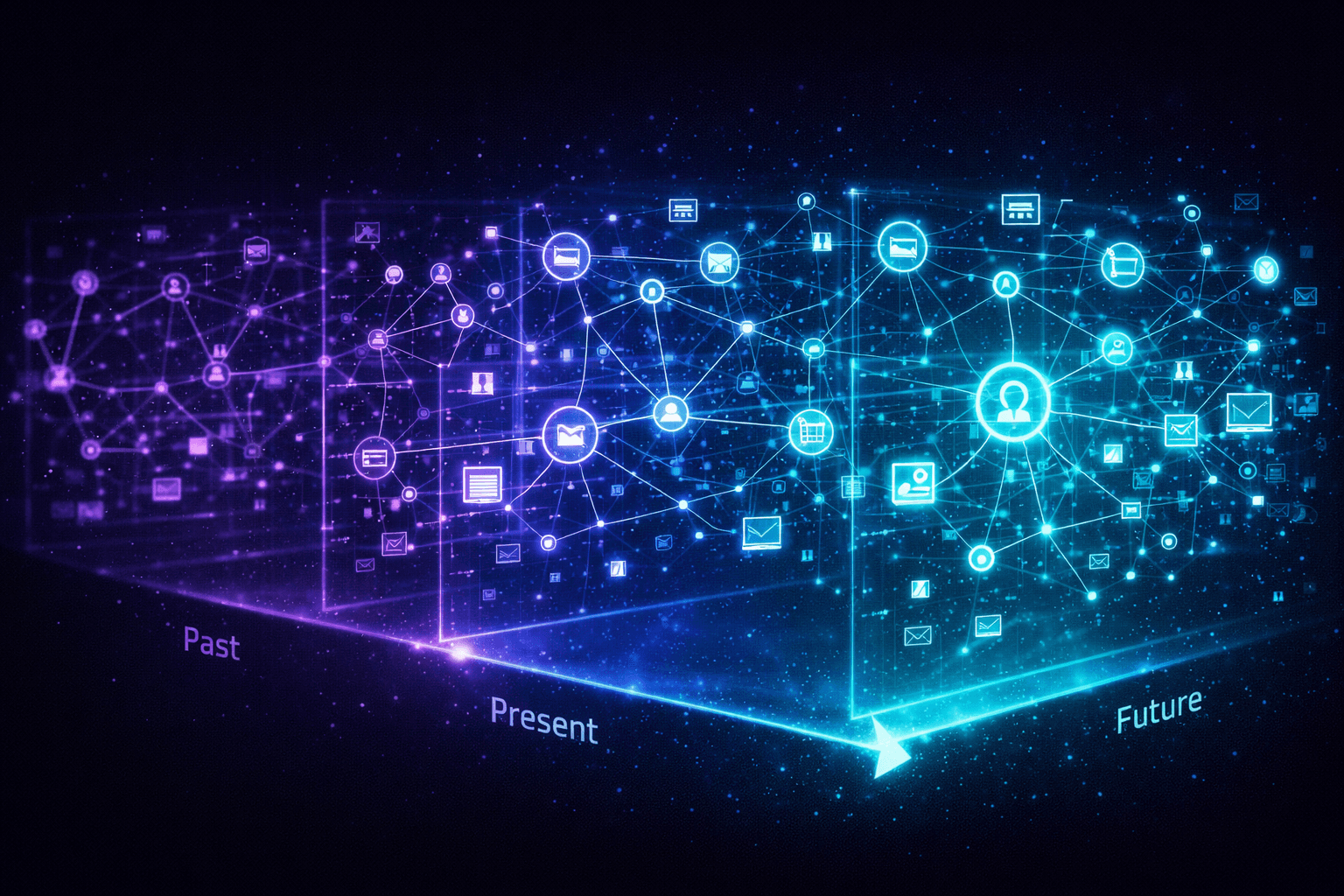
Knowledge graphs capture relationships between entities, but static graphs miss the full story. A relationship that was true six months ago might be false today, yet your graph shows it as current.
Your AI agent made a decision based on context that's now outdated. The facts it relied on have changed, shifted, or expired. A temporal knowledge graph is a dynamic representation that captures not just what is related to what, but when those relationships were true and how they evolved.
This matters because AI agents operate in the real world, where time isn't optional. When you build temporal graphs for AI agents, you answer different questions than static graphs ever could: "What was the state of this system on March 15th?" and "What sequence of events led to this outcome?"
You're tracking causality, not just correlation. You're enabling explainability by showing exactly which facts your AI relied on at which moment. This article walks through temporal knowledge graphs end-to-end, from why static graphs fail to how you build production systems that track context evolution.
Static vs. Temporal Knowledge Graphs
Static Graphs: The Problem
Static knowledge graphs represent facts as eternal. "Company A acquired Company B" becomes a relationship that exists forever in the graph.
But that's not how the real world works. A company that was a startup five years ago is now a market leader, an intern is now a director, and a critical risk is now mitigated.
Static graphs have no temporal dimension and discard historical context. This creates real problems for AI systems. Your agent might recommend a strategy based on outdated information, predicting revenue growth based on abandoned product roadmaps.
Without time, you lose context and auditability. Why did a decision fail? You can't trace it back because the graph doesn't remember what was true when.
Temporal Graphs: The Solution
Temporal graphs fix this by making time explicit. Every relationship has a validity window: when it started, when it ended, and what events triggered the change.
Instead of storing "Company A acquired Company B" as permanent, a temporal graph stores it with timestamps. You can ask: "Show me all relationships that were true on March 1st, 2025" and get a snapshot of that moment.
Temporal graphs enable trend detection and event-driven knowledge representation. You see how metrics evolved over weeks and predict inflection points. You detect anomalies that appear or disappear unexpectedly, and link events in sequence to show causality.
Real-World Impact
For recommendation engines, temporal graphs mean your system remembers what a user was interested in six months ago without treating old interests as current. For risk assessment, you're evaluating risk based on the current state, not frozen historical data.
For debugging AI decisions, you replay the exact context the agent had at decision time. This is a game-changer for explainability and reproducibility.
Temporal Graph Data Structures
Time Intervals
The simplest way to add time to a graph is intervals. Each relationship gets two timestamps: a valid_from and valid_to date.
But there are subtleties. Valid time (when a fact was true in reality) differs from transaction time (when the fact was recorded in your system). You might discover historical data and record it now, even though it was true months ago.
Handling uncertainty matters too. You might know a relationship was true in 2024, but not the exact date. Temporal graphs support fuzzy intervals like "sometime in Q2" or "before March but after January", letting you work with imprecise historical data.
Event-Based Models
Some temporal graphs represent time through events instead of intervals. An event is a node in the graph, and temporal edges connect events in sequence.
This model shines when you care about causality, with events like "User logged in," "Product price updated," and "Risk threshold breached." Other events point to these as consequences, creating explicit causal chains that enable temporal reasoning about how changes cascade.
Event-based models make causality explicit. A static graph shows employee X is now a manager and employee Y is their report. A temporal graph shows the sequence: Y joined the company, Y was hired as analyst, Y promoted to senior analyst, X was hired as manager, X assigned Y as direct report. This sequence is your audit trail.
Hierarchical Temporal Graphs
Real systems operate at multiple time granularities. Daily stock prices aggregate to weekly trends, which aggregate to yearly patterns.
A hierarchical temporal graph supports all these levels at once. You store minute-level events at the leaf, hour-level aggregations at the next level, and day-level summaries at the top. This lets you efficiently query "What was the trend last year?" without scanning millions of minute-level events.
Querying Temporal Graphs
Time-Aware Queries
Standard graph queries don't ask about time. "Find all people who report to Bob" works on static graphs. On temporal graphs, you need to be specific.
"Reconstruct the state at date" queries ask: "Who reported to Bob on January 1st, 2025?" You get the exact org chart at that moment. "Find changes between dates" queries show: "What relationships changed from January to February?"
"Predict next change" queries use historical patterns to guess: "When will Bob next reorganize his team?" These queries unlock time-travel debugging for AI systems by replaying the exact state when your agent made a decision.
Temporal Path Queries
Temporal path queries are powerful. Instead of asking "Is there a path from A to B?" you ask "Is there a causal path from event A to event B?"
This means checking: Did A happen before B? Could A have caused B given the timing? Are there intermediate events that connect them? You reverse-engineer causality from graph structure and timing, invaluable for root cause analysis.
Sequence of events queries enumerate all steps that led to an outcome, in order, with timing. If your system made a bad decision, you see: at 10am market data updated, at 10:05am risk calculation triggered, at 10:07am agent made decision based on stale data. This makes explainability automatic.
Pattern Detection
Temporal graphs excel at finding patterns. Periodic patterns answer: "Does this relationship recreate every month?" Trend detection answers: "Is this metric increasing or decreasing?"
Anomalies are relationships or events that deviate from expected patterns. An employee who always works 9-5 suddenly logs in at midnight. A product that usually gets 10 review updates per day suddenly gets 100. Temporal graphs flag these automatically.
Building Temporal Graphs for AI Agents
Schema Design
Start with your entities and relationships. For e-commerce: products, users, orders, reviews. For enterprise: employees, departments, projects, resources.
Now add temporality using temporal graphs AI principles. Each relationship needs a validity period. When does it start? When does it end? Some relationships are permanent (user was born on X date). Others expire (user subscribed until Y date).
Define events as separate entities. An event is a moment when something changed. "User subscribed," "product launched," "price updated." Link events to the relationships they caused. This creates your causal graph.
Data Population
Your application logs are the first source. Every log entry is a timestamp plus an event. Parse your logs and create temporal edges.
Use LLM-powered extraction to pull structured facts from unstructured data. If you have email discussions about project timelines, an LLM can extract "Project X scheduled for May 2025" with the email date as timestamp. This turns historical documents into temporal graph data.
Implement continuous updates and knowledge graph versioning. As your system generates new events, add them to the graph immediately with current timestamps. Graphiti, an open-source temporal context graph engine, handles this for AI agents by tracking facts with creation and expiration timestamps, maintaining version history automatically.
Tool Stack
Neo4j supports temporal queries through date functions and properties, making it suitable for point-in-time queries and historical tracking. For transactional workloads with localized queries, Neo4j delivers consistent low-latency performance through index-free adjacency.
TigerGraph excels at large-scale temporal reasoning through distributed architecture. According to benchmarks, TigerGraph can be 1808.43x faster than Neo4j on three-hop path queries, making it ideal for deep causal chain analysis.
HydraDB Context Graphs are purpose-built for temporal reasoning in AI systems. Rather than retrofitting temporal features onto a generic graph database, context graphs make time a first-class citizen from the schema level up.
Temporal Graphs for Agent Reasoning
Understanding Context Evolution
AI agents need to understand how the world changed between decisions. A temporal graph shows this explicitly.
Reconstruct context at any moment. Your agent made a prediction on March 15th. You can replay the exact state of the graph on that date and see which facts were true then.
As research on temporal reasoning shows, agents that integrate temporal constraints into information retrieval achieve significantly higher accuracy. One temporal agent framework called TempAgent achieved 70.2% accuracy on temporal knowledge graph question answering, a 41.3% improvement over baseline models.
Explainability and Auditing
This is where temporal graphs deliver transformative value. Your agent isn't just a black box anymore. It's a system with a complete audit trail.
Time-audit trails show when every fact was recorded, when it became true in reality, and when it was superseded. If a decision went wrong, you know which facts the agent had access to at decision time. This is regulatory gold in finance, healthcare, and regulated industries.
Reproducibility follows automatically. You can rerun the agent's reasoning with the exact historical state and see if it produces the same decision. Root cause analysis becomes systematic, not guesswork.
Handling Conflicting Histories
Real systems sometimes have conflicting information. You might learn from one source that an event happened on March 1st and from another that it happened on March 3rd.
Temporal graphs handle this through multiple timelines. You don't delete the old fact. You mark it as superseded and keep the new one. You can query "What did we know on March 2nd based on available information?" versus "What actually happened?"
Assign confidence scores to relationships. High-confidence facts come from authoritative systems. Lower-confidence facts come from user submissions or inferred data. Your agent reasons about uncertainty explicitly.
Merging conflicting histories happens when you discover two separate records of the same event. You reconcile them, keeping the better source and creating a merged relationship. The graph records that a merge happened, maintaining complete transparency.
Frequently Asked Questions
Storage overhead—won't temporal graphs blow up in size?
Not necessarily. Intelligent implementations use compression. You don't store every version of every relationship separately. You store deltas (the changes). A relationship that lasts for years is one record with two timestamps, not millions of copies. Temporal graphs are typically only 20-30% larger than static graphs.
How do I convert an existing static graph to temporal?
Add timestamps retroactively using your business logic and historical logs. For relationships you can't date precisely, use fuzzy intervals. Add new relationships with current timestamps as they occur. Gradual migration works—you can have both static and temporal relationships in the same graph while you transition.
Querying temporal graphs sounds complex. Are queries actually fast?
They can be. Most temporal queries use indexes on the temporal dimension. Range queries are efficient. Path queries are more expensive, but distributed systems like TigerGraph parallelize them. Start with the queries you actually need, not hypothetical ones.
Conclusion
Static knowledge graphs capture relationships, but temporal graphs capture reality. They track how facts evolved, when relationships started and ended, and what caused what.
For AI systems, temporal graphs are table-stakes. They enable explainability through audit trails and time-aware knowledge graphs. They enable causality by linking events in sequence through temporal reasoning. They enable predictions by revealing patterns over time.
Start small. Pick one temporal relationship that matters. Build temporal edges. Write queries that ask "what was true on this date?" Once you see the value, temporal graphs become hard to build without.
Your AI agents deserve context that spans time. Build temporal graphs, and you'll build AI systems that are not just smarter, but trustworthy.
Want to explore temporal graphs for your AI? HydraDB's Context Graphs are designed for exactly this use case. Learn more at hydradb.com.