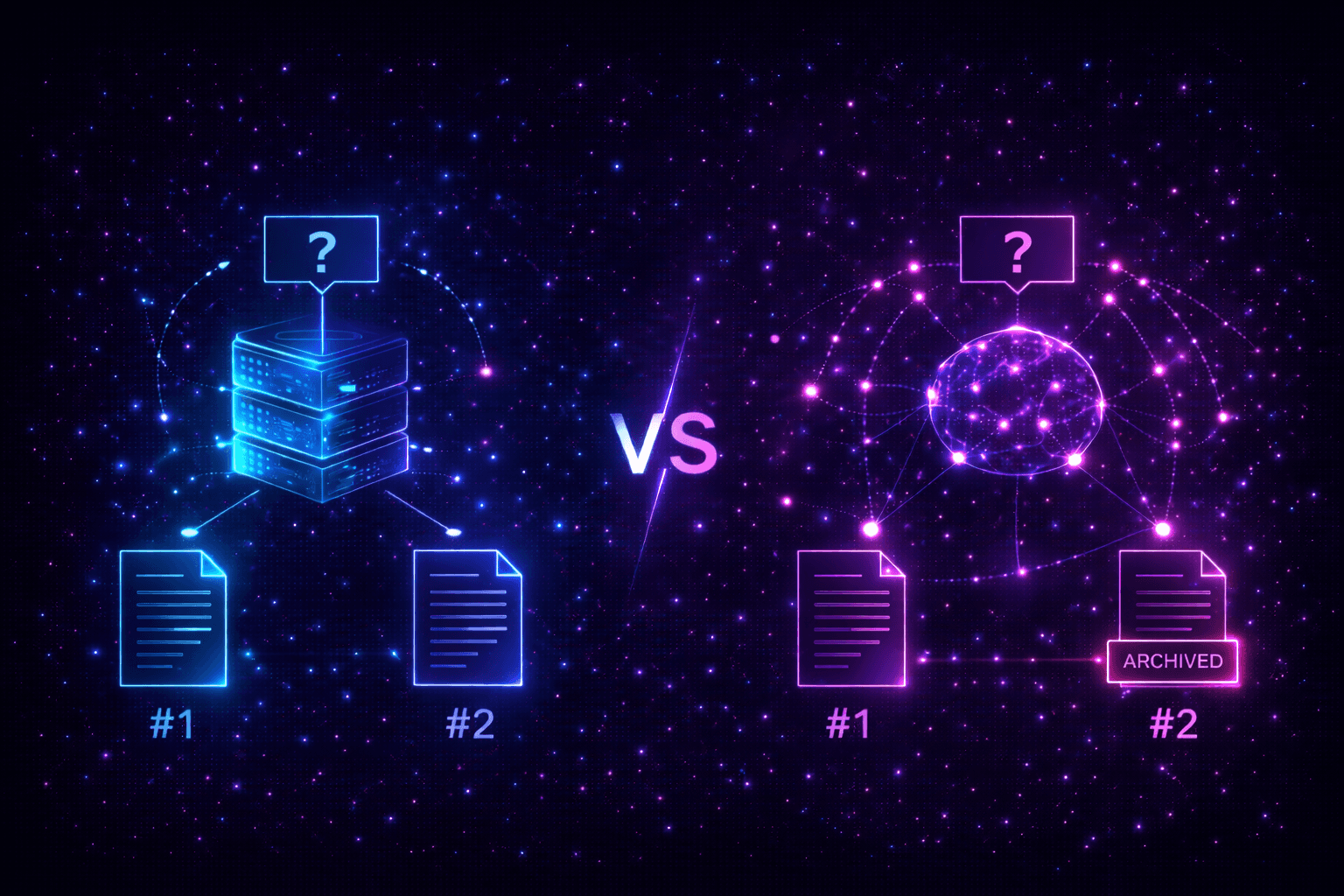
Two options on the table. Option A: keep your vector database — fast, familiar, works for semantic search. Option B: move to a context engine that understands relationships, time, and multi-signal relevance. Which actually moves your relevance metrics?
Context engines move the needle further. But the right choice depends on what you're optimizing for.
A vector database converts your query to an embedding and returns documents ranked by cosine similarity. One-dimensional: maximize semantic overlap. A context engine also considers semantic overlap, but layers in document relationships, temporal validity, verification status, access frequency, and structural context. Multi-dimensional.
For simple queries against homogeneous documents, vector databases are sufficient. Searching product docs with straightforward questions? Similarity search delivers. But the moment your problem gets complex — when temporal accuracy matters, when you need to distinguish "related" from "actually relevant," when documents contradict each other across versions — vector databases lose precision.
The production difference shows in the details. Your vector database returns documents A and B as top matches, but they contradict each other — different versions of a policy, and the system can't flag the conflict. A context engine surfaces the version relationship and lets the consumer decide. Your vector database returns a perfectly similar document that was deprecated last month. A context engine marks it as archived.
The key distinction: vector databases optimize for retrieval. Context engines optimize for relevance. You can retrieve something and have it be irrelevant. Those aren't the same problem.
What works in practice is a hybrid approach. Use vector similarity as one signal within a context engine. Let similarity narrow candidates to semantically plausible documents, then apply context-aware scoring to rank them. Speed of vector databases, relevance of context engines.
The deeper insight is that similarity is not context. Understanding the retrieval problem vector databases don't solve shows where the gap becomes visible. And recognizing that relevance requires relationships, not just embeddings explains why multi-signal scoring outperforms similarity alone.
FAQ
Can I migrate without rebuilding everything? Yes. Most context engines work alongside vector databases. Layer context-aware scoring on top of existing similarity search for incremental improvement. No rip-and-replace required.
What's the latency tradeoff? Context engines evaluate more signals, so expect 10-100ms end-to-end depending on implementation. For many use cases, perfectly acceptable. For millisecond-critical apps, keep vector search as your initial retrieval layer and apply context scoring as a second pass.
How do I know when I've outgrown a vector database? Track your false positive rate. When your vector database returns results that technically match the query but aren't actually useful for the agent's task, you've hit the ceiling. That's when context engines start paying dividends.
Conclusion
The vector database vs context engine question isn't about which is "better." It's about which solves your actual problem. Vector databases solve fast similarity search. Context engines solve relevance. Those aren't the same thing, and the difference matters enormously in production.
Most mature systems end up using both — they're complementary layers in a retrieval architecture that delivers relevant results at scale. If your constraint is speed and your problem is simple, stay with vector databases. If your constraint is accuracy and your problem is complex, context engines are worth the operational investment.
Don't mistake "it works" for "it's optimal." The problems where context matters are the ones where a context engine pulls ahead.