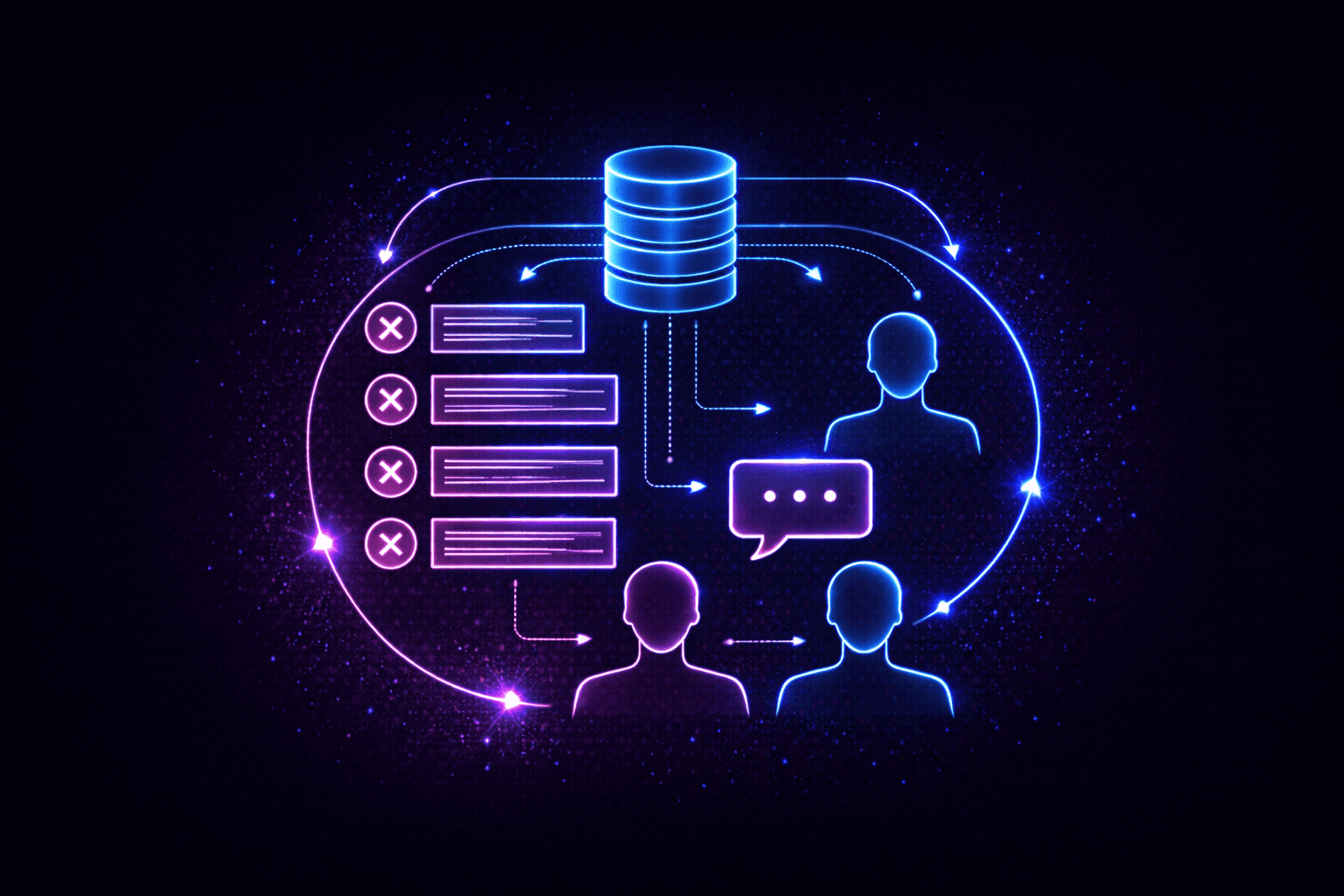
An AI agent retrieves five chunks to answer a customer question. The customer ignores the response and rephrases. The agent retrieves different chunks — this time the answer works.
Tomorrow, a different customer asks a nearly identical question. The agent retrieves the same original five chunks. The same wrong answer. The same rephrase cycle.
Nothing was learned. Vector databases do not have a feedback loop between retrieval outcomes and future quality. Every query starts from the same static index, optimized only by whatever the embedding model captured at ingestion.
The Static Retrieval Problem
Vector databases are read-optimized stores. Data goes in, embeddings are computed, similarity search runs. The quality of retrieval depends on two factors: the embedding model and the corpus content.
Neither changes based on how well retrieval performs. If the embedding model places a critical document far from the queries that need it, that document consistently underperforms — and the system never self-corrects.
This is fundamentally different from how teams expect production infrastructure to behave. Search engines adjust rankings based on click-through data. Recommendation systems reweight features based on engagement. Vector databases do none of this.
What a Learning Loop Looks Like
A retrieval system with feedback captures signal from every interaction. When a user accepts an answer, the system reinforces the retrieval path. When a user rejects or rephrases, the system adjusts — downweighting chunks that failed.
This works through learned reranking, query-specific threshold adjustments, or dynamic weighting based on historical performance. The key is that the system improves with usage rather than remaining static. In production environments serving thousands of queries daily, even small per-query improvements compound into significant accuracy gains within weeks.
Why This Matters for Agent Memory
The inability to learn creates a specific failure mode: the agent makes the same mistakes repeatedly. Users notice — the agent always misses the same type of question, always retrieves the wrong policy.
Predictable failure erodes trust faster than random errors. Users tolerate occasional wrong answers. They cannot tolerate the same wrong answer every time. Memory systems must distinguish between storing facts and learning from interactions. Learning requires architecture that models relationships between queries, results, and outcomes.
The Operational Cost
Teams compensate through manual intervention — reviewing logs, identifying failure patterns, adjusting chunking, re-embedding content, fine-tuning prompts. This is expensive, slow, and scales linearly with failure patterns.
A self-improving system automates this feedback loop, handling high-frequency pattern-based improvements that consume most maintenance time. Not eliminating human oversight, but reducing the operational burden significantly.
Frequently Asked Questions
Can I add a learning loop to my existing vector database?
You can build one at the application layer — logging outcomes and adjusting reranking logic. But this is custom infrastructure outside the retrieval engine that requires ongoing maintenance.
How quickly does self-improving retrieval show results?
It depends on volume. Systems processing thousands of queries daily show measurable improvements within one to two weeks. A few hundred queries on the same topic cluster is typically sufficient to start adjusting behavior.
Conclusion
Retrieval that never improves is retrieval that falls behind. User expectations grow, knowledge bases expand, and query complexity increases — but a static index stays where it was on day one. Production agents need infrastructure that learns from every interaction, turning usage into a compounding advantage.