What Is MemGPT? Understanding the OS-Inspired Approach to AI Memory
What if your AI agent could forget intentionally?
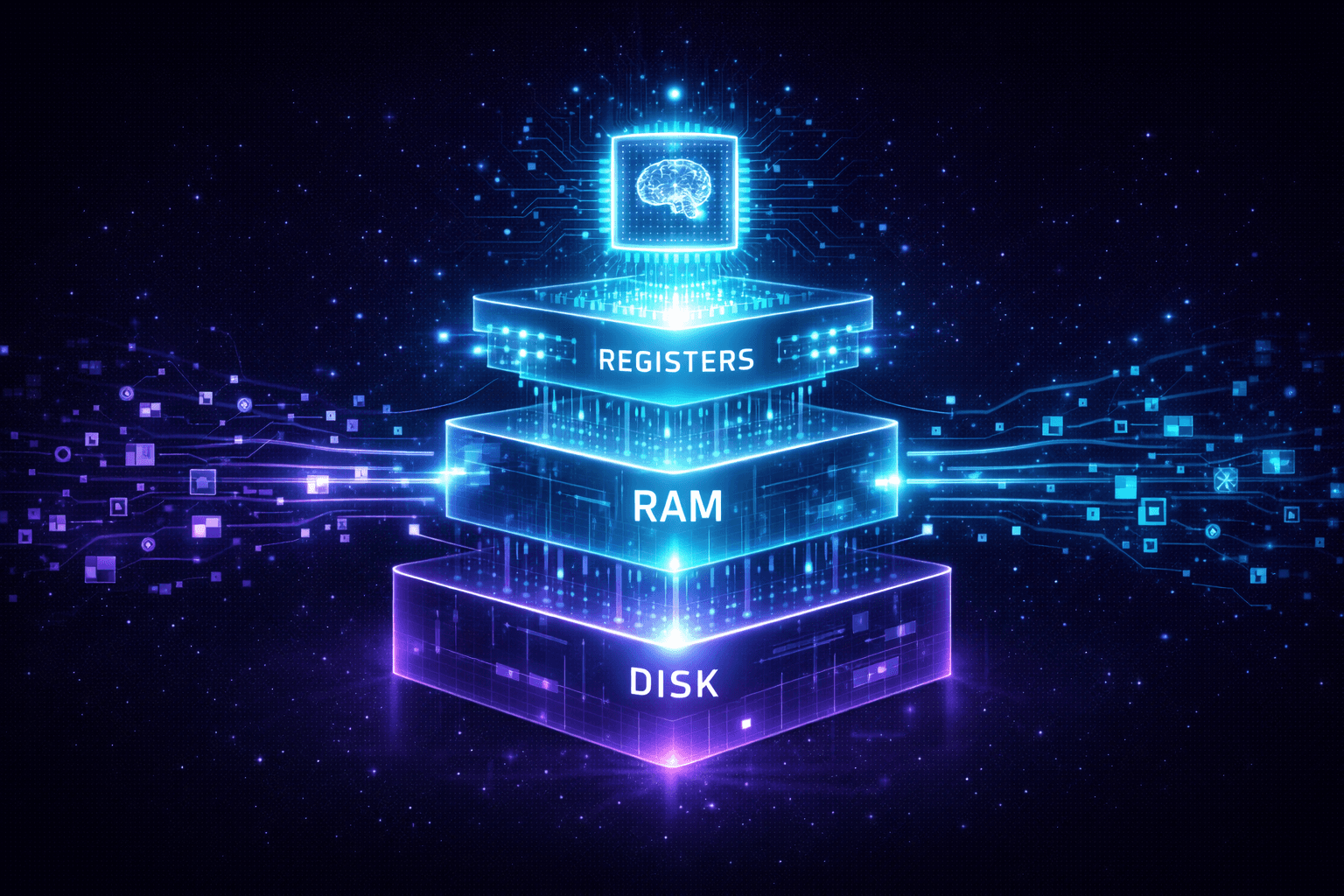
That's the radical idea behind MemGPT, a framework that treats AI memory like an operating system treats RAM and disk storage. Instead of stuffing everything into a context window, MemGPT lets agents actively manage what they remember—moving old information to storage, pulling it back when needed, and keeping only what matters in their "working memory."
MemGPT launched in 2024 and was developed into an open-source framework called Letta. It's changing how developers think about long-running AI agents that need to maintain context over hours, days, or months.
This article breaks down how MemGPT works, why it matters, and how it compares to other memory approaches. Whether you're building support agents, research tools, or coding assistants, this architecture offers real solutions to memory problems you've probably already hit.
The problem MemGPT solves
Context window limits are a real ceiling
Modern LLMs have large context windows. GPT-4o gives you 128,000 tokens. Claude gives you even more.
But here's the catch: your conversation history grows forever.
A support agent handling ticket after ticket accumulates thousands of interactions. A research agent scanning papers for a week builds a massive pile of notes. A coding assistant helping you build a project over months collects endless file histories.
Drop all that into the context window and you're burning through tokens fast. The model gets slower. Your costs explode. And eventually—you hit the limit.
Then what? You delete history. You lose context. Your agent forgets why certain decisions were made.
The token-management burden falls on developers
Right now, developers manually decide what gets fed to the LLM. You write code to summarize old conversations. You build rules about which documents to include. You spend hours tuning what fits and what gets cut.
MemGPT flips this around. Instead of you managing context, the agent manages itself.
It calls special functions—like read() and write()—to fetch information from storage when it needs it. The framework handles what's in "working memory" and what's pushed to disk. The LLM doesn't care about token limits. It just asks for what it needs.
This is huge if you're building systems that run for weeks at a time.
MemGPT architecture: three layers
Think of MemGPT as a filing cabinet, not a single sheet of paper.
Layer 1: Core memory (always loaded)
Core memory is permanent. It's the agent's identity.
This layer holds facts that never change: the agent's name, role, key instructions, fundamental context. Identity facts. Critical instructions.
Core memory stays loaded in the context window at all times. It's small—typically 50 to 500 tokens—so it doesn't waste space.
When the agent responds to anything, this memory is always there. It knows who it is. It knows its job. It knows its personality.
Layer 2: Context memory (current conversation)
Context memory is your working desk.
This is where the agent keeps the active conversation, recent decisions, and immediate context. It's what the agent actively reasons about right now.
It's larger than core memory—usually 1,000 to 5,000 tokens—but not huge. Just enough to keep the agent focused on what matters in this moment.
As conversations continue, older items get pushed out. The agent can write new notes here as it goes. It's ephemeral. It changes constantly.
Layer 3: Scratch and archive (long-term storage)
Everything else goes to disk.
Old conversations, historical context, past decisions, learned facts—they all live in a searchable archive. Unlimited size.
When the agent needs something from the past, it calls read() and fetches it. No token penalty. The information sits on disk until needed.
This is the game-changer. Your agent never loses memories. It just doesn't keep everything in its head.
How MemGPT operates: the paging analogy
MemGPT works exactly like virtual memory in operating systems. Your computer has RAM (fast, small) and a disk (slow, huge). The OS moves data between them automatically.
Initialization
When an agent starts, the framework loads core memory (the identity) and context memory (recent history if any exists). These load into the context window.
The agent is ready to interact. It has just enough information to start reasoning.
During interaction
The agent receives a message. It reasons about what to do.
If it needs historical information, it calls read(timestamp) or read(query). The framework fetches relevant archive data and injects it into the context.
The agent reasons again with this new information.
When the context window fills up, the framework automatically pages out less-important information. New context comes in. Working memory refreshes.
The agent keeps moving forward without ever knowing the limit exists.
Page replacement strategies
Modern MemGPT implementations use different strategies to decide what gets removed from context:
LRU (Least Recently Used) removes the information the agent hasn't touched in the longest time.
Relevance-based uses embeddings to score which information is most relevant to the current task. Less relevant data gets paged out first.
Importance scoring weights information by how critical it is. Instructions get higher weight than casual notes. Conclusions get higher weight than raw observations.
The best strategy depends on your use case. Some teams use LRU for simplicity. Others layer in relevance scoring for smarter decisions.
MemGPT's key innovations
Automatic memory management
Developers stop deciding. The agent decides.
The agent knows when it needs information. It knows when to write things down. It knows when something is no longer relevant.
This is fundamentally different from RAG (which we'll compare later). RAG retrieves information based on similarity. MemGPT retrieves based on explicit agent decisions.
Persistence without growing context
Here's what makes MemGPT special: you get unlimited memory without token explosion.
A support agent can remember every customer interaction from the last year. A research agent can keep notes on every paper it's read. A coding assistant can maintain history across thousands of edits.
All without the context window ever exceeding reasonable size.
The agent pays a small latency cost when fetching archived information. It doesn't pay a token cost. That's the whole point.
Hierarchical organization
MemGPT organizes memory into layers, not a flat pile.
This means the agent can focus on what's important. Identity is always there. Current conversation is always there. Everything else is organized on disk by recency, relevance, or importance.
This mirrors how human memory works. You don't consciously think about how to walk. You don't remember every conversation from five years ago unless you retrieve it deliberately.
MemGPT vs. traditional memory systems
MemGPT isn't the only answer to the memory problem. Let's compare.
vs. simple context window expansion
Some teams just wait for larger models. GPT-5 will have 500K tokens, they think. That solves it.
It doesn't.
A year of daily interactions still exceeds any realistic context window. Doubling context size doesn't solve the problem fundamentally. It just delays it.
MemGPT solves it by changing the architecture, not just the numbers.
vs. RAG (Retrieval Augmented Generation)
RAG retrieves documents based on semantic similarity. You ask a question, the system finds related documents, and the LLM reads them.
RAG is great for document-heavy tasks: customer support with a knowledge base, research with a paper library, Q&A over a website.
But RAG doesn't let the agent actively manage memory. RAG doesn't let the agent decide what's important. RAG doesn't model ongoing reasoning or decision-making.
MemGPT is better for agents that build reasoning over time. Agents that make decisions today that affect decisions tomorrow.
Learn more about RAG vs. agent memory.
vs. traditional agent memory systems
Products like Mem0 and HydraDB handle memory for AI agents.
Mem0 adds memory layers to agents and uses retrieval + synthesis to maintain context.
HydraDB is a database designed for agent memory, allowing agents to store and retrieve vectors efficiently.
These are excellent products. But they work differently.
Mem0 focuses on enriching agent memories after the fact—synthesizing insights, categorizing information, improving retrieval.
HydraDB focuses on the storage layer itself—giving agents a database built for their needs.
MemGPT is a complete framework. It defines not just where memory lives, but how the agent actively manages it. The agent calls read() and write(). The agent decides what goes where.
Explore more memory alternatives.
Real-world MemGPT use cases
Long-running support agents
A support agent answers the same customer's questions over weeks.
Without MemGPT, context grows: conversation 1, conversation 2, conversation 3... By conversation 10, you've used 50,000 tokens just to load history.
With MemGPT, the agent keeps the current conversation in context and queries its archive for relevant past interactions. "This customer complained about feature X last month. They asked about Y before that."
The agent maintains context without bloat.
Research agents
A research tool scans hundreds of papers over days.
It needs to compare claims across papers. It needs to remember which sources made which arguments.
MemGPT lets the agent write notes to archive as it reads. When synthesizing findings, it queries the archive for relevant research. It never loses anything. It never carries everything in context either.
Coding assistants
A coding assistant helps you build a project over weeks.
It needs to remember your architecture decisions. It needs to know why you chose one library over another. It needs context on your coding standards.
MemGPT lets the assistant actively build a knowledge base of your project. New files get learned. Decisions get recorded. The assistant grows smarter with every session without context bloat.
MemGPT challenges and limitations
MemGPT isn't a silver bullet.
Complexity
This is a more complex architecture than simple context windows. Developers need to understand how paging works. Latency matters more because fetching from archive adds delay.
Integration requires thinking carefully about memory layers. What goes in core? What goes in context? What gets archived?
For simple applications, this overhead isn't worth it.
Semantic search gaps
MemGPT's archive retrieval depends on how you implement search.
If you're using semantic embeddings, you'll miss information that's relevant but different in wording. If you're using keyword search, you'll miss context that matches semantically.
There's no perfect retrieval system. You'll need to tune this for your use case.
Not ideal for all tasks
If your agent runs for 30 minutes and never needs history, MemGPT adds unnecessary complexity.
If you have a closed-world problem with predictable context needs, simple context management works fine.
MemGPT shines when you have unbounded context needs and long agent lifespans.
Frequently asked questions
Is MemGPT better than other memory systems?
It depends on your use case. For agents that actively reason over accumulated knowledge, MemGPT is excellent. For systems that need simple document retrieval, RAG is simpler. For managed memory without full framework commitment, Mem0 is easier. MemGPT wins when you need active, agent-driven memory management with persistence.
What about cost?
MemGPT reduces cost by shrinking context windows. You're not paying tokens to load everything every interaction. But you pay latency costs when fetching archived information. For long-running agents where latency is acceptable, costs usually decrease. For low-latency requirements, the tradeoff matters less.
Does it work with any LLM?
Mostly. MemGPT needs an LLM that can call functions (like GPT-4, Claude, Llama with function calling). It works with any model that supports function calling in its API.
The OS-inspired approach changes everything
AI agents face the same memory problem that operating systems solved decades ago.
You can't keep everything in RAM. You need a hierarchy. You need automatic management. You need the system to handle complexity so humans don't have to.
MemGPT brings that wisdom to AI. It's not revolutionary. It's evolutionary.
And if you're building agents that need to remember things—that need real memory, not just context—it's worth your attention.