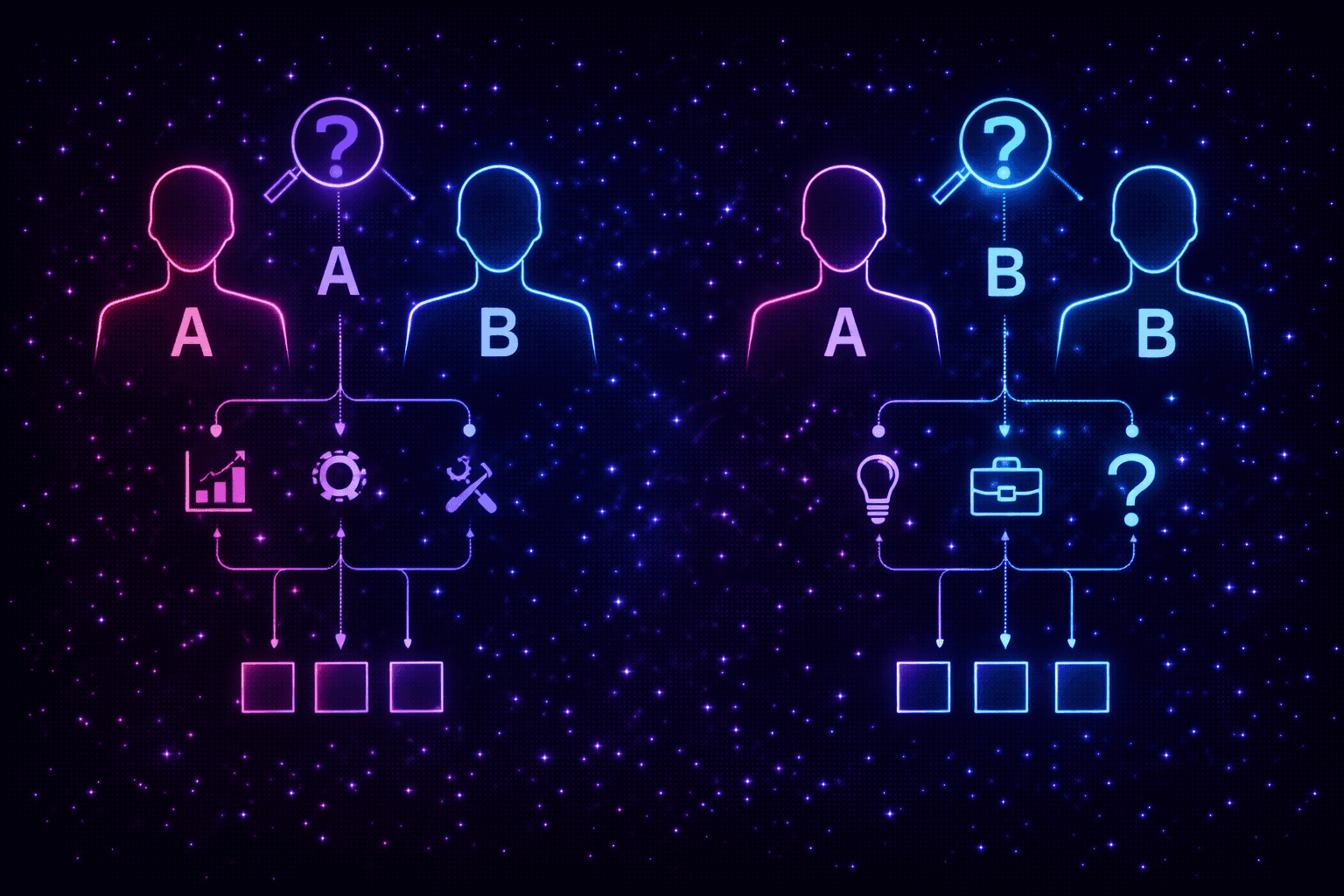
You build a feature recommendation system. User A queries "what should I build next?" Your vector database returns 5 recommendations ranked by cosine similarity. User B asks the exact same question. Gets the exact same 5 results in the exact same order.
That's not personalization. That's the same results for everyone.
Personalization requires context that similarity search fundamentally doesn't have. It requires understanding what User A has already built, what failed, what worked, what skills they have. User B might be a complete beginner asking the same question, but they need completely different recommendations.
A vector database can't answer "what should this specific person do next?" It can only answer "what's similar to the embedding space of this query?" Those are different questions. The first is personalized. The second is generic.
Here's what happens in practice. You ship similarity-based recommendations. They work okay for average users. But unusual users get generic results that don't fit. Power users get basic recommendations they know. Beginners get advanced recommendations.
Real personalization requires a user model. What has this user done? What patterns do they follow? What's their skill level? A vector database has none of that.
Personalization also requires memory. If User C ignored a recommendation yesterday, they shouldn't see it again today. If User D spent 3 hours learning a technique, today's recommendation should build on that. Vector databases don't maintain memory.
The deeper issue is that memory is fundamentally a relevance problem, not a similarity problem. What's relevant to User C today depends on what they did yesterday. Similarity to embeddings has nothing to do with it.
Time compounds the problem. Your system recommends a framework. It was the best choice six months ago. Today it's outdated. Your vector database has no sense of time. It doesn't know that this recommendation was good in March but is questionable in April.
This is why temporal context is a missing layer in retrieval systems. Personalization without time awareness is half-personalization. You're evaluating recommendations against an eternal static embedding space. The real world changed. Your recommendations didn't.
Adding personalization on top of vector databases means building extra layers. You're admitting vector similarity isn't enough. That's expensive and fragile.
Better systems treat personalization as a first-class concern from the ground up. They understand that relevance is personal and temporal and relational. They know what this specific person needs right now.
Companies pursuing personalization usually stick with vector databases and add complexity. Those that switched to context-aware systems often report personalization became simpler because they stopped trying to make similarity work.
FAQ
Can't we personalize by reranking similarity results? You can rerank based on user history, but you're starting from similarity-based candidates. Many personalized relevant results might not appear in your top-K.
What if we embed user history into the query? Embedding user history means adding tokens to every query hoping the model captures temporal meaning. It's fragile and doesn't scale.
Should we use a different embedding model for personalized searches? No. Better embeddings optimize similarity ranking. They don't solve the fundamental problem: similarity isn't personalization.
Conclusion
Vector databases were built for semantic search. Personalization is personal and stateful. They're solving different problems.
Real personalization requires understanding context—user state, temporal position, and relationships. It requires systems that know who the user is, what they've learned, what changed since yesterday.
When your recommendation system gives two different users the same recommendations for the same query, you haven't shipped personalization. Stop pretending ranking is personalization and build systems that actually know your users.