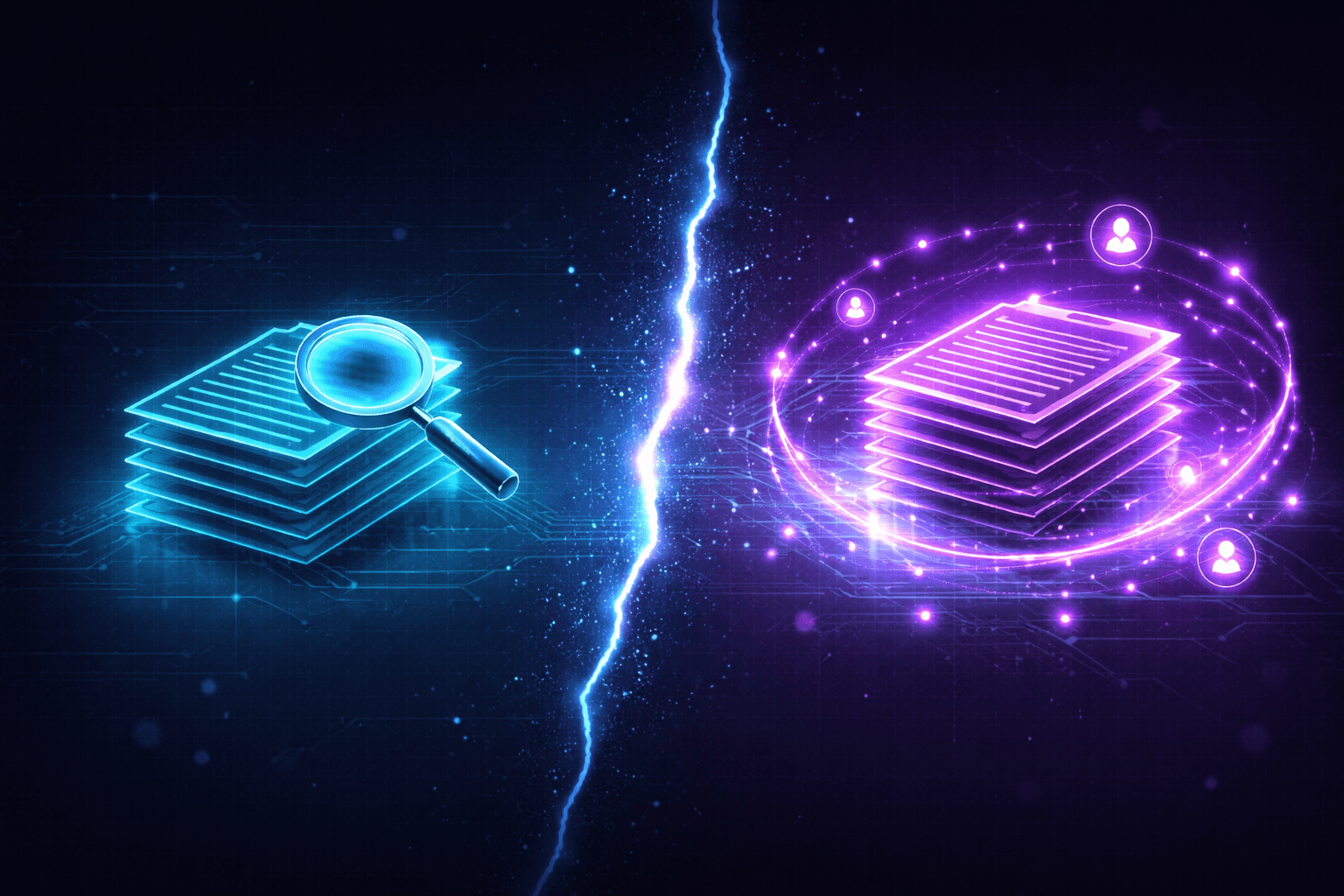
RAG is broken. At least, RAG alone is broken for production.
When retrieval-augmented generation (RAG) first hit the scene, it felt like the answer to everything. Give your AI access to documents.
Ground it in facts. Boom.
You've solved hallucinations.
For years, every startup and enterprise was building RAG pipelines. The economics seemed perfect: cheaper than fine-tuning, faster than retraining, and conceptually simple.
But RAG alone isn't enough for production AI agents. Teams are discovering this the hard way in actual deployments with real users.
You can see it happening. A well-funded startup launches an AI assistant powered by RAG. Early feedback looks great.
"Finally, an AI that actually knows our documentation!" But then something breaks.
Retention drops. Users get frustrated.
The magic wears off.
RAG handles one job: answering "what does this document say?" It's brilliant at that. RAG doesn't hallucinate about facts because it's reading directly from your documents.
But production AI agents need to answer different questions: "What does this user need?" "What did they ask last week?" "How has their preference changed?"
These are the questions that matter in real applications. RAG doesn't answer them.
The gap between RAG prototypes and production AI agents is widening. As VentureBeat reported, "observational memory cuts AI agent costs 10x and outscores RAG on long-context benchmarks."
The research is clear. The market is shifting from retrieval alone to memory-augmented AI.
This isn't hype. This is what teams are actually shipping.
RAG fails in four critical ways that break production deployments. Memory fixes these gaps by transforming your AI from a document reader into an actual agent that learns about users and their needs.
What RAG does well
Grounding LLMs in external knowledge
RAG solved a real problem. LLMs hallucinate because they're trained on data from yesterday.
They don't know your company's policies. They don't know your product docs.
They don't know your customer's recent interactions. Ask an LLM without RAG about your internal policy, and it will confidently make something up.
That's the core problem.
RAG plugs in external knowledge. You ask your AI a question.
The system retrieves relevant documents. The AI reads them.
Then it answers based on facts, not fabrications. It's elegant.
The LLM sees your documents and generates answers grounded in reality.
This is powerful. At HydraDB, we see RAG handling factual queries beautifully.
Questions like "what's our refund policy?" or "how do I set up a VPN?" get accurate answers. When the document exists and the retrieval works, RAG delivers gold-standard accuracy.
There's no hallucination. There's no guessing.
Just facts.
The math is simple. Better documents in, better answers out.
If you index your docs well and retrieve them accurately, your AI gives accurate answers.
But simplicity is the problem. RAG works brilliantly in a narrow lane. Outside that lane, it fails silently.
The 4 gaps RAG doesn't fill
Gap 1: Personalization
Here's a real scenario. A customer returns to your AI assistant after three months. They ask a question about your product.
RAG doesn't know they're back or that they asked something similar before. It doesn't know their previous answer was wrong and they're trying a different approach.
It has no idea about their skill level or what they ultimately chose to do.
So your AI gives the same generic response it gives everyone. A detailed explanation.
A list of options. Technical jargon.
Everything a beginner needs and everything an expert hates.
This is where production falls apart. Users expect AI to remember them.
They expect personalization. They expect intelligence.
Real production agents need personalization. They need to know this user hates long explanations and is an expert who should skip basics for advanced features.
They need to know this customer's previous issue and how it was resolved so they don't repeat the same advice. They need to know whether this user prefers examples over theory, or vice versa.
This isn't nice-to-have. This is what separates an agent from a chatbot.
Mem0, a platform focused on AI memory, frames it perfectly: "RAG answers 'what does this document say?' while Memory answers 'what does this user need?'"
That gap is the difference between a one-size-fits-all tool and a real agent. One scales knowledge.
The other scales understanding.
Gap 2: Cross-session continuity
Your AI remembers nothing between conversations. This is by design.
Every session starts from zero. Your system spins up, answers, and shuts down—all context gone.
If your customer tells your agent "I prefer email summaries over phone calls," that preference vanishes when the conversation ends. Next time they return, the agent suggests phone calls again. Same conversation, different answer.
Users notice. They get frustrated. They stop using your AI.
This is death in production. It destroys the illusion of intelligence.
It kills trust. An AI that forgets you is just a fancy search engine.
RAG is stateless by design. It retrieves documents.
It answers. It forgets.
There's no persistent memory. No learning. No continuity.
Each request is independent.
AWS's documentation on agentic memory makes this distinction clear: "Long-term memory handles personal context and session continuity while RAG provides current factual knowledge." You need both. Not one or the other. Both working together.
The engineering to fix this isn't complicated. Store conversation summaries.
Track user preferences. Build an actual memory layer separate from your document retrieval.
But RAG doesn't come with this. You have to build it yourself.
Or use a platform that combines both.
Gap 3: Learning and adaptation
Your AI cannot improve based on what actually works. The system doesn't learn.
You ship your RAG pipeline. Users interact with it. You see which answers fail, which responses don't help, and which questions the documents can't answer.
You get real signal and real data.
But RAG doesn't learn from this. Your documents stay static. Your retrieval logic stays static.
You're manually editing documents when you should be automatically improving. You read user feedback and manually rewrite docs.
You notice retrieval is missing documents and manually adjust your index.
Everything is manual. Everything is slow.
Production agents at companies like OpenAI and Anthropic are moving toward systems that track what works and what doesn't. They log failures.
They analyze which queries get poor results. They adapt retrieval parameters automatically.
They surface gaps to the team with data.
RAG as a framework doesn't support this. It's a lookup system, not a learning system.
There's no feedback loop. No iteration.
No continuous improvement built in. You can bolt it on top, but it's not native to RAG.
Gap 4: Multi-user context
RAG collapses context across users. Everyone gets the same answer.
Imagine you're building an internal agent for your company. Alice asks about Q3 budgets.
RAG retrieves the budget document and returns all the numbers. Bob asks the same question.
RAG retrieves the exact same document with the same content and format.
But Alice is a VP who needs a high-level summary and key decisions. Bob is an intern in marketing who only needs to see his department's numbers. Alice needs confidential detail that Bob shouldn't see.
RAG doesn't know who's asking or understand roles, departments, or access levels. It's context-blind.
You'd have to manually implement role-based filtering, content summarization, and different response formats for different users. This means you're building a memory and context system anyway, duplicating work that a real agent platform should do out of the box.
Filling the gaps: memory + RAG
The production architecture
The winning setup isn't RAG. It's not memory alone either. It's both working together.
Here's the architecture:
First layer: RAG handles factual retrieval. "What does our documentation say?"
Second layer: Memory handles user context. "What does this user know? What do they prefer?"
Third layer: Hybrid search combines both. You search documents and user history at the same time.
This is what "production-ready" actually means. You're not replacing RAG. You're giving it context.
RAGFlow, a platform for building RAG systems, acknowledged this shift in their 2025 review: "RAG remains fundamentally an 'on-the-fly retrieval and transient composition' pipeline, lacking core memory manageability features."
That admission is the turning point. Teams are adding memory layers because RAG alone can't do it.
Implementation with HydraDB
Building this hybrid approach doesn't require reinventing everything. And it's becoming table stakes for production AI.
HydraDB combines both RAG and memory in one platform built from the ground up. You upload your documents.
HydraDB indexes them with 20+ configurable retrieval parameters tuned for your use case. You track user interactions.
HydraDB stores them as searchable, structured memory.
Then you query both simultaneously. When your agent answers, it's drawing from:
The documents in your database (RAG layer)
This specific user's history, preferences, and context (memory layer)
Hybrid search that weights both equally and resolves conflicts
The results are concrete. HydraDB scores 90.23% accuracy on LongMemEval-s benchmarks. That's production-grade performance, not lab results.
And it's serverless. You don't manage infrastructure.
You don't manually tune retrieval parameters every week. You don't debug why search suddenly broke.
You configure the system once and it scales without intervention. That's what production AI actually needs.
Redis tested RAG at scale and found the breaking point: "RAG prototypes work with 1,000 docs and 3 test users, but at scale things break."
Vector databases bloat. Retrieval latency spikes.
Cost explodes.
Hybrid memory-augmented search doesn't break at scale because it's designed for it from the foundation to handle millions of users and massive document libraries.
Frequently asked questions
Should I replace my RAG pipeline with a memory platform?
No. Don't rip out RAG. Replace your RAG-only approach with a hybrid model.
Your documents are valuable. They're factual.
They're authoritative. Keep retrieving them.
But add memory on top. Store user preferences.
Track conversation history. Build context about who's asking and what they actually need.
Let the LLM see both the documents and the user's history at the same time.
Think of it like this: RAG is your library. Memory is your librarian who knows the reader.
A good answer uses both.
When is RAG alone sufficient?
RAG is enough when all three of these are true:
Users are anonymous (no personalization needed)
Each conversation is independent (no continuity needed)
Your documents are complete and accurate (no learning needed)
Examples: A public FAQ bot for your website. A one-time customer lookup for unknown users. A documentation search that anyone can access.
But almost nothing in production matches all three constraints. Most real applications need to know their users.
They need to remember conversations. They need to learn from what works and what doesn't.
If your AI has a login. If users come back.
If you care about retention. If you want accuracy to improve over time.
Then RAG alone isn't enough.
Conclusion
RAG was the breakthrough everyone needed. But it solved one problem, not all of them.
Production AI agents fail when they treat every user the same. When they forget conversations.
When they can't learn what works. When they can't adapt.
Memory plugs these gaps. Not by replacing RAG, but by working alongside it.
The best agents aren't powered by better retrieval. They're powered by better understanding of users, context, and what actually works.
If you're building production AI right now, RAG is your foundation. Memory is what makes it real.
Ready to move beyond RAG-only deployments? Explore how HydraDB combines document retrieval and user memory in one platform.
It's serverless, hybrid-search ready, and accurate. Visit https://hydradb.com/ to see hybrid memory-augmented search in action.
Or check out our guide on RAG vs memory for AI agents to understand the full spectrum of AI context.